John Wray - The Lost Time Accidents
Здесь есть возможность читать онлайн «John Wray - The Lost Time Accidents» весь текст электронной книги совершенно бесплатно (целиком полную версию без сокращений). В некоторых случаях можно слушать аудио, скачать через торрент в формате fb2 и присутствует краткое содержание. Год выпуска: 2016, ISBN: 2016, Издательство: Farrar, Straus and Giroux, Жанр: Современная проза, Фантастика и фэнтези, на английском языке. Описание произведения, (предисловие) а так же отзывы посетителей доступны на портале библиотеки ЛибКат.
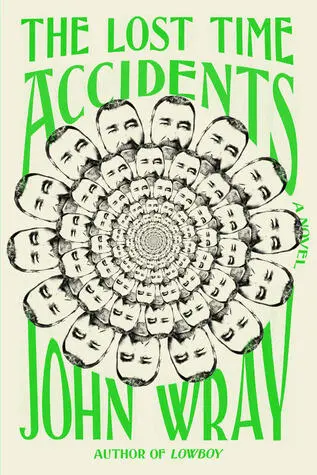
- Название:The Lost Time Accidents
- Автор:
- Издательство:Farrar, Straus and Giroux
- Жанр:
- Год:2016
- ISBN:9781429944526
- Рейтинг книги:4 / 5. Голосов: 1
-
Избранное:Добавить в избранное
- Отзывы:
-
Ваша оценка:
The Lost Time Accidents: краткое содержание, описание и аннотация
Предлагаем к чтению аннотацию, описание, краткое содержание или предисловие (зависит от того, что написал сам автор книги «The Lost Time Accidents»). Если вы не нашли необходимую информацию о книге — напишите в комментариях, мы постараемся отыскать её.
, John Wray takes us from turn-of-the-century Viennese salons buzzing with rumors about Einstein's radical new theory to the death camps of World War Two, from the golden age of postwar pulp science fiction to a startling discovery in a Manhattan apartment packed to the ceiling with artifacts of modern life.
Haunted by a failed love affair and the darkest of family secrets, Waldemar 'Waldy' Tolliver wakes one morning to discover that he has been exiled from the flow of time. The world continues to turn, and Waldy is desperate to find his way back-a journey that forces him to reckon not only with the betrayal at the heart of his doomed romance but also the legacy of his great-grandfather's fatal pursuit of the hidden nature of time itself.
Part madcap adventure, part harrowing family drama, part scientific mystery-and never less than wildly entertaining-
is a bold and epic saga set against the greatest upheavals of the twentieth century.
The Lost Time Accidents — читать онлайн бесплатно полную книгу (весь текст) целиком
Ниже представлен текст книги, разбитый по страницам. Система сохранения места последней прочитанной страницы, позволяет с удобством читать онлайн бесплатно книгу «The Lost Time Accidents», без необходимости каждый раз заново искать на чём Вы остановились. Поставьте закладку, и сможете в любой момент перейти на страницу, на которой закончили чтение.
Интервал:
Закладка:
But I’ve succumbed to achronology again, Mrs. Haven. Before we arrive at the United Church of Synchronology and my own (decidedly upstage) arrival, I need to tell you how my father met my mother, how The Excuse made Orson Card Tolliver into a household name, and how I came to be born in Buffalo instead of Spanish Harlem. The contributing circumstances are as dubious as any others in this history, which is a pretty good argument, as arguments go, for their truth. Whatever else my family might be accused of, rightly or wrongly, no one’s ever questioned our improbability.
* * *
Orson had just begun the third and final section of his novel when he came down with infectious mononucleosis, which goes some way toward accounting for book III’s fever-dream grotesquerie. He arrived at his guardhouse at the Hudson/Gold Power Generating Station punctually at 23:00 EST on December 5, eager to continue his writing; when the day watchman clocked in at 07:00, however, he found my father curled up on the floor. Orson was sent home at once in a car-service limo (which expense was duly deducted from his paycheck) and his next of kin — identified on his ID sheet as “GENTIAN AND ENGINE TOLLIVER”—were notified by means of a reverse-charge telegram.
Less than forty-eight hours later, in a turn of events that would have flabbergasted Orson if he’d been conscious, two salt-and-pepper-haired spinsters, neatly got up in the fashions of the forties, stood shoulder to shoulder in the Main Concourse of Grand Central Station, admiring the constellations on the ceiling.
“They haven’t got Cassiopeia quite right, I don’t think,” said Enzian (in German, in case anyone was listening).
“Hush, Enzie.”
“It’s supposed to be shaped like a W, as in ‘Waldemar.’ That looks more like an M.” Enzian pursed her lips, looking very much like Orson for a moment. “Not that anyone can tell, under all of that soot.”
“It’s beautiful, Enzie. Besides, a W can be an M , if you’re looking at it upside down. It all depends upon your point of view.”
Enzian appraised her sister coldly. “You sound more like the Patent Clerk with every passing week.”
“It’s the Patent Clerk’s world , dear, in case you haven’t noticed. We’ve been living in it for more than forty years.”
“Not me,” said Enzian fiercely, as though she were reciting an oath. “I’ve never lived in it. Not for a day.”
Something like worry passed over Gentian’s face as she regarded her sister; but it was gone again at once. “We’ll be here a week, Enzie. Two weeks at the most. I know you’re in the middle of interesting work—”
“More than interesting . Decisive.”
“—but your research will keep. Our Peanut, on the other hand, might not.”
Enzian rolled her eyes, then gave a grudging nod.
“And don’t forget what I told you about the apartment. Four floors up from the street, rooms arranged in a ring, the unit below currently vacant.” She was quiet a moment. “It could be perfect, Enzie. Much better for us than Pine Ridge Road.”
Enzian looked at her sharply. “The downstairs apartment is vacant? Who told you that?”
Gentian only smiled.
“He’d never agree to it,” Enzian said, chewing her lip. “Not Orson.”
Her sister said nothing.
“You have a scheme of some kind.” She squinted at Gentian. “I can see it in your face. You have a scheme.”
“I’m sure you’ll find Manhattan stimulating,” Gentian said, taking up her valise. “They say people here never sleep at all.”
* * *
Orson’s fever lasted a week and a day — a muted, shadowed interval, of which his sisters wasted not one instant. By the time he’d recovered enough to grasp what was happening, Enzie and Genny had altered his apartment beyond recognition: the waterstained walls of the entryway had been papered in a fleur-de-lis pattern that seemed kitschy even by the twins’ standards, and the windows overlooking the park had been draped in bulky tangerine damask, giving the west-facing rooms the ambience of an out-of-date bordello. My father had assumed that he knew all there was to know about his sisters, but the speed with which they managed to fill that cavernous space with armchairs and gouaches and Ottoman carpets — some bought in antique shops, some shipped by rail from Buffalo, some scavenged from neighborhood dumpsters — hinted at talents he’d never suspected. He emerged from his delirium to find them cozily ensconced in a city he’d taken years to feel at home in.
More astonishing still, at least to Orson himself, was his lack of dismay at this turn of events. He was a prisoner now, more at Enzian’s mercy than he’d been since his earliest childhood. This ought to have been my father’s darkest nightmare — he’d dreamed it many times, in fact, with only a handful of differing details — but something inexpressible had changed. The Excuse no doubt contributed, long-due settling of accounts that it was; it’s even possible that Orson found Enzian’s nearness — and the return to the dynamic of his first years of writing — in some subliminal way inspiring. Whatever the reason, my father wrote as fluidly and surely during his convalescence as at any time since coming to New York. As he neared the end of his first draft, he became more convinced than ever that the book would bring him prominence, wealth, and the attention of beautiful women. As C*F*P would have it, Mrs. Haven, he was right on all three counts — though in drastically different ways than he imagined.
A number of facts had come clear to my father by the time his rough draft was completed. Firstly, that the manuscript was in dire need of revision; secondly, that his position at the station had long since been filled; and lastly, that his sisters, now that they’d finally come down for a visit, hadn’t the slightest intention of leaving. This last revelation came effortlessly, even innocently, over breakfast in the damask-shrouded parlor. (Orson had never called that room the “parlor”; it wouldn’t have occurred to him to call it anything. Genny, on the other hand, had christened every room in the apartment. It wouldn’t have surprised him if she had names for the closets.)
“It’s such a treat to breakfast here, in the south parlor,” Genny said as she dispensed the oolong. “The morning light through the windows is just so”— she paused for a moment—“so encouraging. Don’t you agree, Peanut?”
“Those are west-facing windows, as you know very well,” said Enzian, pointing across the table with her scone. “The sun comes straight in every afternoon.”
“Of course — how goosey of me! It must be the drapes. They lend such a sense of promise to the place.”
Orson took a sip of tea — then another, longer sip — and cleared his throat. “Now that I’m better—”
“You’re not really better, Peanut. Not completely.”
“How long will the two of you be staying?’
“Oh! We may stay quite a while,” Genny said merrily. “Isn’t that so, Enzie?”
Enzian, whose mouth was full of fried egg, gave her trademark noncommittal nod.
Orson set his teacup down. “I see.”
“Why do you ask, Peanut? Do you mind very much?”
“Of course not, Genny. I don’t mind.” He shut his mouth and stared down dumbly at his plate. It had just occurred to him that this was true.
“Lovely! It’s settled, then.”
He buttered his toast in a state of bafflement. “Would you mind if I asked why?”
“Why what?”
“ Why do you want to stay?”
“Because we love you, Peanut,” Genny said. She hesitated. “And also because we quite enjoy it here.”
Читать дальшеИнтервал:
Закладка:
Похожие книги на «The Lost Time Accidents»
Представляем Вашему вниманию похожие книги на «The Lost Time Accidents» списком для выбора. Мы отобрали схожую по названию и смыслу литературу в надежде предоставить читателям больше вариантов отыскать новые, интересные, ещё непрочитанные произведения.




Обсуждение, отзывы о книге «The Lost Time Accidents» и просто собственные мнения читателей. Оставьте ваши комментарии, напишите, что Вы думаете о произведении, его смысле или главных героях. Укажите что конкретно понравилось, а что нет, и почему Вы так считаете.