John Wray - The Lost Time Accidents
Здесь есть возможность читать онлайн «John Wray - The Lost Time Accidents» весь текст электронной книги совершенно бесплатно (целиком полную версию без сокращений). В некоторых случаях можно слушать аудио, скачать через торрент в формате fb2 и присутствует краткое содержание. Год выпуска: 2016, ISBN: 2016, Издательство: Farrar, Straus and Giroux, Жанр: Современная проза, Фантастика и фэнтези, на английском языке. Описание произведения, (предисловие) а так же отзывы посетителей доступны на портале библиотеки ЛибКат.
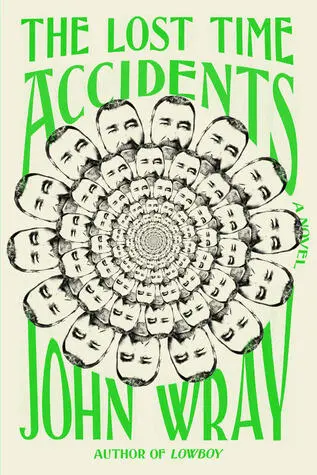
- Название:The Lost Time Accidents
- Автор:
- Издательство:Farrar, Straus and Giroux
- Жанр:
- Год:2016
- ISBN:9781429944526
- Рейтинг книги:4 / 5. Голосов: 1
-
Избранное:Добавить в избранное
- Отзывы:
-
Ваша оценка:
The Lost Time Accidents: краткое содержание, описание и аннотация
Предлагаем к чтению аннотацию, описание, краткое содержание или предисловие (зависит от того, что написал сам автор книги «The Lost Time Accidents»). Если вы не нашли необходимую информацию о книге — напишите в комментариях, мы постараемся отыскать её.
, John Wray takes us from turn-of-the-century Viennese salons buzzing with rumors about Einstein's radical new theory to the death camps of World War Two, from the golden age of postwar pulp science fiction to a startling discovery in a Manhattan apartment packed to the ceiling with artifacts of modern life.
Haunted by a failed love affair and the darkest of family secrets, Waldemar 'Waldy' Tolliver wakes one morning to discover that he has been exiled from the flow of time. The world continues to turn, and Waldy is desperate to find his way back-a journey that forces him to reckon not only with the betrayal at the heart of his doomed romance but also the legacy of his great-grandfather's fatal pursuit of the hidden nature of time itself.
Part madcap adventure, part harrowing family drama, part scientific mystery-and never less than wildly entertaining-
is a bold and epic saga set against the greatest upheavals of the twentieth century.
The Lost Time Accidents — читать онлайн бесплатно полную книгу (весь текст) целиком
Ниже представлен текст книги, разбитый по страницам. Система сохранения места последней прочитанной страницы, позволяет с удобством читать онлайн бесплатно книгу «The Lost Time Accidents», без необходимости каждый раз заново искать на чём Вы остановились. Поставьте закладку, и сможете в любой момент перейти на страницу, на которой закончили чтение.
Интервал:
Закладка:
Every male of the species, I’m fairly sure, is flabbergasted by the first woman who doesn’t run from him in bug-eyed horror, and goes on to suffer a kind of blissful PTSD for months thereafter — but even after adjusting for my near-total lack of sexual intelligence (not to mention my overall state of shock), Tabitha Guy was inexplicable. She was ferally at ease in her own body, as if she’d never heard of either Testament; she was pale and plump and up for almost anything. She had hair in her armpits the color of honey. She was a black studies major. And out of some occult motive — some faux-political agenda, some inscrutable kink — she was willing to lower her overalls for me (her corduroy overalls!) in the lockable single-stall bathroom on the fourth floor of the Clay Undergraduate Library, less than an hour before I caught the bus home for Thanksgiving.
“You can give thanks for that , Tolliver,” she announced when it was over. “Waldy? Look at me, Waldy. How soon are you going to be sick?”
The loss of my virginity enlightened me on a number of points that everyone else seemed to know already, such as the fact that it’s possible, for short periods of time, to go agreeably insane. Thanksgiving break that year was an extended hallucinogenic odyssey for which all the necessary psychoactive compounds were produced by my own stunned metabolism. I remember only three things about it with any clarity: Orson’s forced-seeming cheer, the Kraut’s puzzling remoteness, and a letter to me from my aunts — the first one in years — that I used as a bookmark instead of opening. I might as well have spent that week inside of Enzie’s plywood crate.
Tabitha’s surrender stood as the defining singularity of my duration — at least until spring term started, when it practically became an hourly event. She surrendered to me on the futon of her “divided double” in the all-girls wing of Jodorowsky Hall; she surrendered in the coed showers of my dorm, cool and arch-backed and sudsy, like a hooker in a made-for-cable movie; she surrendered pretty much anywhere, in private and in public, without even considering it surrender. For my part, I partook ravenously, hysterically, certain that my luck was temporary. I was availing myself of some providential oversight, some dimple in the cosmic status quo, and I knew that a correction would be made before too long.
What I didn’t suspect, Mrs. Haven — not even in my wildest fits of adolescent mania — was that I would make the correction myself.
I can’t say when I first got wind of the Ogilvy Synchronology Society, known unofficially around campus — for appropriately cryptic reasons — as the Stuttering Few. No one took the SFs seriously except the SFs themselves, who took their society so excruciatingly seriously that they never spoke its name aloud or publicized their meetings. This was rote cult behavior, of course, but it also made practical sense: self-promotion was risky at Ogilvy, especially if you were into something geeky. The Ogilvy Middle-Earth Collective (the “Elfdiddlers,” in Ogilvy-speak) had learned this the hard way the previous spring. In the hope of attracting fresh blood to their weekly Helm’s Deep reenactments in the college arboretum, they’d plastered the campus in Celtic-lettered flyers:
HEAR YE! HEAR YE!
ALL YE STEADFAST OF BROADSWORD
AND NIMBLE OF BOW!
ALL YE YEOMEN OF VIRTUE!
THE HOUR IS AT HAND.
COME DO BATTLE WITH ORKS IN THE ARB.
All it had taken to undo their good work was one unbeliever with a Sharpie, a few idle hours, and the idea of prefacing ORKS with an uppercase D. The Elfdiddlers never recovered.
I’d have managed to ignore the Ogilvy Synchronology Society altogether, I think, if it hadn’t been for Tabitha Guy. It happened by the ruthless whim of C*F*P: as Tabitha and I reclined on her mattress one midwinter evening, both of us smug and sweat-soaked and (temporarily) immortal, I noticed a dog-eared pamphlet on the floor. Its bottom half was wedged under the bedframe, and the author’s name — in a Celtic-looking font, if I remember correctly — was badly smudged, but its title was plain, even in the lava lamp’s slithering light:
THE HOUR IS AT HAND.
THE HOUR ***ALWAYS*** IS AT HAND.
& SO CAN YOU!
The jumbled-clock symbol of the UCS was stamped underneath, not quite centered on the page, but I didn’t need to see it. I could smell an Iterant a mile away by then, Mrs. Haven, if the wind was blowing right. Or so I’d always let myself believe.
“What’s this?” I said to Tabitha, as nonchalantly as I could. She scratched one honey-colored armpit and emitted a coo.
“Tabitha. Hey.”
“I’m trying to sleep, bunny. What do you want?”
I jerked the pamphlet free of the mattress, biting back my paranoia, and laid it across the humid sheet between us. “I asked you about this—” I hesitated, not sure what to call the thing. “This literature.”
“Oh! That,” she said, yawning. Her yawn struck me as false: it seemed too athletic, too studied. “I’ve been meaning to show that to you, actually. There’s some trippy shit in there.”
I’d told Tabitha nothing about my history with the Iterants. This wasn’t because I distrusted her, necessarily, but because of the vow I’d sworn to bury the teenaged iteration of Waldy Tolliver alive, along with his retainer and his collection of Timestrider memorabilia and the green knickerbockers his parents had dressed him up in before he was old enough to reason for himself. I was less a “new man” at college, psychosocially speaking, than a man who’d demolished his identity and reassembled the rubble along wildly incongruous lines, thereby becoming both his own executioner and his own parent. (Unlikely as this sounds, the Church of Synchronology preaches that just such a wonder is possible, once the time-consuming — and costly — Seventeenth Level of Iteration has been reached.) But we tamper with the weft of the universe at our peril, Mrs. Haven, as I was about to discover. I was beginning to suspect that the Tolliver/Toulas had had things backward from the very beginning: we’d brought our combined wills to bear on escaping our past, when the future was the thing we should have run from.
* * *
I didn’t tell Tabitha about the Iterants the night I found that pamphlet, either, though it would have been the perfect occasion. I didn’t tell her over the course of that next week, during which period I grew steadily more guarded and suspicious; and I didn’t tell her that following Saturday — exactly seven days from our first and only conversation about the UCS — when I suggested that we “spend some time apart.”
I felt sick to my stomach as I watched the meaning of that hateful phrase register on her lovely face; but I also felt jaded and cosmopolitan, master of my emotions — the tragic, stiff-lipped, self-denying hero. This is what adults do, I assured myself coolly. In reality I was terrified, hopelessly out of my depth, gnawed to ribbons by a frantic, all-purpose jealousy that had no fixed target and therefore applied to everything I saw. Tabitha Guy had been an Iterant all along: I saw that clearly now. Why else would someone so exquisite have allowed my piggish fingers to besmirch her?
* * *
Right or wrong, Mrs. Haven, the rest of sophomore year confirmed this theory nicely. Girls recoiled from me as if I still had green knickerbockers on, or my entire face were covered in lipstick, or I’d invited them to fight dorks in the Arb. Friends ran out of patience with my customized blend of paranoia and self-pity almost instantly — with the exception of Hornbanger, who never listened to me very closely — and before long I was spending my nights in the periodicals reading room on the third floor of Clay, combing back issues of Galaxy Science Fiction for mentions of my father and trying not to think about the lockable single-stall bathroom one flight up. Galaxy loathed the works of Orson Card Tolliver — it hated all of his books, soft- and hard-core alike — with a dedication I found oddly soothing. (Sample quote: “Mr. Tolliver writes his novels for the ages. The ages between five and eleven.”) After a couple of weeks, however, even the periodicals reading room began to lose its charm.
Читать дальшеИнтервал:
Закладка:
Похожие книги на «The Lost Time Accidents»
Представляем Вашему вниманию похожие книги на «The Lost Time Accidents» списком для выбора. Мы отобрали схожую по названию и смыслу литературу в надежде предоставить читателям больше вариантов отыскать новые, интересные, ещё непрочитанные произведения.



Обсуждение, отзывы о книге «The Lost Time Accidents» и просто собственные мнения читателей. Оставьте ваши комментарии, напишите, что Вы думаете о произведении, его смысле или главных героях. Укажите что конкретно понравилось, а что нет, и почему Вы так считаете.