John Wray - The Lost Time Accidents
Здесь есть возможность читать онлайн «John Wray - The Lost Time Accidents» весь текст электронной книги совершенно бесплатно (целиком полную версию без сокращений). В некоторых случаях можно слушать аудио, скачать через торрент в формате fb2 и присутствует краткое содержание. Год выпуска: 2016, ISBN: 2016, Издательство: Farrar, Straus and Giroux, Жанр: Современная проза, Фантастика и фэнтези, на английском языке. Описание произведения, (предисловие) а так же отзывы посетителей доступны на портале библиотеки ЛибКат.
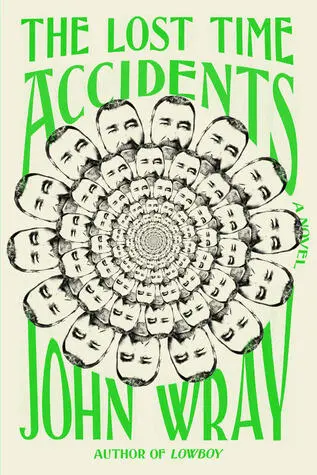
- Название:The Lost Time Accidents
- Автор:
- Издательство:Farrar, Straus and Giroux
- Жанр:
- Год:2016
- ISBN:9781429944526
- Рейтинг книги:4 / 5. Голосов: 1
-
Избранное:Добавить в избранное
- Отзывы:
-
Ваша оценка:
The Lost Time Accidents: краткое содержание, описание и аннотация
Предлагаем к чтению аннотацию, описание, краткое содержание или предисловие (зависит от того, что написал сам автор книги «The Lost Time Accidents»). Если вы не нашли необходимую информацию о книге — напишите в комментариях, мы постараемся отыскать её.
, John Wray takes us from turn-of-the-century Viennese salons buzzing with rumors about Einstein's radical new theory to the death camps of World War Two, from the golden age of postwar pulp science fiction to a startling discovery in a Manhattan apartment packed to the ceiling with artifacts of modern life.
Haunted by a failed love affair and the darkest of family secrets, Waldemar 'Waldy' Tolliver wakes one morning to discover that he has been exiled from the flow of time. The world continues to turn, and Waldy is desperate to find his way back-a journey that forces him to reckon not only with the betrayal at the heart of his doomed romance but also the legacy of his great-grandfather's fatal pursuit of the hidden nature of time itself.
Part madcap adventure, part harrowing family drama, part scientific mystery-and never less than wildly entertaining-
is a bold and epic saga set against the greatest upheavals of the twentieth century.
The Lost Time Accidents — читать онлайн бесплатно полную книгу (весь текст) целиком
Ниже представлен текст книги, разбитый по страницам. Система сохранения места последней прочитанной страницы, позволяет с удобством читать онлайн бесплатно книгу «The Lost Time Accidents», без необходимости каждый раз заново искать на чём Вы остановились. Поставьте закладку, и сможете в любой момент перейти на страницу, на которой закончили чтение.
Интервал:
Закладка:
“Go on , Walter,” you said. “Open it.”
It was a typical teenage boy’s treasure chest — crows’ feathers, spent shotgun cartridges, dated Czechoslovakian coins — except for three sheets of foolscap at the very bottom, slightly too wide for the box, covered in precise courant script. The first two pages were journal entries; the third looked to be a single formula, so dense as to be almost indecipherable. I’d have to find a mathematician to make sense of it, I realized, and possibly a handwriting specialist. I was getting ahead of myself, Mrs. Haven, but I couldn’t help that. It was all that I could do to keep from shouting.
“It was wonderful of you — both of you — to have guarded these papers,” I murmured. “My family has been searching for my great-grandfather’s notes since the day of his death. We thought that they’d vanished forever.”
“ He told Marta — our Marta — that men would be coming,” Adéla Hargova said. “Coming after the papers. He told her not to give them.” She grew suddenly shy. “That is the story I know.”
“And she hid them. Bless her for that. She knew they were important.”
“Ah! I’m not sure about that .”
“What do you mean, Mrs. Hargova?”
“He told her to burn them,” Artur said, smiling strangely.
“Burn them?”
He nodded. “Or throw them away.”
* * *
As soon as we stepped outside I saw the mover. He was standing at the entrance to Masarykovo Square, dressed in a well-cut gray suit, holding his hands out, palms upward, as if checking for rain. It was the man who’d been carrying the clipboard in my cousin’s apartment, the one the other movers deferred to: the man they all called Little Brother. The square was unusually crowded — it was Saturday, a market day — but he stood out as if he were spotlit. I felt surprise, I remember, but only a flutter. It was as if I’d agreed to meet him there, at that particular juncture of spacetime, then forgotten we had an appointment. He of course showed no surprise at all.
I waited until we were halfway across the square to tell you. You took my hand and gripped it.
“You were right, Walter. We should have left yesterday.”
“Do you recognize him?”
“It’s you they’re here for — you and Ottokar’s papers. Not me.” You let go of my hand. “It’s all right. We can lose him.”
“Lose him? How would we—”
“There’s just one of him — at least so far — and two of us. We’ll have to split up.”
“What if you’re wrong? What if it’s you they want?”
You shook your head. “They’ve been waiting for this to happen, Walter. Waiting for you to come here for those notes.”
I stopped short and turned you to face me. We were at the edge of the square, screened from view by a row of stalls selling iridescent raincoats; I couldn’t see Little Brother, but I knew he was close. The sun came out then, shining into your eyes, and I watched your pupils narrow into pinpricks.
“How long have you known about this, Mrs. Haven?”
“There’s no time for that, Walter — do you understand? Meet me in an hour at the Václav Prokop Divis house. I’ll get us a car.”
You spun on your heels — your square, well-calloused heels that fit so perfectly into my palms — and hurried off down Kollárova Street. Just that morning you’d treated my search for my great-grandfather’s papers with amused condescension; now you’d told me with perfect matter-of-factness that your husband’s goons had followed us to Europe for no other reason. You’d looked pained to have to say it, even angry. But that may have been due to the sun.
“Mrs. Haven!”
“Yes, Walter? What is it?”
You came back to me eagerly, as though you knew we’d never meet again, and wanted one last look, however ill-advised, to recollect me by. I still choose to believe that was the reason.
“Take the notes, Hildy.”
“The notes?” you said, frowning. “I don’t understand.”
“If that man follows me, it’s the notes that he wants. But if he follows you —if you’re the reason he’s here — then the notes aren’t important. And either way they’re safer in your hands.”
You made as if to say something, then closed your eyes and gave the slightest nod. I undid the top two buttons of the jacket you’d bought in Vienna and slid the pages inside, then pulled your body close to mine and kissed you. It was my best attempt at a heroic gesture, my last turn in the spotlight, and I’m proud to say I took my time about it. That kiss enabled me to recover my nerve, Mrs. Haven, the way an overdone flourish helps a second-rate actor remember his line. By the time you’d disappeared around the corner of Kollárova Street I was ready for the worst that might befall.
I slipped out past the raincoats, back into the open, and waited calmly there for Little Brother. He came into view almost instantly, no longer feigning indifference, fixing his creased pink smoker’s eyes on mine. He was moving like an old man, silently and smoothly, in that terrible, deliberate tai chi way of his. He could have moved faster, I’m sure, but he chose to go slowly. He was giving me a sporting shot — the chance to make my break — and I didn’t wait around to ask him why.
You’d taken Kollárova Street south, so I headed due west, down Lazebnická Street toward the river. You’d been right, Mrs. Haven. It was me he was after. The thing to do now was give him the slip and get to the Divis house without attracting notice. I forced myself to think. We bought our breakfast houskas from a baker on Antonínská Street, less than half a block away. If I ducked into his shop before Little Brother rounded the corner, and begged him, as a loyal customer, to let me through into the courtyard—
“Hello, Waldy.”
I recognized that honeyed voice at once. It belonged to a man in a corduroy blazer and cheap-looking loafers, leaning against a pockmarked stucco wall, leafing casually through the local paper. Which had to mean that he’d known, well before I knew myself, that I’d come running up the street at just that hour.
He studied me at his leisure, paying particular attention to my eyes, as though taking note of how the years had changed me. I could find no anger or ill will in his expression — I could locate no emotion there at all. I remembered what you’d told me on the train up from Vienna: your husband cultivated boredom to impede his sense of time. And I became aware, as I stood frozen in place — excruciatingly aware, but in a far-off sort of way — that panic seemed to have the same effect.
“No cause for alarm, pal,” he said sleepily. “I’m not going to cut your cock off with a rusty pair of scissors. I’m not even going to punch you in the nose.”
I took a half step backward, slipping slightly on the cobblestones, and asked him why not.
“Do you need me to say it?” He raised his eyebrows. “Because you’ve rendered me — and the Church of Synchronology, and the entire human race — an invaluable service. A service that only you, Waldemar Gottfriedens Tolliver, son of Orson, grandson of Kaspar, great-grandson of Ottokar, could have performed. We’ve been trying to get our hands on that theorem for years.”
I mumbled something to the effect that I thought he’d put his Iterant days behind him — that he was a financier now. He smiled wistfully.
“It’s a fallen world, Waldy. I’ve had to adapt. The public respects a businessman considerably more than a philosopher in the current age, never mind a prophet.” He folded his newspaper neatly down the middle. “But thanks to you, pal, public opinion is going to matter less to us— much less — than it has previously. We’ll have other means of bringing folks around.”
Читать дальшеИнтервал:
Закладка:
Похожие книги на «The Lost Time Accidents»
Представляем Вашему вниманию похожие книги на «The Lost Time Accidents» списком для выбора. Мы отобрали схожую по названию и смыслу литературу в надежде предоставить читателям больше вариантов отыскать новые, интересные, ещё непрочитанные произведения.


Обсуждение, отзывы о книге «The Lost Time Accidents» и просто собственные мнения читателей. Оставьте ваши комментарии, напишите, что Вы думаете о произведении, его смысле или главных героях. Укажите что конкретно понравилось, а что нет, и почему Вы так считаете.