T. Boyle - Water Music
Здесь есть возможность читать онлайн «T. Boyle - Water Music» весь текст электронной книги совершенно бесплатно (целиком полную версию без сокращений). В некоторых случаях можно слушать аудио, скачать через торрент в формате fb2 и присутствует краткое содержание. Год выпуска: 1983, ISBN: 1983, Издательство: Granta Books, Жанр: Современная проза, на английском языке. Описание произведения, (предисловие) а так же отзывы посетителей доступны на портале библиотеки ЛибКат.
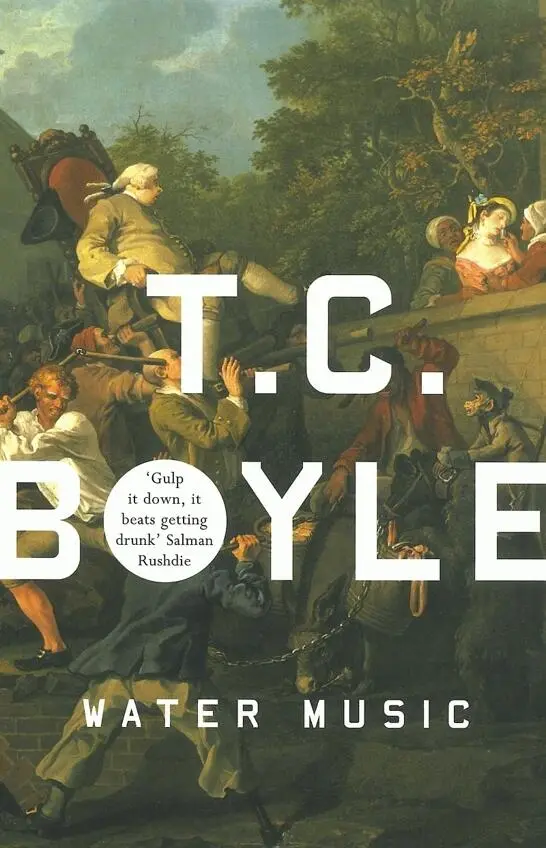
- Название:Water Music
- Автор:
- Издательство:Granta Books
- Жанр:
- Год:1983
- ISBN:9781862071551
- Рейтинг книги:3 / 5. Голосов: 1
-
Избранное:Добавить в избранное
- Отзывы:
-
Ваша оценка:
Water Music: краткое содержание, описание и аннотация
Предлагаем к чтению аннотацию, описание, краткое содержание или предисловие (зависит от того, что написал сам автор книги «Water Music»). Если вы не нашли необходимую информацию о книге — напишите в комментариях, мы постараемся отыскать её.
Water Music — читать онлайн бесплатно полную книгу (весь текст) целиком
Ниже представлен текст книги, разбитый по страницам. Система сохранения места последней прочитанной страницы, позволяет с удобством читать онлайн бесплатно книгу «Water Music», без необходимости каждый раз заново искать на чём Вы остановились. Поставьте закладку, и сможете в любой момент перейти на страницу, на которой закончили чтение.
Интервал:
Закладка:
As Smirke goes limp in his arms, the great wet bulk of the man weighing on him like leviathan and forcing him to the deck while Martyn shouts commands and blasts on his whistle and footsteps come thundering up the planks, Ned Rise begins to reconsider his position, thinking with a certain regret of his pallet back at Goree, thinking that perhaps he’s made a mistake, thinking that maybe, in the final analysis, this isn’t all it’s cracked up to be.
♦ DISAPPOINTMENT AT PISANIA ♦
The initial disappointment is trifling — the result of a minor accident, unforeseeable, unavoidable — and yet for all that, something of an evil portent, a bringdown, a rotten and insipid way to launch so historic an adventure as this. Even worse, it involves the first death.
Leland Cahill, like most of the men recruited from the garrison, had been drinking heavily in celebration of his reprieve from the certain doom of Goree, drinking to the success of the expedition, the honor of Mungo Park, the courage of his companions and just about anything else he could think of. Cahill was an acne-scarred eighteen-year-old, somewhat below the median in intelligence, who presented an innocuous and winning front, and who had been sentenced to life imprisonment for sacrilege, public micturition and stealing woollen clothes from tenter grounds. Sober, he was a notch above worthless; drunk, he was no more capable of pulling his weight than a cross-eyed catatonic from Bethlehem Hospital. Nonetheless, when the Crescent came to anchor off Pisania it was his task — along with Mitchell Mewshaw — to secure the gangway.
Since the river was running low at this season, the ship’s captain was forced to drop anchor some hundred and twenty yards offshore. Fortunately, Mungo had foreseen this eventuality and had sent ahead to have a raft constructed for the purpose of transporting men, animals and equipment from ship to shore. The raft was waiting for them as they rounded a bend in the river and drew within sight of the outbuildings of the factory.
By unanimous consent of the officers, the asses — whose stench was terrific in such close quarters and high temperatures — were to be evacuated first. As if aware of their prerogative, the asses became increasingly animated as the two sleek Pisanian negroes positioned the raft alongside the ship. Unfortunately, Cahill and Mewshaw, passing a bottle of gin and swapping dirty stories, took no notice of the situation. When the raft was properly secured they merely backed up a step or two, fastened the ropes and guided the wooden gangway over the side of the ship and into position. A mistake. As the gangway breached the bulwarks the asses began to stamp and snort, impatient with the crowding and the swaying of the ship; the instant it touched down they stampeded. A dun blur shot over the rail and down the narrow walkway in a fury of crashing hoofs, pandemonious braying and hellish kicking. Eighteen asses plunged directly into the water. The remainder managed to make the raft — shaken and wild-eyed — scrambling hard to escape the push from behind. Inevitably they spooked the negroes and capsized the raft. In all, six asses were lost. As for Leland Cahill, private first class, he was last seen pitching headlong down the sloping ramp of the gangway, one hundred and eight individual hoofs making their separate imprints in his flesh.
♦ ♦ ♦
The second disappointment is less tangible, more a mental and spiritual letdown than the first. More a disappointment in the true sense of the word — a betrayal of expectation rather than a sudden tragic turn of events.
After the explorer had straightened out his men and asses and assigned a crew to grapple the river for Cahill’s body, his first thought was of Dr. Laidley. It had been nearly eight years. And yet when he thought of Africa, he thought of Laidley. The old man had equipped and instructed him in preparation for that first mission — had taught him Mandingo, filled him in on native customs and introduced him to Johnson. While Mungo lay back in bed, nearly eviscerated from his first bout with jungle fever, Laidley had nursed him, brought him cup after cup of stiff, cleansing native tea, read to him from Donne, Milton and Shakespeare in a voice as serene and assured as the Bank of England. He was the last to see the explorer off and the first to congratulate him on his return — and the first white man to hear the historic news of the Niger. He was the center in a chaos of colors, dialects, tattoos and nose rings, the single fixed point in an ever-shifting pattern of bizarre needs, wants and practices. He was Mungo’s mentor.
As the explorer made his way through the tumble of reed huts — each with its barking dog and naked children framed in the entranceway — and up the dusty street to the doctor’s rambling residence cum fortress cum factory, he broke into an anticipatory grin as he thought of the pleasure of seeing him again, shaking his hand and introducing him to Zander, telling him of the phenomenal success of the book and the effect his discovery was having on the cartographers of Europe. He could already picture the congenitally flushed cheeks, the white tonsure, the nodding head and pursed lips, the sideways contemplative glance of the old man as he sat in his cane rocker absorbing all the news of England before exploding in a flurry of hospitality. “Yes, yes, yes,” he’d say, fatherly, Franklinesque, trotting round the room till the tails of his jacket caught the wind, “but here, have some palm wine, some goat’s cheese, a dish of kouskous. Or how about a steak? Cigar? Brandy?” Mungo would inscribe a copy of his Travels for him, and they’d sit back on the veranda and immerse themselves in a connoisseur’s palaver about the countryside, the flow of words laving him, washing out the lint of seven years’ absence, conjuring up half-forgotten truths about meteorology and geography, about royal succession and tribal boundaries. If the truth be known, the explorer was in sad need of a refresher course.
All this ran through his head as he and Zander ascended the familiar rough-hewn steps of the piazza, but a nagging question kept intruding itself as well: why hadn’t the old man come out to greet them as they landed? Was he indisposed? Away in the bush?
The answer waited for him just behind the open door, in the lank-haired, unshaven person of D. K. Crump, the doctor’s former assistant and temporary successor. Crump was slouched in a wicker chair, a bottle of gin on the desk before him and a reefer of mutokuane fuming in his hand. His eyes were latticed with red. Beside him, her heavy lids half shut in ecstasy or stupor, a black woman in a striped shift languidly rotated a fan while Crump, his hand thrust through the armhole of her dress, manipulated her breasts as if they were potatoes in a sack.
It took a moment for the explorer’s eyes to adjust to all this. The factory was dark and immense, strewn with articles for barter. There were knives, muskets, kegs of powder, bolts of cloth, mirrors, demijohns of wine and brandy, kegs of nails, axes, saws, jacks-in-the-box and penny candies by the barrel. And up against these, a mountain of local products taken in exchange — elephant tusks, teeth and feet, amorphous mounds of beeswax, birds’ feathers of every hue and description, baskets of peppercorns and peanuts, great twisted tangles of ebony, the limp pelts of leopard, lion and zebra. It looked like the aftermath of some natural disaster, the leavings of a flood, driftwood and jetsam, piled in a dusty heap that lost itself in the dim reaches of the warehouse. The explorer took in the sweep of it, and then turned back to this bare-chested man with the stringy biceps who seemed to preside over it all.
“I’m Mungo Park,” he said, bowing, “and this is Alexander Anderson, my second-in-command. Is Dr. Laidley about?”
Читать дальшеИнтервал:
Закладка:
Похожие книги на «Water Music»
Представляем Вашему вниманию похожие книги на «Water Music» списком для выбора. Мы отобрали схожую по названию и смыслу литературу в надежде предоставить читателям больше вариантов отыскать новые, интересные, ещё непрочитанные произведения.





Обсуждение, отзывы о книге «Water Music» и просто собственные мнения читателей. Оставьте ваши комментарии, напишите, что Вы думаете о произведении, его смысле или главных героях. Укажите что конкретно понравилось, а что нет, и почему Вы так считаете.