Manuel Munoz - What You See in the Dark
Здесь есть возможность читать онлайн «Manuel Munoz - What You See in the Dark» весь текст электронной книги совершенно бесплатно (целиком полную версию без сокращений). В некоторых случаях можно слушать аудио, скачать через торрент в формате fb2 и присутствует краткое содержание. Год выпуска: 2011, Издательство: Algonquin Books, Жанр: Современная проза, на английском языке. Описание произведения, (предисловие) а так же отзывы посетителей доступны на портале библиотеки ЛибКат.
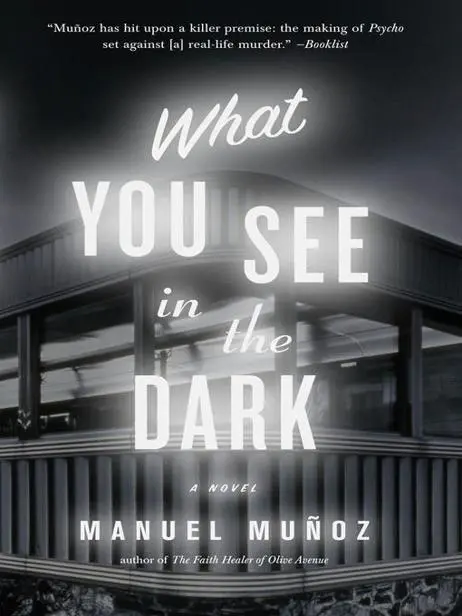
- Название:What You See in the Dark
- Автор:
- Издательство:Algonquin Books
- Жанр:
- Год:2011
- ISBN:нет данных
- Рейтинг книги:5 / 5. Голосов: 1
-
Избранное:Добавить в избранное
- Отзывы:
-
Ваша оценка:
What You See in the Dark: краткое содержание, описание и аннотация
Предлагаем к чтению аннотацию, описание, краткое содержание или предисловие (зависит от того, что написал сам автор книги «What You See in the Dark»). Если вы не нашли необходимую информацию о книге — напишите в комментариях, мы постараемся отыскать её.
—frame by frame, in pans, zooms, and close-ups — Munoz’s re-creation of a vanished era takes the reader into places no camera can go, venturing into the characters’ private thoughts, petty jealousies, and unrealized dreams. The result is a work of stunning originality.
What You See in the Dark — читать онлайн бесплатно полную книгу (весь текст) целиком
Ниже представлен текст книги, разбитый по страницам. Система сохранения места последней прочитанной страницы, позволяет с удобством читать онлайн бесплатно книгу «What You See in the Dark», без необходимости каждый раз заново искать на чём Вы остановились. Поставьте закладку, и сможете в любой момент перейти на страницу, на которой закончили чтение.
Интервал:
Закладка:
The hooks on the shower curtain popped off in release, twirling around the shower rod, one by one, like dancers releasing their movements in sequence.
She slumped near the toilet, the hardest part of all, the rim of the tub lodged in her ribs.
The showerhead looked down at everything.
The blood streamed down, second by second, the tub being rinsed clean. It spiraled into the drain, disappearing.
And then her own eyes, in a close, tight focus and a slow, painful pullback, trying not to blink. But it had been worth it, her face frozen in the stupor of cruel death, the close-up of her eye. A spiral, a circling. The slow dance in the tub repeating. Such brutality meant erasure, a cold, unblinking eye, a woman lying in a pool of her blood, which was draining away, vanishing. The bathroom in near silence, save the flow of the water, as the camera glided over to a newspaper concealing the stolen money.
The Actress watched the rest of the film in disbelief, terrified at the shock, but strangely satisfied at her last, unblinking appearance, her face registering — for the first time she could remember in a film — that a death meant something. An absence. There was something unsettlingly gorgeous about the slow spiral of her eye, the movement gradually coming to a finish, the way a dance ends.
She wasn’t in the rest of the picture, and yet she was.
At the close of the film, she stood up proudly as the people in the screening room — the other stars, some of the crew, some of the studio people — congratulated one another on a job well done. She knew she had nailed it. A death scene, what every actress wanted. Even if it wasn’t a hospital, a slow and wasting disease.
This had a dark beauty to it. The character worked because of everything that had come before, the suggestion she’d granted to her in the quiet, strange flashes of feeling across her face. The Actress shook more hands, proud, grateful. Might this ever come again, the chance to make a woman out of nothing but words on the page? The woman had to live before she could die. It was as simple as that. Even if it was the vulgarity of real life — the needs and the mistakes, but also the desire to correct them, the effort toward a forgiveness of herself. A woman like that. All those lonely hours. All the things people do to try to escape.
Part Three
Ten
When had she picked up the habit of faithfully reading the Los Angeles Times every day? Not the Californian, the local newspaper she glanced at while at the kitchen table or in the motel office or swiping down the café counters, but the print from over the Grapevine, the pulse of the large city but a couple of hours away. At the café, Arlene had always been left to clean up the discarded copies of Modern Screen and Look that the girls left behind, and for a while she took these home with her on the sly, the magazines tucked into a paper bag in case anyone saw her slipping out the door with the very gossip she chastised the girls for believing. And people were watching her, after all. Back then, in the initial days after the news spread about the dead girl and Dan’s involvement with her, Arlene thought she would never live down the heavy stares in the dining area of the café. Arlene volunteered for kitchen cleanup and washed dishes and bused tables, kept herself moving, all to avoid those eyes. In the kitchen’s break area, she swept up the girls’ cigarette butts and candy wrappers and, at first, stacked the magazines neatly in a corner. As the months went on, Arlene found her voice again — the stern, somewhat prickly voice she was capable of — and when the girls found the magazines gone one day, none of them dared ask what might have happened to them.
The pleasure she took in the magazines, she knew, was nothing but escape, yet maybe for the first time, sitting in the armchair of her living room, flipping through the pages of a Photoplay, Arlene knew what the girls of the café might be dreaming about, why they were moved by picture after picture of movie stars posed with one leg pivoted forward, jewels haloed with gleam. All of this taking place just over the Grapevine, another way to live altogether, the dust giving way to red carpet and camera flash and expensive champagne. Sometimes, in the pictures of the much younger starlets, she could almost see vague semblances of the café girls, similarities so sharp that Arlene felt she, too, could imagine their regret over living in Bakersfield.
The local paper, carrying word of her own real world, appeared on her porch every day and remained there, curled up with its rubber band, yellowing after a few days of going un-collected. She knew what the paper said. She had a life much more regrettable than the café girls did. She stuck to the magazines: perfectly useless information, but a needed distraction from the local news, the chatter that went on in the café as she ran plates under hot water. What ran in the newspaper was not rumor anymore as the days went on. Truth was confirmed. It was true that the girl had no family in town and that there was no one to claim her. It was true that Dan had fled and no trace of him had been found. It was true that he had beaten the girl to death in the dark stairwell leading to her apartment above the bowling alley. It was true that a Mexican was deported, though everyone knew he had had no involvement in the death whatsoever.
Other things were true as well: Arlene did not know where Dan had gone, though sometimes she felt as if the town didn’t believe her. It was true that the girl was the daughter of a woman who used to work in the café years ago, around the time of the earthquake in 1952, but so much time had passed that people couldn’t even remember where that woman had gone.
Arlene knew what was in the local paper better than anyone else did, yet her eyes never left the glossy movie magazines, seeing the same pictures, the same stars, over and over, as she leafed through the pages day after day. Would the news about Dan ever go away? Would the feeling of being stared at in the café’s serving area ever lessen, the silent accusation? At home, she would pause and put down the movie magazine, close her eyes. But there was no wishing away what she had to face.
“You’re faster than the young girls,” the new shift manager had said, almost two months after Arlene had taken to volunteering to do anything that would keep her in the kitchen. “I need you back out front.” The shift manager was in his late twenties, but respectful of her. Without prompting, he called her Arlene and not Mrs. Watson. Arlene liked this about him, as if he wanted to let her know that he didn’t think of her as anyone’s mother.
His voice was fraught with his own need for help, but she could still detect the kindness underneath it. “Those girls,” he said, “are too slow to handle anything all by themselves.”
At first, put back full-time at the front of the café, Arlene felt on display, charging briskly by customers without saying a word, aware of the large plate-glass windows and the people walking by, maybe staring inside at the woman who worked there. Her fingers trembled sometimes from nerves, jittery in anticipation of the arrival of the police, coming to break the news of how they’d captured Dan. The deputy who used to come in daily for a grilled cheese, home fries, and a cola stopped doing so, as if to spare her the discomfort. It was like that for a while — all jitters, forks slipping out of her fingers, one time being spooked so badly by the glimpse through the plate glass of a Bakersfield officer coming along the sidewalk that Arlene dropped a whole tray full of dirty dishes.
But things change. She had always told herself that on particularly difficult days. Things change. People would forget. People would find other things to whisper about. Who whispered now about her husband having left her? Who even remembered? Most of the bachelor farmers who used to give her the eye and the sweet talk stopped doing so, their heads dropped over their plates as soon as breakfast came. That had to do, she knew, with her getting older, not with her being divorced, not with what had happened to Dan.
Читать дальшеИнтервал:
Закладка:
Похожие книги на «What You See in the Dark»
Представляем Вашему вниманию похожие книги на «What You See in the Dark» списком для выбора. Мы отобрали схожую по названию и смыслу литературу в надежде предоставить читателям больше вариантов отыскать новые, интересные, ещё непрочитанные произведения.





Обсуждение, отзывы о книге «What You See in the Dark» и просто собственные мнения читателей. Оставьте ваши комментарии, напишите, что Вы думаете о произведении, его смысле или главных героях. Укажите что конкретно понравилось, а что нет, и почему Вы так считаете.