Manuel Munoz - What You See in the Dark
Здесь есть возможность читать онлайн «Manuel Munoz - What You See in the Dark» весь текст электронной книги совершенно бесплатно (целиком полную версию без сокращений). В некоторых случаях можно слушать аудио, скачать через торрент в формате fb2 и присутствует краткое содержание. Год выпуска: 2011, Издательство: Algonquin Books, Жанр: Современная проза, на английском языке. Описание произведения, (предисловие) а так же отзывы посетителей доступны на портале библиотеки ЛибКат.
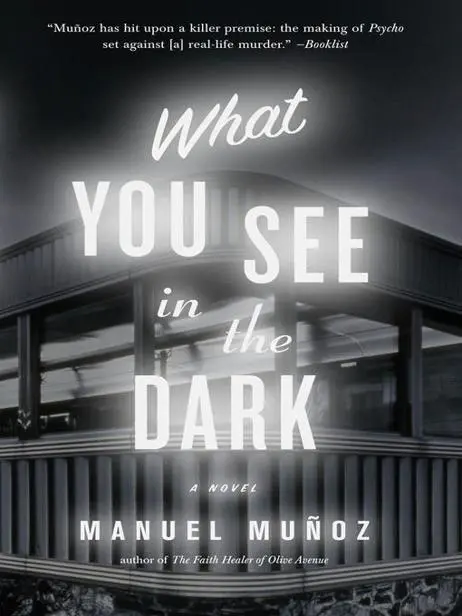
- Название:What You See in the Dark
- Автор:
- Издательство:Algonquin Books
- Жанр:
- Год:2011
- ISBN:нет данных
- Рейтинг книги:5 / 5. Голосов: 1
-
Избранное:Добавить в избранное
- Отзывы:
-
Ваша оценка:
What You See in the Dark: краткое содержание, описание и аннотация
Предлагаем к чтению аннотацию, описание, краткое содержание или предисловие (зависит от того, что написал сам автор книги «What You See in the Dark»). Если вы не нашли необходимую информацию о книге — напишите в комментариях, мы постараемся отыскать её.
—frame by frame, in pans, zooms, and close-ups — Munoz’s re-creation of a vanished era takes the reader into places no camera can go, venturing into the characters’ private thoughts, petty jealousies, and unrealized dreams. The result is a work of stunning originality.
What You See in the Dark — читать онлайн бесплатно полную книгу (весь текст) целиком
Ниже представлен текст книги, разбитый по страницам. Система сохранения места последней прочитанной страницы, позволяет с удобством читать онлайн бесплатно книгу «What You See in the Dark», без необходимости каждый раз заново искать на чём Вы остановились. Поставьте закладку, и сможете в любой момент перейти на страницу, на которой закончили чтение.
Интервал:
Закладка:
“I have one,” Candy said. “Pricey.”
“I’d imagine so.”
Candy moved fully into the aisle now, her arms still crossed in front of her.
“You going to buy one someday?”
She looked down at Candy, unsure of how to answer. “Maybe I’ll save for one.”
“They’re expensive, you know. Did you know you have to buy needles all the time? Or else they scratch your records if they’re not sharp enough.”
“What do you mean, needles?”
“For the record player,” Candy answered, her mouth opening a little in surprise when Teresa looked back at her blankly. “The arm on the record player,” she explained. “It has a tiny needle that fits exactly — exactly — into the groove of the record.”
“I see,” said Teresa. They remained looking at each other, Teresa on top of the ladder and Candy at the bottom, arms still folded, the silence drawing longer, more awkward. She realized then that maybe Candy had seen her in front of the record store.
“All of that — the needles and the records — starts to add up. That’s a lot of money for a salesgirl,” said Candy.
“Who bought yours?” Teresa asked.
Candy’s arms tightened in their fold. “A boy I’ve been seeing.”
“That’s generous of him.”
“He’s a sweetheart,” said Candy.
Though she was on the ladder and above Candy, Teresa felt vulnerable and intimidated, as if it were not Candy at the bottom of the ladder but Mr. Carson’s awkward teenage son, trying to look up her skirt. Candy’s banter was odd — she rarely spoke to Teresa except to give orders.
“I saw you,” Candy finally said. “In front of the record shop. I was on my way to get a couple of doughnuts for me and Mr. Carson and I saw you standing out by the window.”
How long? she wanted to ask Candy. Teresa pictured her standing across the street the entire time, silently watching, with hardly anyone else around to notice either of them. She imagined seeing herself as Candy had, looking at a still figure admiring the glacial turns of the records hanging from fishline, the shimmer of the window, and how easy it was to guess what she desired.
But there was nothing — was there? — in Candy making note of her standing in front of the shop. Teresa looked down at the clipboard and the salmon-colored index cards as if they might give her an idea of what to say. Candy, though, spoke first.
“You stand in front of store windows a lot,” she said.
Teresa swallowed. “I like to watch the variety shows at lunch,” she said calmly.
“The singers,” said Candy. “I didn’t know you sang.”
“Well, I don’t—”
But Candy interrupted. “I saw you yesterday, too. Riding in Dan Watson’s truck.” She looked up at Teresa, and the tone in her voice was unmistakable: accusatory, yet not mean spirited, a flat statement that dared to be denied, as if she were confronting Teresa with an empty cashbox, wordless, yet with the facts in hand, a fact that needed to be explained.
“He was taking me home,” Teresa said cautiously, the words feeling too deliberate. She knew immediately that she would not be able to say either too little or too much.
Candy already had a story in her head, standing there in her pleated purple skirt, a thin gold bracelet shimmering on her wrist, her blue blouse with a stitched pattern on the collar, a sheer pink scarf knotted at the side of her long throat. She shopped at department stores rather than make her own clothes from Simplicity patterns from TG&Y — that much Teresa could tell just by looking at her, though in truth she knew nothing about Candy. Candy gave her things to do, instructed her as if she were the boss when in fact they were hired to perform the same tasks. A pretty girl who shopped at department stores, who owned a record player, was being courted by a sweet boy, and yet somehow still wanted more and could not hide it.
Teresa knew she shouldn’t say any more, but she wanted Candy to know and not know at the same time: “He plays guitar and he’s teaching me,” Teresa said, and the moment she said it, she realized for the first time that maybe her own life could be an existence that others could dream about. That everyone, at one time or another, stood near a window and looked out, imagining a life that was not their own. “How do you know him?” she asked, because she wanted to ask the questions now, not just answer them.
“Everyone knows Dan Watson. Just like everyone knows Mr. Carson. Just like everyone knows everyone here.”
“No one knows me.”
“I know you,” said Candy, but both of them knew it wasn’t so. All she knew was that her name was Teresa and that she stood outside store windows for a long time and that the most handsome man in Bakersfield had opened the door to his pickup truck to give her a ride home.
Mr. Carson’s heavy, lopsided footsteps sounded at the entrance to the storage room, and that finally broke Candy away from the aisle. She eased back toward the desk as if she had never carried on a conversation with Teresa, simply going on with the business of the morning, and though Teresa could not see Mr. Carson, she knew Candy’s demeanor had worked. “Oh, there you are,” she heard Mr. Carson say, and then he began discussing a matter for the front desk.
Teresa went back to her inventory. I know you, she kept hearing as she counted out pairs of sandals she remembered having ordered a year ago. I know about you, she imagined Candy saying, and there it was — just the additional word, the single key and the lock turning for a door that revealed everything about Teresa in glaring light: her father gone, her mother following, money scarce, the men below her window whistling. I know all about you, she tried, this time her own voice saying it, repeating it, as she counted out white shoes favored by the nurses at the hospitals, tasseled flats in elderly beige, pink canvas sneakers, dancing shoes with glittery straps and heels as thin as expensive vases. I know, I know, I know, as she wrote her counts onto the salmon-colored index cards, the morning passing along torturously and Candy not saying another word to her.
I know. But Candy didn’t. Here was a pair of shoes like Candy’s, a modest pump, the heel barely off the ground, dark brown and plain, no intricate patterning. Teresa glanced at the price on the box and wondered how much Mr. Carson would reduce it — a single pair left, but maybe she could afford it if it went on sale. Women like Candy purchased such shoes throughout the year, the price not too high for them. Candy had a record player and could walk into that record shop and buy every Ricky Nelson song she desired, a different version of his beautiful face on the sleeve any time she wanted.
Teresa continued her inventory but noted more and more shoes she wanted to buy for herself, taking a single index card and jotting down the styles she would pay attention to later. She held them up for inspection: spectator shoes, stack heels, plain Mary Janes and ballerina flats, espadrilles and pumps. All of these for Candy, all of them purchased for her by the sweetheart boy she was seeing. The noon hour crawled closer, and the closer it came, the more she thought of Dan, the things she could have with him, and she felt an impatience that she didn’t have them already. When she came across a single pair of cowboy boots — chocolate, the left one scratched badly at both the tip and the heel, a ring of delicate brown roses etched around the mouth — she took one out of the box and held it up as if it could be broken. How unfair of Candy to want more than she already had. Teresa glanced at the shoe size and knew it would fit, then checked the other one to make sure they were a matching pair, as she was supposed to. There was only one pair of the boots left, meaning Mr. Carson had sold them well, but this box had been stuck near the top of the rack, its cover a little dusty from waiting.
Читать дальшеИнтервал:
Закладка:
Похожие книги на «What You See in the Dark»
Представляем Вашему вниманию похожие книги на «What You See in the Dark» списком для выбора. Мы отобрали схожую по названию и смыслу литературу в надежде предоставить читателям больше вариантов отыскать новые, интересные, ещё непрочитанные произведения.









Обсуждение, отзывы о книге «What You See in the Dark» и просто собственные мнения читателей. Оставьте ваши комментарии, напишите, что Вы думаете о произведении, его смысле или главных героях. Укажите что конкретно понравилось, а что нет, и почему Вы так считаете.