Manuel Munoz - What You See in the Dark
Здесь есть возможность читать онлайн «Manuel Munoz - What You See in the Dark» весь текст электронной книги совершенно бесплатно (целиком полную версию без сокращений). В некоторых случаях можно слушать аудио, скачать через торрент в формате fb2 и присутствует краткое содержание. Год выпуска: 2011, Издательство: Algonquin Books, Жанр: Современная проза, на английском языке. Описание произведения, (предисловие) а так же отзывы посетителей доступны на портале библиотеки ЛибКат.
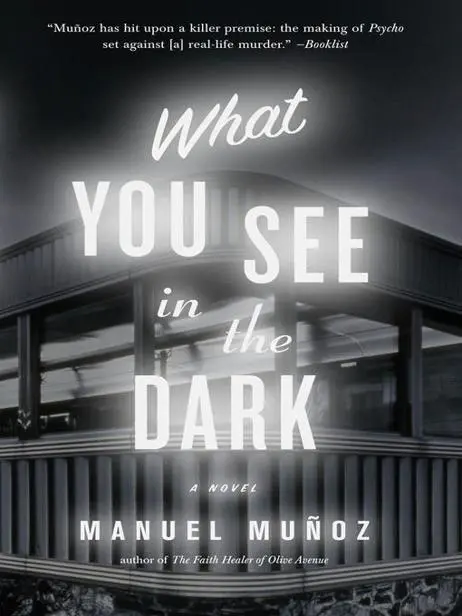
- Название:What You See in the Dark
- Автор:
- Издательство:Algonquin Books
- Жанр:
- Год:2011
- ISBN:нет данных
- Рейтинг книги:5 / 5. Голосов: 1
-
Избранное:Добавить в избранное
- Отзывы:
-
Ваша оценка:
What You See in the Dark: краткое содержание, описание и аннотация
Предлагаем к чтению аннотацию, описание, краткое содержание или предисловие (зависит от того, что написал сам автор книги «What You See in the Dark»). Если вы не нашли необходимую информацию о книге — напишите в комментариях, мы постараемся отыскать её.
—frame by frame, in pans, zooms, and close-ups — Munoz’s re-creation of a vanished era takes the reader into places no camera can go, venturing into the characters’ private thoughts, petty jealousies, and unrealized dreams. The result is a work of stunning originality.
What You See in the Dark — читать онлайн бесплатно полную книгу (весь текст) целиком
Ниже представлен текст книги, разбитый по страницам. Система сохранения места последней прочитанной страницы, позволяет с удобством читать онлайн бесплатно книгу «What You See in the Dark», без необходимости каждый раз заново искать на чём Вы остановились. Поставьте закладку, и сможете в любой момент перейти на страницу, на которой закончили чтение.
Интервал:
Закладка:
“No, no. Practice first. Practice as much as you want. In here, if you like. In the afternoons when I do the cleaning, so you won’t feel nervous.”
He made his way to the front door, picking up his keys from the top of the bar. “Unless you’re going to help me sweep up, maybe I should take you home right now before the drunks come in.”
“I can walk,” Teresa said. The old feeling came back: she wasn’t just worried about Cheno seeing her in Dan’s truck, but about the people in town, how a ride through the afternoon streets with the windows rolled down was far different from Cheno’s careful, tiptoeing courtship.
“It’s not a problem,” Dan said. “Come on.”
Seven years ago, when her mother had announced that money was too hard and that they would both board a Greyhound to Texas, where Teresa’s father lived, Teresa had said, I’m not going with you. Saying that had been like singing a song: opening her mouth and letting the sound crack through. She knew, even then, that Texas was not for her, that her mother wanted to go to the place where the records took her, the violet dark where Teresa’s father lived. She had said no, the static of the record turntable going round and round, and she couldn’t see her mother’s face when she said it.
Dan locked Las Cuatro Copas and made his way to the black Ford pickup truck, opening the door and holding it for her. Teresa looked across the street at the other bar, hoping to catch a glimpse of Ed or even Cheno, some opportunity to stop herself from her own falling, but the building only yawned back with its open door, Dan standing, waiting, his tall, wide-shouldered posture.
“Come on,” said Dan. “What are you waiting for?”
It’s your life, her mother’s silhouette had said, after a long silence between them, in the violet dark of their little room. You do what you want.
Five
She had known, since it was Bakersfield, not to expect anything fancy, but as the driver took them through the center of the city, it became clear to the Actress that all she was getting was a room, plain and simple. She didn’t need anything more, really, though she imagined there were people in the industry who begrudged everything. The driver stopped the car at a building that wasn’t more than four stories or so, flat at the top and made of brick, and they got out. She opened the door on her own, the driver rushing to her side, but she let him know implicitly that he needn’t be at her beck and call. They walked together through the plain glass doors of the lobby — no bellhops, no concierge, but more important, no Director. She had somewhat expected him to be waiting in the hallway lined with striped wallpaper that served as the lobby, sitting at one of the two tidy love seats and examining the fresh flowers set on a long table: the hotel was small, but the effort of small-town pride came through. It was only nine thirty in the morning, and the meeting wasn’t set until ten. She asked at the front desk if anyone from Los Angeles had checked in, but the clerk told her no.
“Are you expecting someone?” the clerk asked.
“A fellow traveler,” she answered, aware that the Director might try to shield himself from scrutiny.
Her room was ready, and the driver accompanied her to the top floor in the tiny elevator, her overnight bag in his hand. At her door, he scurried inside her room and placed the bag on her bed so quickly that she barely had time to open her purse for a tip. “No bother, ma’am,” he told her. “The studio asks that I not take tips. I’ll be with you the entire trip anyway.” He gave her a slight nod and made to exit. “I’ll be waiting in the car after you freshen up. I’ll have the front desk ring you if the Director shows up.”
He closed the door behind him, leaving her alone in the room. Nothing fancy, as she had suspected: a tidy double bed, a nightstand with a lamp and a radio, and a desk tucked in the corner. Enough space for the Los Angeles and San Francisco oilmen to come to town, make their deals, and get some rest. The air felt a little trapped and still, as if no one had actually been in the room, not even to turn down the sheets and check the towels. But this didn’t surprise her — if it had been her job to go from unused room to unused room, she wouldn’t bother with these tasks either; she would kick off her shoes instead and listen to the radio, the minutes of each work morning slowly passing by.
That’s what she was thinking of — what it would be like to be a cleaning woman in a small hotel in an inconsequential city, the daily humdrum of that kind of life. Her mind circled around that scenario as she unzipped her overnight bag and set aside her belongings, giving tomorrow’s blouse a quick snap before putting it on a hanger. She imagined the uniform and the soft shoes, pushing a cart along the narrow corridor she’d just walked along, the quiet red carpet, and the discreet closet at the end where the cart would be hidden away overnight. There was more, she knew, as she emptied her toiletries and set them around the bathroom sink, confident no one would come in to clean: say, for example, the awkward moment when a hotel maid politely knocked on the door and, hearing no one, came in even though the guest was sleeping. Or the curiosity around a stranger’s suitcase sitting like a diary in the corner of a room, the temptation to unzip it and rummage around. Or the toiletries kit left in the bathroom, the inside pocket holding a vial of pills that spoke of nerves, of insomnia, of depression, of a lingering sexual disease.
In her movie script, she had read the description of her character: secretary. She had read the setting: Phoenix. At a leisurely lunch, the Director had told her how he’d already sent a set crew to Arizona to find young women working as secretaries, interviewing them to see how much they made a year, how they dressed, what they ate for lunch, where they ate it, if they had husbands or lived alone or with girlfriends, what their apartments looked like, how they furnished them.
For what? she had asked, because the scenes that took place in the office and the woman’s apartment were brief.
To get it right, the Director had told her, taking a long sip of wine. I want it to look like a girl’s apartment, you see. Right down to the cheap dresser.
It was a pity, she had thought as she looked over her salad, that she hadn’t been invited along, if only to witness how the set decorators found these young women and how they engaged them in conversations that, frankly, could slip into the nakedly personal without much effort. She didn’t let on to the Director that she’d been disappointed about missing such a trip. That wasn’t the purpose, she knew. Listening to him explain the purpose of a set — the information conveyed by the atmosphere of the walls, the correct wallpaper, the furniture just so — made her feel that her own concerns about who a secretary might really be had no place at their lunch table.
The Actress knew the answer even now, staring at the clock in her hotel room, five minutes to ten. Smoothing her dress and looking at herself one more time in the mirror, she saw her own incomparable face, the size of her head, her eyes set apart, her breasts, her hair. A singularity. There was no one else like her, for better or worse, and she had been picked for the part for the sum of these attributes, and maybe nothing more. The Actress gathered her pocketbook and headed down to the lobby. She knew the answer, and it would take only a hotel maid to appear in the hallway to confirm it, two women passing silently by each other without knowing a single bit of the other’s history: it was a costume, she realized, not a complexity, a job for the character to have, not a way to explore how she’d come to that point, a single woman in Arizona, of all places.
Читать дальшеИнтервал:
Закладка:
Похожие книги на «What You See in the Dark»
Представляем Вашему вниманию похожие книги на «What You See in the Dark» списком для выбора. Мы отобрали схожую по названию и смыслу литературу в надежде предоставить читателям больше вариантов отыскать новые, интересные, ещё непрочитанные произведения.











Обсуждение, отзывы о книге «What You See in the Dark» и просто собственные мнения читателей. Оставьте ваши комментарии, напишите, что Вы думаете о произведении, его смысле или главных героях. Укажите что конкретно понравилось, а что нет, и почему Вы так считаете.