Andrea Barrett - Ship Fever - Stories
Здесь есть возможность читать онлайн «Andrea Barrett - Ship Fever - Stories» — ознакомительный отрывок электронной книги совершенно бесплатно, а после прочтения отрывка купить полную версию. В некоторых случаях можно слушать аудио, скачать через торрент в формате fb2 и присутствует краткое содержание. Год выпуска: 1996, Издательство: W. W. Norton & Company, Жанр: Современная проза, на английском языке. Описание произведения, (предисловие) а так же отзывы посетителей доступны на портале библиотеки ЛибКат.
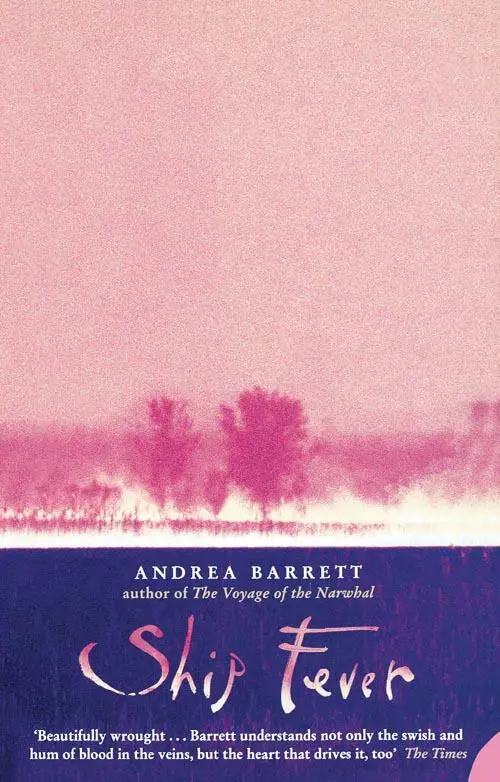
- Название:Ship Fever: Stories
- Автор:
- Издательство:W. W. Norton & Company
- Жанр:
- Год:1996
- ISBN:нет данных
- Рейтинг книги:5 / 5. Голосов: 1
-
Избранное:Добавить в избранное
- Отзывы:
-
Ваша оценка:
Ship Fever: Stories: краткое содержание, описание и аннотация
Предлагаем к чтению аннотацию, описание, краткое содержание или предисловие (зависит от того, что написал сам автор книги «Ship Fever: Stories»). Если вы не нашли необходимую информацию о книге — напишите в комментариях, мы постараемся отыскать её.
).
Ship Fever: Stories — читать онлайн ознакомительный отрывок
Ниже представлен текст книги, разбитый по страницам. Система сохранения места последней прочитанной страницы, позволяет с удобством читать онлайн бесплатно книгу «Ship Fever: Stories», без необходимости каждый раз заново искать на чём Вы остановились. Поставьте закладку, и сможете в любой момент перейти на страницу, на которой закончили чтение.
Интервал:
Закладка:
And of course they had feet, strong and pink and sturdy. The theories about them, Alec learned, had only been misinformation. He was one of the first to see how the islanders, preparing skins for traders, cut off the wings and feet, skinned the body up to the beak and removed the skull, then wrapped the skin around a sturdy stick and a stuffing of leaves and smoked the whole over a fire. This shrank the head and body very much and made the flowing plumage more prominent. Alec prepared his own specimens differently, so that the natural characteristics were preserved. And this absorbed him so completely that only in brief moments, as he fell into sleep, would he wonder about such things as how the golden plumes were related to the emerald disks.
Rain, fungus, aggressive ants, and the ever-ravenous dogs of the region all plagued him. Still, before the fever overcame him and he had to declare his journey at an end, he salvaged four crates of excellent skins and also captured three living specimens. He might not have an hypothesis about the divergence of species, but he knew how these birds lived. At the Smithsonian Institution, where he thought to donate them, he could point to their sturdy pink feet and say, “Look. I was the first to bring these back.”
As he hop-scotched his way across the archipelago to Singapore, he easily found fruit and insects his birds would eat. Little figs they particularly enjoyed, also grasshoppers, locusts, and caterpillars. From Singapore to Bombay he fed the birds boiled rice and bananas, but they drooped in the absence of insect food and after Bombay even the fruit ran out. It was Alec’s good fortune to discover they savored cockroaches, and for him to be aboard a battered old barkentine that swarmed with them. Each morning he scoured the hold and the store-rooms until he’d filled several biscuit-tins, and during the afternoon and evening he doled them out to the birds, a dozen at a time. As the ship headed south to round the Cape he worried that the increasing cold would bother them, but they did fine.
And if, as he learned after being back in Philadelphia for only a month, Wallace had been making his way to England simultaneously, carrying his own birds of paradise; and if Wallace’s trip was shaped by the same quest for cockroaches — what did that matter? Wallace had traveled once more on a comfortable British steamer, aboard which cockroaches were rare; from his forced stops to gather them on land he made amusing anecdotes. But I was the one, Alec thought, who first solved the problem of keeping the birds alive.
From a London paper Alec learned that Wallace had returned to fame, as a result of his Ternate essay. His birds had taken up residence in the Zoological Gardens, where they were much admired. Meanwhile Alec had himself returned, unknown, to a country at war. To a half-country, he thought, which might soon be at war with England. His crates of skins lay uncatalogued at the Academy of Sciences. And the curators at the Smithsonian seemed less than grateful for his beautiful birds. No one had time to look at birds, their eyes were fixed on battles.
Alec wrote to Wallace once more — inappropriately, he knew; their stations had altered, their friendship had lapsed. Still he felt closer to Wallace than to anyone else in the world, and he could not keep from trying to explain himself to this man he’d meant to emulate. After giving the details of his voyage, of his birds and their fate, he wrote:
All of this may be blamed on the war. I cannot explain how bewildering it has been to return, after my long absence, to see what’s become of my country. My mother died during my journey home. All three of my brothers have married, and my father has gone to live with my brother Frank, having lost through improvidence both the tavern and much of the money rightfully mine, which he obtained through trickery from Mr. Barton. Mr. Barton himself is gone, enlisted in the Army. The weather is cold and grey; the streets swarm with pallid people lost in their clothes; the air rings with boys shouting newspaper headlines, over and over again. In the Dyak longhouses, the heads of their enemies hung from the rafters, turning gently as we ate: and I felt more at home with them than here. Do you feel this? When you walk into a drawing-room, do you not feel yourself a stranger?
What I meant to do, what I wanted to do, was to visit Mr. Edwards, whose book sent me off on my life’s work. He is no great thinker himself; only a man who traveled, like me, and described what he saw as I have failed to do. I thought he might help me gather some of my impressions into a book. But now I find that what I must do is abandon my collections, leave home once more, and enlist. The Potomac swarms with a great armada, ready to transport 100,000 men for an attack on Richmond.
As he mailed his letter, he thought about the legend that seemed — even before he left — to be growing up around his presence in the Aru Islands. He’d learned some of the islanders’ language, and had occasionally entertained his companions by lighting fires with a hand-lens, or picking up bits of iron with a magnet, which acts they regarded as magic. And because he asked questions, even laughable questions, about the birds with no feet before he ever saw them; because he knew where beetles might be found and how to lure butterflies to a bit of dried dung; and most of all because he walked alone through the forests, for hours and days, and was comfortable there, and at peace, the islanders ascribed mystical powers to him. The birds, they claimed, came down from the trees to meet him.
One of the boys he hunted with said, “You know everything. You know our birds and animals as well as we do, and the ways of the forest. You are not afraid to walk alone at night. We believe that all the animals you kill and keep will come to life again.”
Alec denied this strenuously. “These animals are dead, ” he said, pointing at a cluster of ants preserved in spirits. “Truly, truly dead.”
The boy looked serenely into a golden glade dense with fallen trees. “They will rise,” he said. “When the forest is empty and needs new animals.”
Alec remembers staring at him; how the jar of ants dropped from his hand and rolled into the leafy litter. The suggestion seemed, in that moment, no more likely or unlikely than what Wallace had proposed for the origin of species: another theory of evolution; another theory. In that instant a line from Wallace’s first letter to him returned and pierced like a bamboo shaft through his heart: Each bird we shot and butterfly we netted was in the service of science.
But this was only ever true for Wallace, not for him, he thinks; he has never been the scientist he’d believed himself to be, perhaps is no scientist at all. And that legend is as false as the moment, on the first leg of his first voyage home, when he hung suspended in joy. All the animals he’s collected, sure that more would spring forth from the earth, are gone and will not rise. But as he packs his bags and readies himself for another murderous journey, they are what he thinks of now. The objects of his desire along the Amazon, in Borneo and Sumatra and Celebes, on the Aru Islands; his sloth, his orangutan, his birds with no feet.
The Marburg Sisters [1. History]
The girls’ mother told them stories: how their grandfather Leo had grafted French vines onto North American roots with his German-Russian hands, finding the western New York winters easy to manage after the Ukraine. At the head of the lake the Couperins, who ran a rival winery, had laughed at Leo’s cultivation practices, but in 1957, when Bianca was born, Leo had his revenge. That winter’s violent cold spell left the Marburgs’ earth-shrouded vines untouched when everyone else’s were killed, and Walter Couperin lost all his hybrid vines and switched back to Concords in a fury.
Читать дальшеИнтервал:
Закладка:
Похожие книги на «Ship Fever: Stories»
Представляем Вашему вниманию похожие книги на «Ship Fever: Stories» списком для выбора. Мы отобрали схожую по названию и смыслу литературу в надежде предоставить читателям больше вариантов отыскать новые, интересные, ещё непрочитанные произведения.








Обсуждение, отзывы о книге «Ship Fever: Stories» и просто собственные мнения читателей. Оставьте ваши комментарии, напишите, что Вы думаете о произведении, его смысле или главных героях. Укажите что конкретно понравилось, а что нет, и почему Вы так считаете.