Andrea Barrett - The Middle Kingdom
Здесь есть возможность читать онлайн «Andrea Barrett - The Middle Kingdom» — ознакомительный отрывок электронной книги совершенно бесплатно, а после прочтения отрывка купить полную версию. В некоторых случаях можно слушать аудио, скачать через торрент в формате fb2 и присутствует краткое содержание. Год выпуска: 2001, Издательство: HarperCollins Publishers, Жанр: Современная проза, на английском языке. Описание произведения, (предисловие) а так же отзывы посетителей доступны на портале библиотеки ЛибКат.
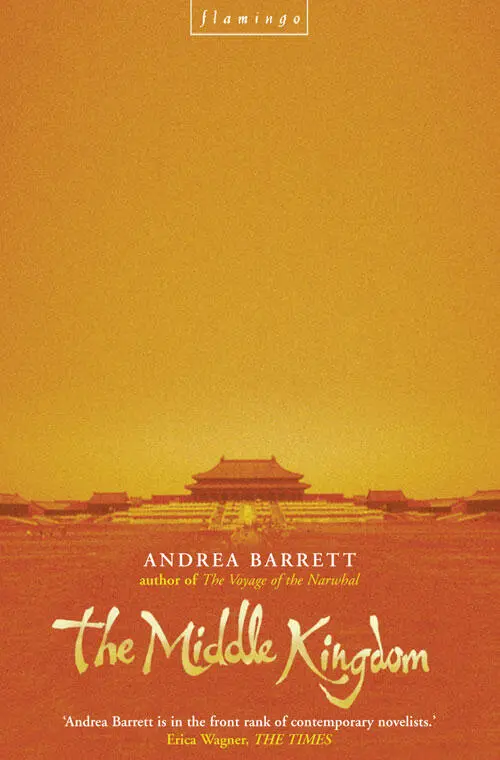
- Название:The Middle Kingdom
- Автор:
- Издательство:HarperCollins Publishers
- Жанр:
- Год:2001
- ISBN:нет данных
- Рейтинг книги:3 / 5. Голосов: 1
-
Избранное:Добавить в избранное
- Отзывы:
-
Ваша оценка:
The Middle Kingdom: краткое содержание, описание и аннотация
Предлагаем к чтению аннотацию, описание, краткое содержание или предисловие (зависит от того, что написал сам автор книги «The Middle Kingdom»). Если вы не нашли необходимую информацию о книге — напишите в комментариях, мы постараемся отыскать её.
Grace Hoffmeier is never quite sure where to invest her energies: in her dying marriage to star scientist Walter or in the possible affairs that flare so startlingly before her like fireworks; in her work or in her home; in things or in people; in the past or in the future.
On an eye-opening trip to a China that has ripped itself apart, yet again, at its very heart in Tiananmen Square, Grace finds — with guidance from unexpected quarters — that what you can choose between is not always your choice to make. The real China soon crackles into being before Grace; its fire and light illuminate for her paths old and new, and a new life in a new kingdom.
The Middle Kingdom — читать онлайн ознакомительный отрывок
Ниже представлен текст книги, разбитый по страницам. Система сохранения места последней прочитанной страницы, позволяет с удобством читать онлайн бесплатно книгу «The Middle Kingdom», без необходимости каждый раз заново искать на чём Вы остановились. Поставьте закладку, и сможете в любой момент перейти на страницу, на которой закончили чтение.
Интервал:
Закладка:
‘Walter?’ I said. ‘But Walter’s fine.’
‘Just to be sure,’ he said.
We had tested my urine, my blood, and my tubes; now we tested Walter’s urine and blood and finally his semen. The doctor spent two weeks trying to convince Walter to submit to this indignity. A magazine full of naked women, a darkened room, a small plastic jar. A sperm sample. A week later, Walter and I returned to the doctor’s office and sat in upholstered chairs pulled up to a broad teak desk.
‘Grace’s infection has responded well to therapy,’ the doctor said. ‘Her left ovary is scarred, but her right one is fine. There’s no reason she can’t conceive in time.’
Walter turned to me and touched my arm, a light tap meant to indicate his forgiveness and to erase all his silent accusations.
‘Unfortunately,’ the doctor said. He cleared his throat and turned to Walter. ‘Unfortunately, your sperm count is extremely low. But there are still possibilities. We can chart Grace’s ovulations carefully, to maximize the chances of successful intercourse. And there are some techniques we can explore to increase the number and motility of your sperm …’
We left the office in a gray, dazed silence. Outside, the streets seemed filled with parents and children, pregnant women, young men proudly carrying infants in canvas pouches pressed against their chests. Two boys flew by on skateboards and Walter, clipped by a set of rear wheels, stumbled and fell to the ground. He tore his trousers and skinned his knee, and when I tried to help him up he batted my hand away.
‘I’m sorry,’ I said, as gently as I could. ‘It’ll be all right.’
‘Just leave me alone,’ he shouted. ‘Just leave me be.’
All around us people turned and stared curiously. Walter lay crumpled on the curb, dabbing at his knee with his handkerchief. I leaned over him, pale and troubled, while the leaves in the gutters moved gently with the wind.
A Yellow Tie
After that fall, the balance of power in our household shifted slightly. I had betrayed biology and the academic world; I had concealed my abortion and my failure to love science. But. But. But it was Walter’s body that kept us from making a child. We had come to a joint in our marriage, a sort of elbow where all that we’d wanted and been took off in a new direction, and nothing was easy between us after that.
Walter called me deceitful. I called him cold. He was hurt that I didn’t want to be his assistant and student forever, and I was hurt that all he wanted of me was that, and we weren’t able to make the child who might have bridged our differences. And we never talked about any of this, because Walter became famous that year. The work that made his reputation had actually been completed at the Quabbin, where the bats had driven us together. But in the two and a half years since then, Walter had published ten papers with my help, and the media people seized on him as acid rain became hot news. It turned out that Walter’s sharply boned face and expressive hands looked good on TV.
I’d drawn the elegant graphs linking reproductive cycles and lake acidity. I’d translated his scribbled notes into clean, clear sentences, deciphered the cryptic instructions each journal gave for the preparation of manuscripts, typed the final drafts. When Walter practiced his talks, I’d been his audience, following his retractable pointer as he traced his way through the figures projected on our darkened living room wall. I’d been the kind of assistant every scientist dreams of — docile, diligent, cheap — and I stood aside as Walter was tenured, promoted to full professor, and placed in charge of a laboratory with six graduate students, three postdoctoral fellows, and a budget that ran into hundreds of thousands of dollars each year.
All through our marriage I’d kept Walter’s house warm and welcoming, cared for his clothes, paid his bills, dealt with minor repairs. I’d shopped and cooked and cleaned and entertained his students, made feasts when scientists visited from other countries. I’d been Walter’s wife before, but I hadn’t been only his wife — although Walter’s colleagues had gossiped (I was young, I was blond, I wasn’t Eileen, whom most of them had known), while I was still in school they had treated me with the same fond encouragement they gave their own students, tempered with the extra respect due Walter’s mate. But after I dropped out, no one seemed to know how to handle me. Walter became a power just about the time I gave up science, and his colleagues assessed the situation and adjusted their attitudes accordingly.
Oh, my social stock plummeted that year. Suddenly I was just a wife, just a second wife at that, and our guests gently condescended to me when a quirk of dinner seating or party movement forced them near me. ‘But what are you doing? ’ the bolder ones asked.
‘Resting,’ I answered sometimes. ‘Recuperating. Taking a break.’
When I felt less sure of myself, I said, ‘I’m looking for a job.’
When I’d had too much to drink and felt snippy and cross, I lied and said, ‘I’m trying to get pregnant.’
That always shut people up, and as the year wore on they seemed to get used to my idleness. I painted the living room and redid the downstairs bathroom; once in a while I helped Walter prepare a manuscript. I threw elaborate dinner parties and tried recipes I’d gotten from library books: Moroccan Chicken. Moussaka. Pot au Feu. In March, Walter said, ‘You know, you only took a leave of absence. You could reapply for the fall,’ and he frowned when I told him I wasn’t ready yet.
‘I have a lot to think about,’ I said.
‘Like what?’
‘Like what I’m going to do with the rest of my life. If we’re not going to have kids …’
He paled, and I knew he felt reproached again. ‘We could adopt,’ he said. ‘If there’s nothing else you want in this world …’
But I couldn’t imagine how any child not our flesh and blood could fill the gap between us. We set that question aside, and as Walter’s life grew even busier, we stopped talking about it. Finally Walter arranged for me to see a therapist at the University Health Service. ‘I’m worried about you,’ he said. ‘I’m worried about us. We need to work out this baby thing, and you need to decide what you want to do …’
I went, but I hated it. My doctor was a woman, dry and aloof, whom I couldn’t warm up to at all. Dr Amadon sat in a swivel chair, her short legs neatly crossed, and she asked me where I saw myself in twenty years.
‘On the street,’ I told her bitterly. And that was true, that was all I could see. When I thought of Page, whom I no longer saw, I imagined her sailing through graduate school, through a fellowship somewhere, finally off in a lab of her own and running a part of the world the way Walter did. But when I pictured the life ahead of me, I saw nothing. ‘Wearing all my clothes at once,’ I said. ‘With everything I own in a shopping bag.’
‘That’s what you want?’ she said. ‘To be a bag lady?’
‘That’s what I see,’ I told her. ‘I’m twenty-seven already. I’m not trained to do anything. Everything I have belongs to Walter.’
I never told her about the voices I was beginning to hear inside my head, or about the sense I sometimes had, walking down the street, that my skin had turned permeable. I felt myself leaking out my pores, and I felt other lives leaking in, and it scared me so badly I threw all my energy into finding something to do. Work, I thought. That was what I needed. Any work, anything that would catch me the way Walter’s work had caught him and provide that crisp glaze of purpose and separateness.
On my third visit, Dr Amadon asked me why I stayed with Walter, and instead of answering I left her for good. I went out to the car Walter had bought me, a new orange Subaru with a flashy white stripe down the side, and I turned up the radio and headed for Belchertown, for the tip of the reservoir. Since the doctor had delivered his bleak news, I’d taken to keeping secret foods in the car, which I used as a mobile diner; as I drove I ate my way steadily through a box of chocolate-mint Girl Scout cookies and thought how even the girl who’d sold them to me had something to do.
Читать дальшеИнтервал:
Закладка:
Похожие книги на «The Middle Kingdom»
Представляем Вашему вниманию похожие книги на «The Middle Kingdom» списком для выбора. Мы отобрали схожую по названию и смыслу литературу в надежде предоставить читателям больше вариантов отыскать новые, интересные, ещё непрочитанные произведения.











Обсуждение, отзывы о книге «The Middle Kingdom» и просто собственные мнения читателей. Оставьте ваши комментарии, напишите, что Вы думаете о произведении, его смысле или главных героях. Укажите что конкретно понравилось, а что нет, и почему Вы так считаете.