Raja Alem - The Dove's Necklace
Здесь есть возможность читать онлайн «Raja Alem - The Dove's Necklace» весь текст электронной книги совершенно бесплатно (целиком полную версию без сокращений). В некоторых случаях можно слушать аудио, скачать через торрент в формате fb2 и присутствует краткое содержание. Год выпуска: 2016, Издательство: The Overlook Press, Жанр: Современная проза, на английском языке. Описание произведения, (предисловие) а так же отзывы посетителей доступны на портале библиотеки ЛибКат.
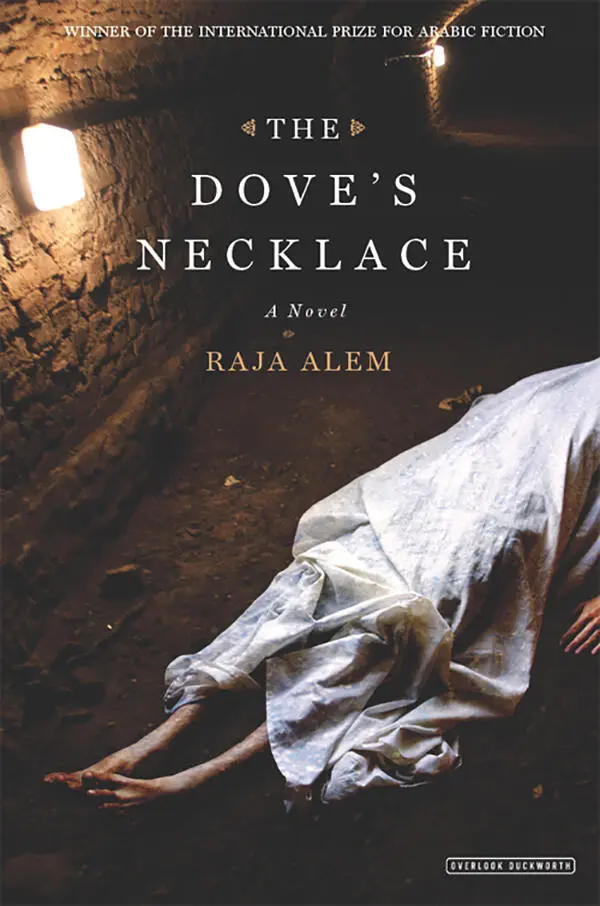
- Название:The Dove's Necklace
- Автор:
- Издательство:The Overlook Press
- Жанр:
- Год:2016
- ISBN:нет данных
- Рейтинг книги:4 / 5. Голосов: 1
-
Избранное:Добавить в избранное
- Отзывы:
-
Ваша оценка:
The Dove's Necklace: краткое содержание, описание и аннотация
Предлагаем к чтению аннотацию, описание, краткое содержание или предисловие (зависит от того, что написал сам автор книги «The Dove's Necklace»). Если вы не нашли необходимую информацию о книге — напишите в комментариях, мы постараемся отыскать её.
Tackling powerful issues with beautiful and evocative writing, Raja Alem reveals a city-and a civilization-at once beholden to brutal customs, and reckoning (uneasily) with new traditions. Told from a variety of perspectives-including that of Abu Al Roos itself-
is a virtuosic work of literature, and an ambitious portrait of a changing city that deserves our attention.
The Dove's Necklace — читать онлайн бесплатно полную книгу (весь текст) целиком
Ниже представлен текст книги, разбитый по страницам. Система сохранения места последней прочитанной страницы, позволяет с удобством читать онлайн бесплатно книгу «The Dove's Necklace», без необходимости каждый раз заново искать на чём Вы остановились. Поставьте закладку, и сможете в любой момент перейти на страницу, на которой закончили чтение.
Интервал:
Закладка:
AS USUAL, SHE HUNG HER MIRROR ON THE BACK OF THE DOOR, HER FACE LIT BY THE streetlamps, and began to make herself up. The eyelashes of her left eye fluttered as she ran the kohl over them and suddenly she felt something watching her in the darkness. She dared not turn around. For a second, she thought her time had come — that after the murdered woman her turn was next, that the hidden killer had come looking for her. The kohl hardened in the corners of her eyes. The death ritual replayed itself in her mind like a video: She’d washed that afternoon, and her hair, which she’d tied into a bun behind her head, still smelled of Abu Ajala soap. She’d performed her ritual ablutions before squeezing into the outfit the wedding planner had sent over. It covered her from tip to toe and had a white apron that tied at the waist and draped to her knees like folded wings; it matched what the rest of the servers would be wearing. She didn’t have to worry about being unclean, she thought; she was as ready for death as you could be. If only this person who’d snuck up on her in the dark had given her the chance to pray the evening prayer: four obligatory sets of prostrations plus two extra for supererogatory blessings. If only he’d done it while she was prostrate in prayer. But it occurred to her that dying on her prayer rug on all fours, like an animal, would leave all her curves exposed to the eyes of the policemen who’d come to find her body. Even if dying in prayer was the quickest way to enter heaven. For the first time, she understood the wisdom of her grandmothers’ prayers: “God grant us a good ending!” She thought she should repent, but in that gossamer limbo between life and death she couldn’t think of anything she had to repent for. In her mind’s eye, she could see the image of that specter, the visitor who used to appear at night in the Lane of Many Heads back before they’d found the body.
Halima drove that madness from her mind and focused on her tongue. The tongue is a secret portal that can open up under a Muslim’s feet at any time, plunging them down into the lowest circles of hell. Her grandmother had driven that image into her memory. There was no way she could repent for every rude thing she’d ever said. Instead she thought back on that bag of high heels she’d come home with one night. They were given to her by a woman in a car that was worth as much as the whole Lane of Many Heads neighborhood itself.
“Pray for Khalid Bin Nura, Auntie dear,” the woman had bent down and whispered to Halima, who was sitting on the floor in front of the Abu Dawoud Mall selling pots of waxing sugar. She motioned to her driver to give the bag to Halima.
Halima’s tiny feet were swimming in those size thirty-nines but she didn’t let that stop her. She stuffed each shoe with cotton so she could strut around like a peacock at weddings, and she generously let the neighborhood girls borrow them, too.
She had no idea who was weighing her soul down with all these heavy thoughts at precisely the moment when she needed to concentrate on one simple thing, one simple sentence. Out of the darkness emerged the figure of a man. “I testify that there is no god but God and that Muhammad is his prophet!” The profession of the faith had scarcely burst out of the lump in Halima’s throat when she recognized Mu’az. “You scared me, God damn you!” She noticed how thick his eyelashes looked, and he cut her off:
“Yusuf is in a safe place, Auntie Halima. He asked me to check on you.”
“Thank God, thank God a million times. Does he have enough to eat? Does he have enough to drink? Is he feeling well? Is that electric in his brain keeping him up at night? Is he sleeping?” The whole neighborhood was used to Halima worrying about her son’s sleep and the electrical activity in his brain. “How about his metal knee? Is he keeping it warm? Take him some Zamzam water that prayers have been read over. And give him this.” She reached three fingers into her cleavage to pull out some rolled-up banknotes and pressed them into Mu’az’s palm.
He looked her up and down. “My, my Halima, bird wings and high heels?” he teased.
“If the job demands it.”
“Give me one of your outfits. I can put a veil on and come help you.”
“No boys allowed.”
“I’ll come as your little assistant boy and help carry your stuff. I can just peek through the door.”
“You call the prayers and you’ve memorized three-quarters of the Quran and you’re sharp enough to steal the kohl off an eyelid — and now you want to come peep at girls?”
“Just from the doorway. I want to see what an eight-star hotel looks like on the inside. I want to see what Mecca looks like from a skyscraper. I promise you I’ll look down at my feet the whole time. I’ll only look up to see the sky.”
“Everything in the neighborhood’s topsy-turvy now. I don’t know what to think. Even you all, sons of the imam! You’re not like you used to be.”
His pure eyes stared straight into her own and pleaded. For a moment she looked to him like the very embodiment of tragedy. Her deep-set eyes were like graves for her husband and son, the whole neighborhood even. He could have lain down to die in one of her all-enveloping eyes. Tragedy stopped at her neckline, however. Maybe if he’d been able to picture one of those great big breasts, he’d have enjoyed a glimpse of paradise, the promised land of milk and honey.
She draped her veil over her face. She didn’t permit him, nor did she forbid him, so he followed her in silence. They walked down the alley amidst barking dogs and jangling music videos.
It was night. He was all in black and she wore heels with flashy diamante buckles on the side. They got into Khalil’s cab. The scent of olive-oil soap preceded her into the back seat. Khalil turned the car over robotically and set off into the Meccan night, smirking with menace, searching for what to say to annoy Mu’az.
“So,” began Halima, “How do you like being married?” It was the question all of the Lane of Many Heads had been wanting to ask ever since they attended his wedding to Ramziya the sewage cleaner’s daughter. The question came as a shock.
This woman was the definition of a trooper, he thought to himself. Nothing — not a body, not the disappearance of her son or beloved — nothing could put an end to the rituals of her life. Here she was, made up and tottering on high heels off to a wedding, and asking him about his bride.
“Well, to tell you the truth, Auntie—”
“Now don’t you start complaining!” she warned him with her usual giggle.
He couldn’t help but laugh.
“I haven’t laid eyes on Ramziya since we got kicked out of the Arab League. I sent her back to her father’s house and I started living in this cab.” His voice conveyed a mixture of relief and sadness as they drove through the al-Zahir district.
“Khalil, don’t just abandon her like a house that’s been left to someone in a will. God will curse you for wronging her!”
“My body’s been sucked into a void and my mind’s in a different space altogether. Please, Auntie, stop giving us headaches with this curse business. I’m a man and I won’t be beat. I defeated cancer. Doctors in the U.S. said I was a miracle case. It had spread through my stomach despite the intense chemotherapy, and they’d given up hope.” Khalil looked at himself in the rearview mirror and ran his hand over his hair, which had grown back sparsely after his treatment. “I was determined to make the angel of death choke on my dust. I fought back with yogurt and garlic, clinging to life like a flea on the back of a bull. I drank buckets of that stuff. One morning I woke up and discovered the cancer vanished. It was a miracle. The will to live can make miracles out of Moses’ staff, or yogurt, even. But it’s not working at the moment, now that I’ve got Azza eating away at me. She keeps metastasizing. And Ramziya’s like a bucket of garlic, burning up all my cells, benign and malignant together.” Khalil’s expression was all bitterness now. Everyone knew that the chemotherapy had left him infertile. The day he went to ask Yabis for Ramziya’s hand he surprised everyone with an award-winning performance.
Читать дальшеИнтервал:
Закладка:
Похожие книги на «The Dove's Necklace»
Представляем Вашему вниманию похожие книги на «The Dove's Necklace» списком для выбора. Мы отобрали схожую по названию и смыслу литературу в надежде предоставить читателям больше вариантов отыскать новые, интересные, ещё непрочитанные произведения.





Обсуждение, отзывы о книге «The Dove's Necklace» и просто собственные мнения читателей. Оставьте ваши комментарии, напишите, что Вы думаете о произведении, его смысле или главных героях. Укажите что конкретно понравилось, а что нет, и почему Вы так считаете.