Raja Alem - The Dove's Necklace
Здесь есть возможность читать онлайн «Raja Alem - The Dove's Necklace» весь текст электронной книги совершенно бесплатно (целиком полную версию без сокращений). В некоторых случаях можно слушать аудио, скачать через торрент в формате fb2 и присутствует краткое содержание. Год выпуска: 2016, Издательство: The Overlook Press, Жанр: Современная проза, на английском языке. Описание произведения, (предисловие) а так же отзывы посетителей доступны на портале библиотеки ЛибКат.
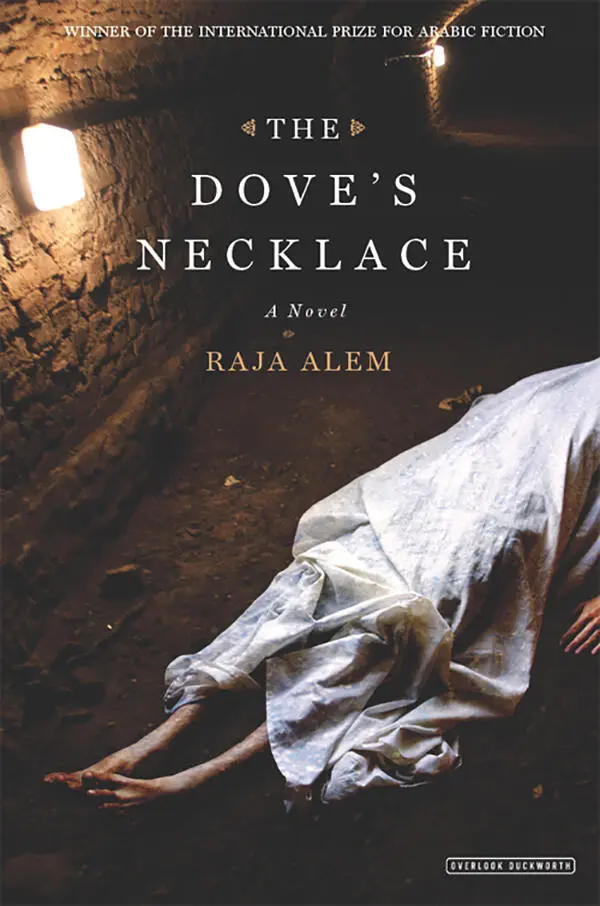
- Название:The Dove's Necklace
- Автор:
- Издательство:The Overlook Press
- Жанр:
- Год:2016
- ISBN:нет данных
- Рейтинг книги:4 / 5. Голосов: 1
-
Избранное:Добавить в избранное
- Отзывы:
-
Ваша оценка:
The Dove's Necklace: краткое содержание, описание и аннотация
Предлагаем к чтению аннотацию, описание, краткое содержание или предисловие (зависит от того, что написал сам автор книги «The Dove's Necklace»). Если вы не нашли необходимую информацию о книге — напишите в комментариях, мы постараемся отыскать её.
Tackling powerful issues with beautiful and evocative writing, Raja Alem reveals a city-and a civilization-at once beholden to brutal customs, and reckoning (uneasily) with new traditions. Told from a variety of perspectives-including that of Abu Al Roos itself-
is a virtuosic work of literature, and an ambitious portrait of a changing city that deserves our attention.
The Dove's Necklace — читать онлайн бесплатно полную книгу (весь текст) целиком
Ниже представлен текст книги, разбитый по страницам. Система сохранения места последней прочитанной страницы, позволяет с удобством читать онлайн бесплатно книгу «The Dove's Necklace», без необходимости каждый раз заново искать на чём Вы остановились. Поставьте закладку, и сможете в любой момент перейти на страницу, на которой закончили чтение.
Интервал:
Закладка:
Serpent of Serenity
I T WAS TEN IN THE MORNING WHEN THE SUN’S LIGHT WOKE YUSUF, WHO’D BEEN lying against a pillar by Farewell Gate. He looked around him in panic, but there was nothing there except the huge air-conditioning unit humming away and flocks of doves around the Kaaba. He was careful not to look in the direction of Abu Qubays, frightened at the thought of seeing the bier as he’d seen it yesterday, swinging in mid-air. For a moment he stayed there crouched like an animal on all fours, pinned down by an orphanhood so disturbing it was like there was a void where his heart and belly should be. He didn’t want to think how long Adam, Eve, and Seth would remain swinging in the air or in the emptiness inside him.
He sensed a pilgrim eyeing him up in his crouching position, so he struggled to his feet and staggered to the taps of Zamzam to the side of the Mas’a, the very spot where he and the key thief had come to blows. After having been cordoned off for several days, the area had been re-opened and the taps once again distributed the flowing water that was free to all, as they had throughout Mecca’s entire history.
Yusuf splashed water from the Well of Zamzam on the back of his neck and dampened his aching heart before purifying himself for prayers. He headed toward the Hijr of Ishmael, the part of the Kaaba that’s not covered over, where people could get a taste of what it was like to be inside the House of God. Stealthily, he pressed his body against the black cloth embroidered with verses from the Quran and closed his eyes, sinking his face into the stone between two of God’s names: “The Greatest” (a disguised name) and “The Everlasting” (a revealed name), so that his pursuers would lose sight of him. He knew that if he ever left the Kaaba they would be able to see his nakedness. He hid his face where Hagar lay beneath the rain-sluice and where breezes of agarwood and ambergris emanated from the cloth covering the Kaaba. His pulse and his nervous system slowed, taking his body to within reach of death. He waited for the serpent, over whose body the foundations of the Kaaba had been laid, to encircle him, waited to see it just as it appeared to Ibn Saj: it had the head of a cat, and wings; it could talk, and it moved like a delicate breeze. It had come from Armenia with Abraham, Friend of God, who’d been led by an angel to the site where he would rebuild the House of God. When they eventually arrived in Mecca, they found Ishmael, who was just twenty at the time and who’d long since buried his mother in the spot now known as the Hijr of Ishmael. The angel showed Abraham the location of the House, and he and his son Ishmael began to dig, looking for the foundations. They hit huge foundation stones, emeralds the size of a camel that not even thirty men together could move: the first foundation stones ever laid by the descendants of Adam. As they built over the foundation, the Angel Sakina — Serenity — came forward and coiled itself over the foundation and cried, “Build the House over me, Abraham!” So he did. That’s why whoever circumambulates the House of God, be they timid Bedouin or fearsome giant, is filled with the same engulfing sense of serenity.
Yusuf could have stayed there all day and night were it not for the guard’s hand upon his shoulder: “Make some space for your brother Muslim.” Yusuf remained still for a moment; suddenly, he felt a sweaty hand slip into his pocket. He was torn from the grasp of the snake of serenity. He opened his eyes and looked around him; there was no one there other than an elderly man rocking back and forth as he made his rotation, repeating, “God Everlasting!” Yusuf didn’t dare touch his pocket. He flew on the wings of that snake back to the colonnade, where — heart pounding, fingers trembling — he slid his hand in his pocket and drew out a small piece of paper folded around a tiny key. The paper was damp and the ink had run, but he could just about make out the words “Locker 27.” Yusuf was shaking. His loitering was no longer something he’d chosen for himself; he’d become part of the plot that Mushabbab had dreamed up. He knew instantly that the key would lead him to a point from which there was no hope of return.
Locker 27. He racked his brains, trying to work out where the locker might be. By the entrances to the mosque, there were shelves where worshippers stored their shoes, but they didn’t have doors or locks. They were open for anyone to use … Without thinking, he hurried through Ajyad Gate toward King Fahd Gate, which had recently been added as part of the expansion of the Sanctuary complex. With the Tawhid Intercontinental Hotel to his left, he made for the modern building that served as a cloakroom, a tall aluminum-encased construction with a glass edifice set in the middle of the marble plaza. He wanted to test his hunch.
The dark-skinned doorman stopped him at the entrance: “Locker number, please.” Yusuf fished the slip of paper marked with the number 27 out of his pocket. The attendant took it from him and led him to a locker at the very end of the row. Blood thumped against his temples, and the attendant could see he was shaking. Yusuf stiffened: in front of him inside the open locker was the silver amulet, a locket shaped like a half-moon. The sight of it, lying there, threw the switch on Mushabbab’s conspiracy theory. The day the body had turned up, he’d confided to Yusuf that he had documents he was going to hand over to them, not on a tray, but in a silver amulet. At the time Yusuf hadn’t paid any attention to what he assumed was a metaphor, but now he’d come face to face with the amulet. There was no time to lose. He had to get the evidence out of Mecca.
Mushabbab had warned him: “When the amulet comes into your possession, call me on this number and I’ll guide you to where I am. Any delay could cost you your life.” Mushabbab had been sure to get ready for the challenge. The whole time Yusuf thought that the supposed appearance of the amulet was just a storyline out of a cartoon, but the amulet in front of him turned the game into a nightmare.
The faint rustling caused the cloakroom attendant to crane his neck to sneak a glimpse into the locker; he was taken aback by the silver amulet inside. Yusuf hurriedly stuffed it into a paper bag and scurried away. The attendant’s gaze was following Yusuf’s thin form as he hurried toward Misyal Street in Misfala when two men — their faces hidden by their red-checked headscarves — swooped past him on a motorcycle. The man riding behind ripped the package out of Yusuf’s hands and shoved him into the path of an oncoming bus as the motorcycle sped away and was lost from sight. The bus, brakes squealing, screeched to a halt, and Yusuf, who was almost between its front wheels, leapt to his feet. The scene, which had lasted only a few seconds, was over. When the cloakroom attendant’s shock wore off and he took a look around him, it seemed none of the passersby had noticed anything; even Yusuf had disappeared.
In a narrow side-street, Yusuf stood panting. He found a phone kiosk and dialed the number.
“They stole it off me.” Silence. Yusuf’s plans for escape crumbled before his eyes.
“Maybe we rushed. We missed things … We need to take a few steps back.” His instruction to Yusuf to lie low seemed insufficient. They both knew that it was only a matter of time until he was run over — though by which set of tires and from which direction they’d be coming was anybody’s guess.
The Pilot
I F THEY’D INTERROGATED ME UNDER OATH, I’D HAVE SAID THAT KHALIL WAS THE killer. The tricks he played on his passengers were beyond even Nasser’s twisted imagination. If only he’d consulted with me before summoning Khalil for interrogation … But then Nasser wasn’t capable of forcing a spiteful old alleyway like me to snitch on a head that was like a novelty decoration among my other miserable faces. Khalil was fun to watch, to observe, to challenge and hate, and if it weren’t for him, life would’ve been depressing. To me, Khalil belonged to some cyborg race, and nothing entertained me more than his blind tenacity. He’d simply been programmed. I’d watch him slipping along like a thin, glistening water snake, taking care not to go near any of my filthy corners. This snake didn’t want to have anything to do with me, holding his breath and sticking out his chin as he moved along. He’d stop under Azza’s window, take a deep breath, and repeat his oath—“Either I’ll have you, or the Angel of Death will”—then he’d continue on his way to her father’s store. Sheikh Muzahim never invited him to sit down, never reached out to turn over a cup and pour him some coffee, so Khalil always repeated his request for Azza’s hand standing up, and he continued to do so even after he’d married Ramziya, Yabis’ daughter. At times like that the signs of madness would show on Khalil’s face: a deeply buried disfigurement rose to the surface along with an anger vicious enough to tear your insides apart. Have I mentioned that I was rather proud of this Khalil? No doubt every sensible head resting on my shoulders will despise me for that slip of the tongue. Let’s just say he was the best at Action and Horror. His thirst for sadism certainly did make me uncomfortable, as did his noble descent and family history, and the way he identified with machines like the taxi he earned his living from part-time. In truth, it was a vehicle of deportation, and I felt as if he were draining me, the Lane of Many Heads. His withering looks left scars on my pride. Nevertheless in my mean old age I spend my nights feigning interest in his nostalgia, listening to him resurrect in obsessive-compulsive detail the legend of his father Nuri bin al-Hadrami, known to one and all as The Pilot because he was so very well-traveled. I’m supposed to listen enraptured while he goes on and on, staring at a photo of charming, sunny Nuri, gray adorning his jet-black locks. He went down in history as the first gentleman to bare his head in a public gathering. Every day, from afternoon prayer till midnight, he would hold court — as if a king — from the first-floor balcony of his large house, which was jam-packed with aunts, uncles, and grandparents, and look out over the Sanctuary complex amidst the spellbinding melodies of the famous Taher Catalog’s endless oud playing. Mecca’s men of note would pass by to greet him, or simply linger to listen to the jokes and hearty laughter that rained down from the balcony onto the Sanctuary. Nobles and common people alike would stay up half the night listening to his many stories about the magic of the Nile and its naiads, who dissolve pearls in flutes of champagne for their lovers to sip and light cigarettes rolled from green banknotes. His wild stories were shocking and they multiplied; passersby below would catch refreshing breaths of them, and they would drift through Qarara Hill and Shamiya Hill. The whole city fell under charming Nuri’s spell. They followed his every move. Like how in the pilgrimage season, he’d uproot his entire family tree — branches, leaves, and all — and plant them on the roof while he rented out his castle to visiting pilgrims. That brought in enough to last him the whole year. That was until eventually charming Nuri was lost to the nymphs of the Nile for good. His only son failed to fulfill his dream of becoming a pilot, and poverty dragged Khalil and his sister unceremoniously from their balconies on affluent Qarara Hill all the way to where the Lane of Many Heads gave them refuge. My arms are always spread wide to accommodate the dregs of reputable families who have fallen on hard times.
Читать дальшеИнтервал:
Закладка:
Похожие книги на «The Dove's Necklace»
Представляем Вашему вниманию похожие книги на «The Dove's Necklace» списком для выбора. Мы отобрали схожую по названию и смыслу литературу в надежде предоставить читателям больше вариантов отыскать новые, интересные, ещё непрочитанные произведения.








Обсуждение, отзывы о книге «The Dove's Necklace» и просто собственные мнения читателей. Оставьте ваши комментарии, напишите, что Вы думаете о произведении, его смысле или главных героях. Укажите что конкретно понравилось, а что нет, и почему Вы так считаете.