Raja Alem - The Dove's Necklace
Здесь есть возможность читать онлайн «Raja Alem - The Dove's Necklace» весь текст электронной книги совершенно бесплатно (целиком полную версию без сокращений). В некоторых случаях можно слушать аудио, скачать через торрент в формате fb2 и присутствует краткое содержание. Год выпуска: 2016, Издательство: The Overlook Press, Жанр: Современная проза, на английском языке. Описание произведения, (предисловие) а так же отзывы посетителей доступны на портале библиотеки ЛибКат.
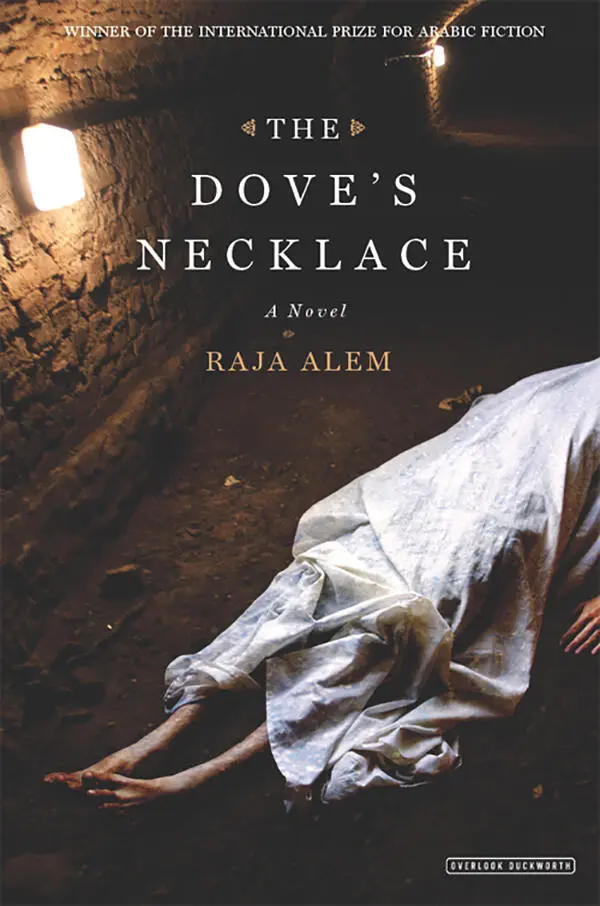
- Название:The Dove's Necklace
- Автор:
- Издательство:The Overlook Press
- Жанр:
- Год:2016
- ISBN:нет данных
- Рейтинг книги:4 / 5. Голосов: 1
-
Избранное:Добавить в избранное
- Отзывы:
-
Ваша оценка:
The Dove's Necklace: краткое содержание, описание и аннотация
Предлагаем к чтению аннотацию, описание, краткое содержание или предисловие (зависит от того, что написал сам автор книги «The Dove's Necklace»). Если вы не нашли необходимую информацию о книге — напишите в комментариях, мы постараемся отыскать её.
Tackling powerful issues with beautiful and evocative writing, Raja Alem reveals a city-and a civilization-at once beholden to brutal customs, and reckoning (uneasily) with new traditions. Told from a variety of perspectives-including that of Abu Al Roos itself-
is a virtuosic work of literature, and an ambitious portrait of a changing city that deserves our attention.
The Dove's Necklace — читать онлайн бесплатно полную книгу (весь текст) целиком
Ниже представлен текст книги, разбитый по страницам. Система сохранения места последней прочитанной страницы, позволяет с удобством читать онлайн бесплатно книгу «The Dove's Necklace», без необходимости каждый раз заново искать на чём Вы остановились. Поставьте закладку, и сможете в любой момент перейти на страницу, на которой закончили чтение.
Интервал:
Закладка:
The negotiations finally came to an end with a long sigh and the stylist took out his scissors. Decisively, like a sculptor bringing to life the image in his head, he cut a line upward from the back of Nora’s neck to the top of her head. Nora’s hair fell to the floor like a curtain. The cleaning lady hurried to gather it up and laid it on the table like a dead body. Nora had one sentence in her head: “Blocking the way back.” She scored it onto the forehead of the woman facing her in the mirror. A stylish French bob that fell over her left cheek to just below her chin and was almost shaved at the back. Dawdling outside the salon, Rafi was struck by her lightness when she emerged.
Rushing happily, almost hysterically, ahead of him, flying on her new bangs, she asked him to take her to the Reina Sofia; Rafi hid his pleasure at her response to the suggestion he’d made. Now and then he stole glances at the radical departure in her silhouette.
The first artwork to greet her when she entered was an installation: two lines of half-columns forming a colonnade like a tunnel, down which a figure in a black habit halfway between a monk’s and a clown’s was making his way. The artist had captured him in a hurry.
“Look at the eyes,” said a young man in English, embracing his girlfriend theatrically. Nora looked. At first glance they reminded her of a pair of eyes she knew well but whose name escaped her. Rafi followed her like a shadow. She submitted to the eyes of the monk, which were looking into another world, at beings other than the beings they knew, and for a moment she lost all sense of who she was and found herself in the place where he was looking.
“This is quite a well-known artist.” The voice speaking Arabic pulled her back. When she turned around discreetly, she saw a photographer, holding a camera, with his girlfriend. “He disappears in the Far East for months at a time, staying in forgotten, impoverished villages and up in the mountains, then reappears with eyes that say nothing, but tell hidden truths about us, ordinary people. With just one look into those eyes you see hidden truths inside yourself and in the outside world.”
In a desperate attempt to recover what she’d seen, Nora slipped between the columns and began walking down the colonnade toward the monk-clown, to look into his eyes, when one of the museum guards noticed her and intervened politely, “Excuse me, ma’am, no walking inside the installation, please.”
She couldn’t go on. She rushed through the upper floors like a wind sweeping across those artistic visions, storing them. Her head was empty; she had to build new cultural reference points out of the mountains of knowledge around her, snatching handfuls of context. But the edifice she was building was so frail, and it didn’t bear the names of its creators, nor their biographies or dates, like the artwork she was looking at now. She didn’t know how to read the name of an artist and place them mentally, or glance at the production date and identify the movement they belonged to. She just looked and absorbed the spirit of the work, decontextualized. After all, she herself was fleeing from her context, and a fragile culture. Before leaving, Nora stopped in the museum bookshop to look; she bought a book called Vitamin P: New Perspectives in Painting , which Rafi had hesitated over for quite a while before suggesting it to her. When she flicked through it quickly, she felt even less burdened, faced with that quantity of names and artistic movements. That map of knowledge, and the destruction of that knowledge in comparison with the one torn page that was the sum of her knowledge and which twisted and turned and ruminated like an isolated, veiled alley, busy with its veils, like women whose patience had deserted them. Defensively, Nora conjured in her heart her own vast spiritual map, which bore dates steeped in nobility and antiquity, but she couldn’t express it or turn it into a currency valid for any human exchange.
That night, alone in bed, Nora heard a faint sound, the sound of a shutter quickly opening and closing, coming from the edge of the pillow. When she looked round in her dream, she couldn’t see anyone, but there were light footsteps heading for her, the light footsteps of a threatening wind, so she began to run. The footsteps were chasing her. The world looked like theater curtains and paper backdrops showing scenes she knew, but she didn’t slow down to look at them or examine their details. Her body was pushing onward at high speed, bursting through the backdrops and leaving them torn behind her. Whenever she wanted to clutch at something in the furnishings or images, the footsteps chasing her sped up, her panic flared, and her lungs threatened to explode. She stopped to take a breath and glanced behind her, glimpsing the owner of the footsteps — a thin young man whose dark complexion contrasted with the bright white of his sneakers and his radiant smile. He didn’t say anything to her; she only had time to glimpse him before the scene froze and the backdrops suddenly lost their relevance, Nora falling in among them like an apparition. The young man came closer and squatted at her feet, pointing his camera and smile right at her. He snapped a shot then ran away again. He seemed to her to be crossing the earth by foot to return to his own remote country.
She awoke in the morning with an emptiness in her chest where the photographer boy had taken his shot.
Between Two Mosques
N ASSER COULDN’T REMEMBER WHEN IT WAS HE’D LAST SLEPT. HE HALLUCINATED, eyes wide open, as he drove. He could hear a voice mocking him: “You’re addicted to medals, aren’t you?” He was driving through Bahra when toilet paper overwhelmed him suddenly. He was remembering the most important advancement in his career, which had been thanks to Bahra, this village on the old Mecca — Jeddah road. His investigation had grown out a rumor that was going around about an illegal recycling plant run by a gang of infidels, who were turning old school books and newspapers into toilet paper that was carcinogenic.
“You’re lying on my blood,” Aisha’s voice breathed directly into his chest. He woke, terrified, and found himself driving through the martyrs of the Battle of Badr. “I lay here waiting for an ambulance. I felt no pain. I looked at the bones protruding from my broken pelvis through torn flesh; it appeared and sat beside me for hours while I waited. There’s a delicate body that emerges from our bodies to save us if we experience a trauma: it gathers our broken limbs and sits with them, far from all pain — it chooses a spot as far as possible from the pain for us to sit together. It sat with me all through the night, and together we looked upon the spot where pain lay waiting, until we heard the ambulance sirens approaching and it handed me over to a paramedic, who plunged a needle into my artery. It was then the pain shot through me, but only for a moment, and then I lost consciousness. In that moment, I heard my pelvic bone smash. I could no longer differentiate between our two injuries.”
“Was it you who died?” His feet stamped on the gas, thrusting body and dream forward to catch up with her answer, but he’d woken himself up, and all that remained was the trace of an answer: “Death isn’t difficult. It’s life that’s so unwieldy.”
The road stretched black before him. He fingered the amulet resting against his chest, and resisted the urge to take it out. He’d have to postpone reading the papers inside till he reached somewhere safe. He clutched at Yusuf’s Window:
When Mecca’s dreams thicken in the world, they flee to Medina. The historian al-Azraqi, who catalogued the marvelous qualities of Medina, noted the strange fact that wolves in pursuit of gazelles would stop in their tracks if the gazelles crossed into the city limits!
Читать дальшеИнтервал:
Закладка:
Похожие книги на «The Dove's Necklace»
Представляем Вашему вниманию похожие книги на «The Dove's Necklace» списком для выбора. Мы отобрали схожую по названию и смыслу литературу в надежде предоставить читателям больше вариантов отыскать новые, интересные, ещё непрочитанные произведения.


Обсуждение, отзывы о книге «The Dove's Necklace» и просто собственные мнения читателей. Оставьте ваши комментарии, напишите, что Вы думаете о произведении, его смысле или главных героях. Укажите что конкретно понравилось, а что нет, и почему Вы так считаете.