Rupert Thomson - Divided Kingdom
Здесь есть возможность читать онлайн «Rupert Thomson - Divided Kingdom» весь текст электронной книги совершенно бесплатно (целиком полную версию без сокращений). В некоторых случаях можно слушать аудио, скачать через торрент в формате fb2 и присутствует краткое содержание. Год выпуска: 2012, Издательство: Bloomsbury UK, Жанр: Современная проза, Фантастика и фэнтези, на английском языке. Описание произведения, (предисловие) а так же отзывы посетителей доступны на портале библиотеки ЛибКат.
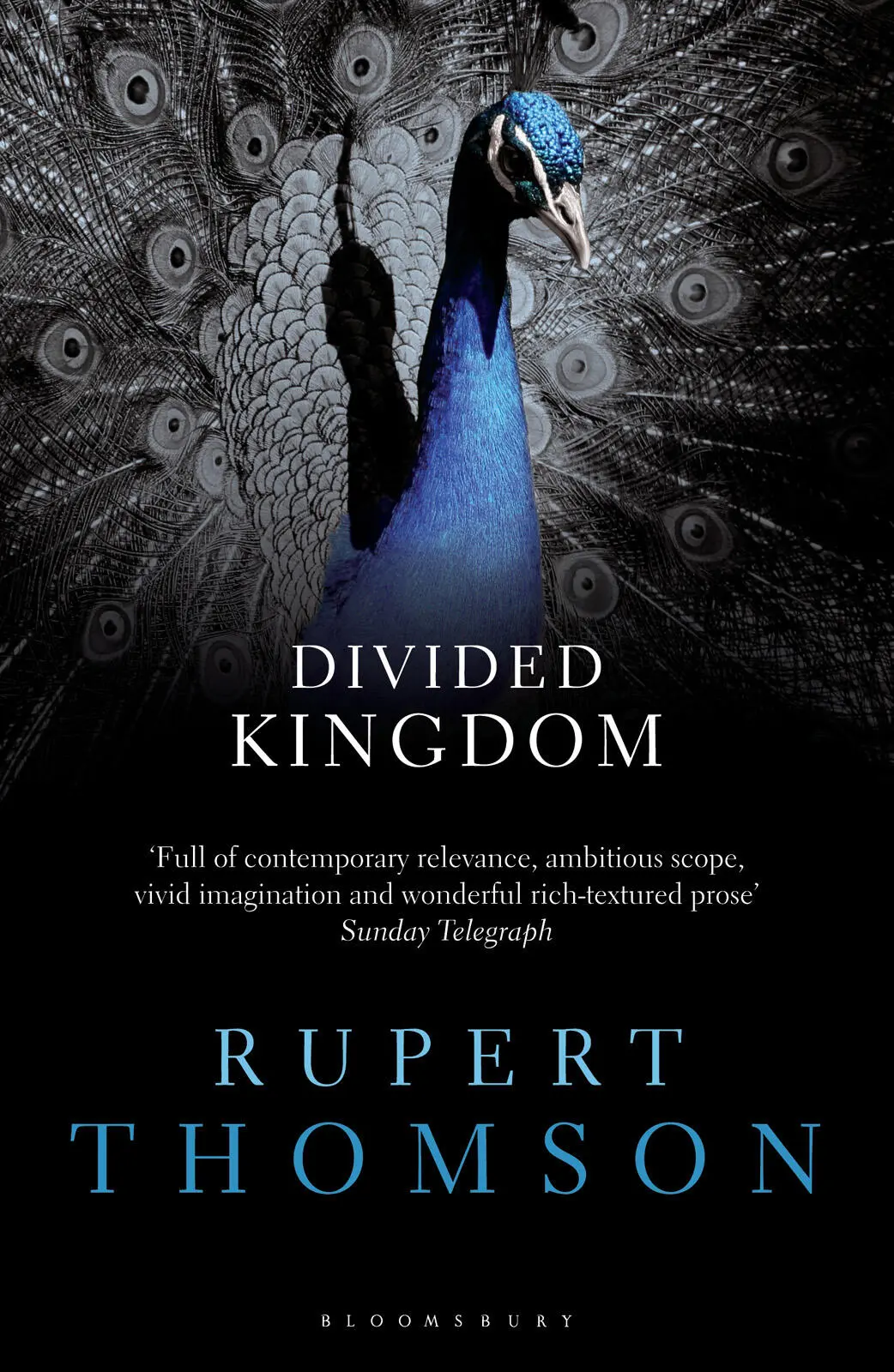
- Название:Divided Kingdom
- Автор:
- Издательство:Bloomsbury UK
- Жанр:
- Год:2012
- ISBN:нет данных
- Рейтинг книги:5 / 5. Голосов: 1
-
Избранное:Добавить в избранное
- Отзывы:
-
Ваша оценка:
Divided Kingdom: краткое содержание, описание и аннотация
Предлагаем к чтению аннотацию, описание, краткое содержание или предисловие (зависит от того, что написал сам автор книги «Divided Kingdom»). Если вы не нашли необходимую информацию о книге — напишите в комментариях, мы постараемся отыскать её.
Divided Kingdom — читать онлайн бесплатно полную книгу (весь текст) целиком
Ниже представлен текст книги, разбитый по страницам. Система сохранения места последней прочитанной страницы, позволяет с удобством читать онлайн бесплатно книгу «Divided Kingdom», без необходимости каждый раз заново искать на чём Вы остановились. Поставьте закладку, и сможете в любой момент перейти на страницу, на которой закончили чтение.
Интервал:
Закладка:
Diana leaned forwards, her eyes appearing to offer shade and rest. ‘Is something wrong?’
‘My family,’ I began, then faltered.
Her smile returned. ‘You’re worried about how they might react,’ she said, ‘which is perfectly understandable. The answer is, they’ll never know. We’ll arrange a phantom job for you. A front. Something they can be proud of’.
‘I would have to lie to them,’ I said slowly.
She looked at her right hand, which lay flat, palm down, on the lacy wrought-iron of the table. The fingers lifted, then dropped — one movement, over in a second. I sensed impatience in her for the first time, though she was doing her utmost to suppress it.
‘If it’s any help to you,’ she said, ‘we could offer them immunity.’
‘Immunity?’
It was Diana’s turn to look away into the garden, her fine-boned, agile face in profile. ‘They would be exempted from all future testing. They would be granted the right to remain here permanently.’ Reaching up, she made a minute adjustment to the wooden comb that held her hair in place. ‘Their status would be guaranteed.’
‘I didn’t know that was possible,’ I said.
She sent me a glance that was both ironic and cautionary, but said nothing.
I would be protecting them, I thought. They would be secure. For the rest of their lives. ‘Could you give me a few days,’ I said, ‘to think it over?’
When Diana faced me again, the spokes in her eyes seemed to be revolving, as though some machinery inside her head had just been set in motion.
Chapter Two
Shortly after joining the Ministry, I received an envelope in the internal mail marked Confidential. Inside, I found a document detailing the imminent transfer of a fifteen-year-old girl from the Red Quarter to the Yellow Quarter. Her name was Chloe Allen. I had been included in the transfer team, my role being described as ‘observer’. A covering letter informed me that I would only accompany the relocation officers as far as the border, and I remember feeling relieved about that, the Yellow Quarter being a wild and brutal country by all accounts, where every kind of barbarity was perpetrated in the name of profit or enterprise, or even, sometimes, for no good reason at all. The fact that Bracewell had wanted to escape to such a place still puzzled me.
I met the transfer team in the Ministry car-park one Friday morning, and we drove south in a white minibus. Behind the wheel was Tereak Whittle, strongly built, laconic, in his mid-to-late-twenties. Pat Dunne sat beside him. With her startled eyes, she looked like someone who had become accustomed to witnessing tragedy. I put her age at about fifty. In relocation work it was standard procedure to pair a man with a woman; they brought complementary skills to the job.
We parked outside a two-storey red-brick house. It had a bay window on the ground floor and a small front garden paved in concrete. I stood behind Dunne and Whittle as they rang the bell. The door swung open to reveal a breathless middle-aged man in a green cardigan. He introduced himself as Mr Allen, then showed us into the living-room. While Dunne took out the transfer documents, Mr Allen sat on the edge of his chair and fidgeted. He had the curious habit of rubbing his right thumb against the palm of his left hand, as though trying to remove a stain.
‘Should I call her yet?’ he said at last.
Dunne glanced up. ‘Please do.’
When Mr Allen opened the door, the girl was already on the other side. ‘Oh.’ He took a step backwards, then turned and smiled foolishly. ‘Here she is. Here’s Chloe.’
The girl moved past her father, into the middle of the room. Though she was probably no more than average height, she seemed larger than him. She took up all the space in that little house. She devoured the air.
Her eyes descended on Pat Dunne. ‘Weren’t you due here an hour ago?’
Dunne looked at her, but said nothing.
The girl shrugged. ‘Better late than never, I suppose.’ She went and stood in the bay window with her back to us, her blonde hair cut level with her shoulderblades and gleaming like gold leaf against the darkness of her jacket.
She didn’t seem in the least upset or even disconcerted by the impending transfer. On the contrary, in putting on a black suit for the occasion, she appeared to be mocking the notion that she might be sad to leave. Or she had dressed for the funeral of that part of her life, maybe. Somehow she managed to give the impression that the whole thing had been her idea.
Leaving Dunne and Whittle to fill in the forms with Mr Allen, I went outside to stretch my legs. In the hallway I paused, glancing up the stairs. I could hear someone crying. Chloe’s mother, I thought. Or a sister, perhaps. Backing away, I opened the front door and stood on the pavement. All the sunlight had gone. Clouds blundered across the sky, shapeless and clumsy, the colour of saucepans. I’m an observer, I kept telling myself. I’m only here to observe.
Towards midday we boarded the minibus again. The law required that Chloe travel in the back, separated from the rest of us by wire-mesh. Like a dog, she remarked as she climbed in. Pat Dunne corrected her. There was no shame attached to the transfer process, she said. It was simply a matter of doing what was best — for everyone. Chloe nodded but chose not to respond. She was gazing at the house where she had grown up, its curtains drawn against her, its front door closed. Was it relief she felt, or remorse? Or was it resentment?
As we crossed the river, heading north, I began to feel that I was in a draught. All the windows were shut, though. It didn’t make sense. After a while the sweet smell of chewing-gum came to me, and I looked round. Chloe was sitting right up against the wire-mesh screen, her face just inches from my own.
‘What,’ she said.
I turned away from her. She began to blow on my neck again, but much more gently this time. I leaned forwards, my elbows propped on my knees.
‘Is she bothering you?’ Dunne asked.
‘No,’ I said. ‘It’s all right.’
Halfway through the afternoon we stopped for petrol. While Whittle filled the tank, Pat Dunne took Chloe to the toilet. The clouds had broken up, and I walked out across the forecourt, the warmth of the sun pressing itself evenly against my shoulder-blades. A tractor laboured through the field behind the petrol station, gulls fluttering in the air behind it like a handful of torn paper. Time drifted.
After a few minutes I became aware that Chloe was moving towards me, not directly, but in a series of contrived half-circles and hesitations as she feigned an interest in the scenery. She ended up standing beside me, facing the same way. She had unbuttoned her jacket, I noticed, revealing a tight white T-shirt underneath. Once again, her presence seemed to demand something from me. I felt it as a weight, a burden, as if she had fainted and I had caught her in my arms.
‘Can you imagine what it’s like to be transferred?’ she said.
‘I don’t have to imagine it,’ I told her. ‘I’ve already been through it’.
‘It was a long time ago, though, wasn’t it? You’ve forgotten.’
I gave her a neutral look.
‘You’re just like the others.’ Half-disappointed, half-provocative, she appeared to be trying to tempt me into some disloyalty or misdemeanour.
‘And what are the others like?’ I asked, keeping my voice light.
‘Look at them.’ She glanced across at Dunne and Whittle, who were standing shoulder to shoulder, studying the map. ‘They can’t think for themselves. They just do as they’re told. They’re drones.’
She was appealing to my vanity, of course, but I couldn’t afford to react. Instead, I had to turn her remarks to my own advantage. Yes , my silence said, I’m just like them. Yes, that’s exactly what I am.
Читать дальшеИнтервал:
Закладка:
Похожие книги на «Divided Kingdom»
Представляем Вашему вниманию похожие книги на «Divided Kingdom» списком для выбора. Мы отобрали схожую по названию и смыслу литературу в надежде предоставить читателям больше вариантов отыскать новые, интересные, ещё непрочитанные произведения.




Обсуждение, отзывы о книге «Divided Kingdom» и просто собственные мнения читателей. Оставьте ваши комментарии, напишите, что Вы думаете о произведении, его смысле или главных героях. Укажите что конкретно понравилось, а что нет, и почему Вы так считаете.