Darragh McKeon - All That Is Solid Melts into Air
Здесь есть возможность читать онлайн «Darragh McKeon - All That Is Solid Melts into Air» весь текст электронной книги совершенно бесплатно (целиком полную версию без сокращений). В некоторых случаях можно слушать аудио, скачать через торрент в формате fb2 и присутствует краткое содержание. Город: New York, Год выпуска: 2014, ISBN: 2014, Издательство: HarperCollins, Жанр: Современная проза, на английском языке. Описание произведения, (предисловие) а так же отзывы посетителей доступны на портале библиотеки ЛибКат.
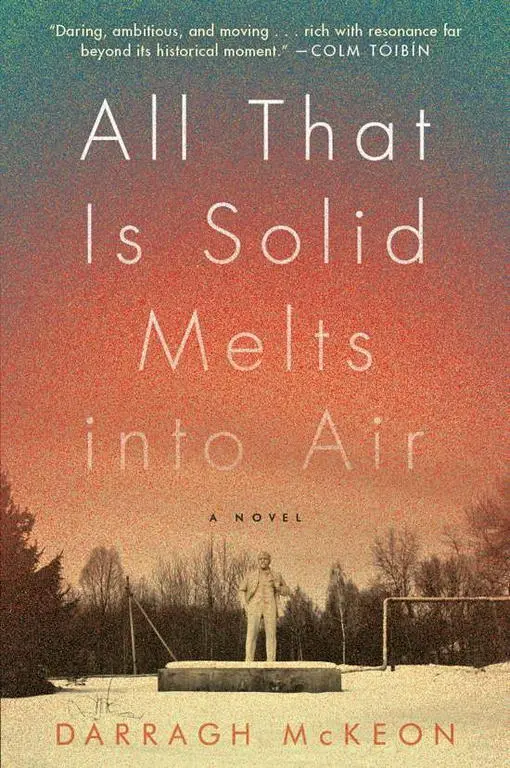
- Название:All That Is Solid Melts into Air
- Автор:
- Издательство:HarperCollins
- Жанр:
- Год:2014
- Город:New York
- ISBN:978-0-06-224687-5
- Рейтинг книги:3 / 5. Голосов: 1
-
Избранное:Добавить в избранное
- Отзывы:
-
Ваша оценка:
All That Is Solid Melts into Air: краткое содержание, описание и аннотация
Предлагаем к чтению аннотацию, описание, краткое содержание или предисловие (зависит от того, что написал сам автор книги «All That Is Solid Melts into Air»). Если вы не нашли необходимую информацию о книге — напишите в комментариях, мы постараемся отыскать её.
And in a village in Belarus, a teenage boy wakes to a sky of the deepest crimson. Outside, the ears of his neighbor's cattle are dripping blood. Ten miles away, at the Chernobyl Power Plant, something unimaginable has happened. Now their lives will change forever.
An end-of-empire novel charting the collapse of the Soviet Union,
is a gripping and epic love story by a major new talent.
All That Is Solid Melts into Air — читать онлайн бесплатно полную книгу (весь текст) целиком
Ниже представлен текст книги, разбитый по страницам. Система сохранения места последней прочитанной страницы, позволяет с удобством читать онлайн бесплатно книгу «All That Is Solid Melts into Air», без необходимости каждый раз заново искать на чём Вы остановились. Поставьте закладку, и сможете в любой момент перейти на страницу, на которой закончили чтение.
Интервал:
Закладка:
“‘She didn’t say exactly .’ But you know where he is.”
He takes a breath, twists a button on his cardigan.
“The news reports of Chernobyl started appearing a couple of days later. I paid close attention. He left the same day they became aware of the accident.”
“Chernobyl is in the Ukraine?”
“Yes.”
A moment of blankness. She stares at Grigory’s name on the letterbox.
“I would have been in touch with you, but I had no idea how to reach you. Grigory Ivanovich hasn’t had any friends drop by looking for him. You’re the first one to visit.”
She has no idea what to do. She finds herself saying this out loud. To Dmitri Sergeevich, of all people. She realizes she doesn’t even know his last name.
“I have no idea what to do.”
“Call the hospital—I’ve been sending his mail there. They’ll be able to help.”
Maria doesn’t take in anything else he says. She knows she thanked the man but doesn’t become aware of leaving the building until she is walking down the slope to the steps by the bridge.
How could they have sent him there? How could he still be there?
She stops and looks around. She’s passed through the innards of the bridge and out onto the viewing platform that sweeps down to Leninsky Prospekt. The Academy of Sciences is to her right, glowing amber and grey. An intricate building that calls to mind the workings of an old watch, as if its outer panels have blown off to reveal the refined minds inside it, grappling with problems far beyond the realm of the humble citizen. To her left, Gorky Park stretches out, unlit, a reservoir of darkness in the vast expanse of the city.
He has already been through so much. She has put him through so much. All of it beginning here, in this very spot.
It was here that Mr. Kuznetsov had first approached her. Even after he had lain naked in her bed, inched his way inside her, she had continued calling him Mr. Kuznetsov, not wanting him to mistake their relations for intimacy. After the first few occasions, she knew that he had grown to find a sexual charge in her formal address, but it was too late then for her to relent.
THAT NIGHT, the first night, she had received a call from one of the copy editors at the paper. A story was breaking which they needed her to cover. Could you come to the office? Looking back, his reluctance to outline what was happening should have raised her suspicions, but she felt such a surge of relief that it overpowered her sense of caution. The call meant she was being invited back into the fold, they were telling her they would forgive her indiscretions. The previous afternoon she had stood before the editor’s desk and watched him hold up her offending article, a short piece, no more than a hundred words, the headline legible from where she stood:
She was hardly surprised. She had known the article would stir up difficulties; in fact, she had done her best to slip it past the editor’s attention, handing it, casually, at the last minute, to the most junior copy editor, apologizing for overrunning her deadline.
It wasn’t an ordinary funeral and it wasn’t an ordinary death. Five days beforehand, two police divers had pulled Father Popiełuszko’s body from a reservoir near the town of Włocławek, an hour’s drive west of Warsaw. The priest’s face was collapsed, beaten, his body bloated. Despite this, when the divers pulled him up, they recognized him immediately. Father Popiełuszko had been more popular even than the Solidarity leader, Lech Wałesa, because he had the extra authority that a collar and cassock bestow. His Sunday sermons had attendances of forty thousand and upwards. They came to hear him talk about the injustices imposed upon the workingman. He stood and reminded them through soaring rhetoric that the child Jesus was born into the family of a carpenter, not of an apparatchik. They came and listened and walked back to their homes, the surge of his speech patterns lengthening their stride.
Father Popiełuszko had had the eyes of the regime firmly fixed upon him. It was well known that he stored funds and passed them on to the Solidarity groups in Warsaw. When his body was identified, such a public rage swept through the city that the authorities immediately identified and arrested the three agents of the secret police who were responsible for his death. It was an unprecedented act for a ruling authority to give up its own agents, but it calmed the situation enough for the funeral to pass off peacefully.
Maria was careful not to write about the background. She detailed the ceremony and included some pointed quotes from the eulogy. She indicated with skilfully selected words that the death was not from natural causes but, otherwise, she kept to the ritual itself and let the readers draw their own inferences.
The editor held up the piece. He accused her of expressing anti-Soviet sentiment, of encouraging dissent. She had her rebuttals prepared. How could this be anti-Soviet subject matter when the authorities themselves had made publicly known that the perpetrators were SB police? She was reporting on a funeral; it had nothing to do with politics. Maria had no doubt she was on steady ground. She could defend every sentence against accusations.
Her editor listened and nodded, and then produced several pages of pink carbon paper, covered in her familiar scrawl. Pages she’d written for a samizdat, which had been typed and copied and typed and copied until her words had been thumbed through by several hundred pairs of hands.
The editor displayed each set of pages and read the headlines:
Maria couldn’t believe it. The samizdat went to incredible lengths to make sure authors would be untraceable.
“I’ve never seen these before.”
“Fine. In that case, I can hand them to the KGB to conduct some handwriting analyses.”
She placed her face in her hands.
“Writing inflammatory articles for a ragged underground paper is one thing. But now you are trying to bring us into disrepute. I’m obliged by law to report you.”
There was nothing to do but wait for it all to unfold.
Maria spent the day pacing the apartment, waiting for the knock on her door, thinking about the interrogation room she would soon find herself in, the sleep deprivation and starvation, the days of endlessly repetitive questioning.
She couldn’t even bring herself to let Grigory know what had happened, telling herself there was no point in burdening him with the same sense of dread. So when she received the call to return to work that evening, she was swept away with relief. She grabbed her coat, made her way to the Metro stop, taking the same route she’s just walked. When she reached the viewing platform, Mr. Kuznetsov was standing there, looking at the traffic below.
Mr. Kuznetsov, her editor. A stale man, desiccated skin, flat, unresponsive eyes.
She stopped, recognizing him straight away; it was clear to her that his being here, intercepting her journey, was no coincidence. Immediately, all that would transpire unfolded in her mind. It was all set up to play out beautifully for him. He would remind her that, due to his discretion, she still had a job. He would remind her that the KGB would be very interested in her dissenting view. She even predicted that he would use the word “implications,” use it to promise the destruction of her husband’s career.
“And there are other implications,” he proceeded to say.
The words still ring out to her, even now, with a terrible clarity. Her life imploding with that single sentence.
Читать дальшеИнтервал:
Закладка:
Похожие книги на «All That Is Solid Melts into Air»
Представляем Вашему вниманию похожие книги на «All That Is Solid Melts into Air» списком для выбора. Мы отобрали схожую по названию и смыслу литературу в надежде предоставить читателям больше вариантов отыскать новые, интересные, ещё непрочитанные произведения.






Обсуждение, отзывы о книге «All That Is Solid Melts into Air» и просто собственные мнения читателей. Оставьте ваши комментарии, напишите, что Вы думаете о произведении, его смысле или главных героях. Укажите что конкретно понравилось, а что нет, и почему Вы так считаете.