Darragh McKeon - All That Is Solid Melts into Air
Здесь есть возможность читать онлайн «Darragh McKeon - All That Is Solid Melts into Air» весь текст электронной книги совершенно бесплатно (целиком полную версию без сокращений). В некоторых случаях можно слушать аудио, скачать через торрент в формате fb2 и присутствует краткое содержание. Город: New York, Год выпуска: 2014, ISBN: 2014, Издательство: HarperCollins, Жанр: Современная проза, на английском языке. Описание произведения, (предисловие) а так же отзывы посетителей доступны на портале библиотеки ЛибКат.
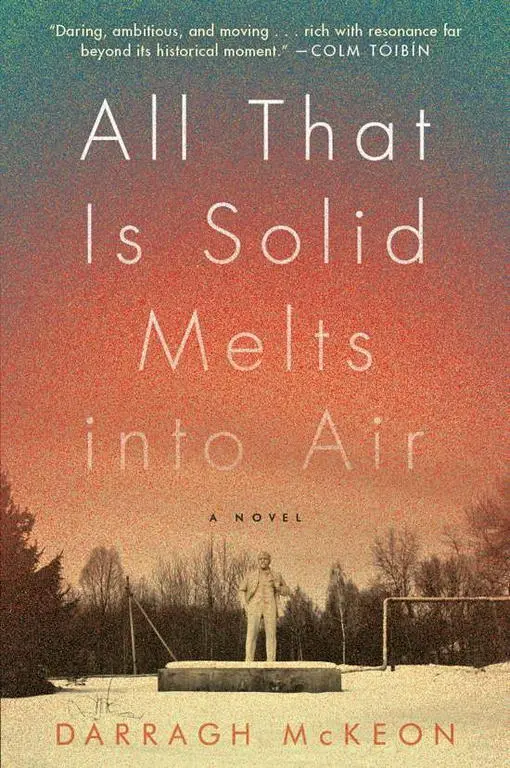
- Название:All That Is Solid Melts into Air
- Автор:
- Издательство:HarperCollins
- Жанр:
- Год:2014
- Город:New York
- ISBN:978-0-06-224687-5
- Рейтинг книги:3 / 5. Голосов: 1
-
Избранное:Добавить в избранное
- Отзывы:
-
Ваша оценка:
All That Is Solid Melts into Air: краткое содержание, описание и аннотация
Предлагаем к чтению аннотацию, описание, краткое содержание или предисловие (зависит от того, что написал сам автор книги «All That Is Solid Melts into Air»). Если вы не нашли необходимую информацию о книге — напишите в комментариях, мы постараемся отыскать её.
And in a village in Belarus, a teenage boy wakes to a sky of the deepest crimson. Outside, the ears of his neighbor's cattle are dripping blood. Ten miles away, at the Chernobyl Power Plant, something unimaginable has happened. Now their lives will change forever.
An end-of-empire novel charting the collapse of the Soviet Union,
is a gripping and epic love story by a major new talent.
All That Is Solid Melts into Air — читать онлайн бесплатно полную книгу (весь текст) целиком
Ниже представлен текст книги, разбитый по страницам. Система сохранения места последней прочитанной страницы, позволяет с удобством читать онлайн бесплатно книгу «All That Is Solid Melts into Air», без необходимости каждый раз заново искать на чём Вы остановились. Поставьте закладку, и сможете в любой момент перейти на страницу, на которой закончили чтение.
Интервал:
Закладка:
EACH NIGHT after his walk he enters once again the few low rooms of the clinic. Returning to hear the breath of sleeping children, all of them waiting to pass under his knife. Grigory knows he has a weaker will than any of them, and there are nights when he lies amongst them, hoping that their courage, their thirst for life, might pass into him, replenishing him.
Children who have already undergone thyroid operations and are regaining their strength sleep on thin mattresses laid out in rows along the floor. In the morning they rise and roll them into a wheel, tie them up with string, and place them in the corner. There is a playground outside with a high net strung across it. They’ve received a batch of tennis balls as part of an aid consignment, and the children invent complicated rhythmical games with them. In the breaks between surgery Grigory watches them and tries to decipher their rules, but they change daily, hourly, and so he pays attention only to the fluid motion of these children, identical scars running horizontally across the base of their necks. These are the healthier ones. The weaker ones lose consciousness while standing. They buckle to the ground, marionettes whose strings have been cut. Nosebleeds break out all the time. At any moment he can look across the yard and see half a dozen children pinching their noses, looking up to the sky, unperturbed by the spontaneous flow from their nostrils.
There are those for whom the sickness has spread to the lungs or pancreas or liver. They lie sweating in the few beds available. Many are placed back with their families in their accommodation, where they are guaranteed somewhere to rest and a visit by a nurse. In the past few months, infants have emerged from the womb with fused limbs, or weighed down with oversize tumours. There are children whose bodies have no sense of proportion, football-size growths on the back of their skull or legs as thick as small tree trunks, or one hand minuscule and the other swollen to grotesque dimensions. Others have hollowed-out eye sockets, lined with flat patches of skin: it looks as though the human eye is an organ that has yet to evolve. For many, there are tiny holes where the ears should sit. A child, a girl, was born two weeks ago with aplasia of the vagina. Grigory couldn’t find any references to such a thing in his textbooks. He had to improvise by creating artificial holes in her urethra through which the nurses would squeeze out her urine.
During these nights, he gazes at them in their cots. Nothing is so unimaginable that it cannot be true, this is what he thinks, beauty and ugliness resting within the single body of a diseased infant, the two faces of nature brought into stark relief.
No officials have made their way here, despite his daily entreaties. He wants them to walk into this room, a place where ideology, political systems, hierarchy, dogma, are relegated to mere words, belonging to files, banished to some dusty office. There is no system of belief that can account for this. The medical staff know that, in comparison, nothing that has gone before in their lives has any significance. There are only these months, these rooms, these people.
When they bury the dead, the corpses are wrapped in cellophane and placed inside wooden coffins, which in turn are wrapped and placed inside zinc caskets and lowered into concrete chambers. The families are never allowed to accompany their loved ones on this final journey. Instead they stand gravely by the door of the mortuary as the sealed van holding their dead disappears into the distance.
GRIGORY REACHES his quarters, still carrying the injured dog, and lays him on the floor beside his single armchair, dark horsehair drooping from its seams, in the narrow space between his bed and the wall. His room has a single bed that dips heavily in the middle, a locker overrun with medical books and some detective novels that have long since outlived their purpose of staving off the penetrative boredom. On the wall opposite the door are a small wardrobe and a washbasin. Grigory leaves the room and returns with a bowl, which he fills with water and places beside the animal’s head. The dog is in too much pain to right itself in order to drink, and so Grigory cradles its neck in his arms and brings it gently to a position where it can lap the water freely, its tongue folding around the liquid, gathering it. Grigory is coated in sweat from the journey, and this is now turning cold, clinging to him, and as he peels the shirt from his body his own odour rises up strong and sour.
He wipes off the sweat with his bedsheet and puts the shirt back on—he hasn’t any clean clothes at the moment, he finds he’s never in the mood to do laundry—and he walks across the yard, which is silent now, an occasional TV set in the surrounding windows throwing patches of throbbing blue light onto the ground. A boy stands at the gable end of one of the buildings, bouncing a tennis ball between wall and ground, the bounce creating a pleasing double rhythm before the ball comes to rest in the boy’s hand. Grigory walks to the supply room of the clinic, gathering all he needs to treat the animal, and on his return, he pauses to watch.
The boy changes hands as he throws and catches. A quick snap from either wrist before he releases the ball, alternating the surfaces, so the ball hits the pavement first and on the next throw strikes the wall first, the flight switching between languorous arches and rapid straight lines.
A solid boy who is almost a man, wide-shouldered, drifting his hips from one side to the other, as if caught by a gentle breeze. This boy too has a scar across his neck. So they have met before, Grigory observes, although he doesn’t recall the boy’s face.
“Do you remember me?”
“Yes. You were the doctor who worked on my neck.”
“That’s right. How are you feeling?”
“A little better, stronger. It doesn’t scratch as much when I eat.”
“Good, that’s a good sign.”
Their voices linger in the air, so few other sounds present.
“What’s your name?”
“Artyom Andreyevich.”
“Artyom. That’s a man’s name.”
The boy smiles.
“I’m glad to see you up and about. It’s a pleasant ending to my day.”
Grigory lifts an open hand in good-bye and then pauses, leaving the hand in the air momentarily, as though he is stopping traffic.
“Are you afraid of dogs?”
“No.”
“Okay. Follow me then.”
Grigory turns and can hear the boy’s footsteps in pursuit, bouncing the ball by his side as he goes, never breaking stride. In the room, the boy kneels over the dog, stroking the side of its head. He hasn’t had an exchange with an animal since he left Gomel, and he feels this lack intensely, a farmboy surrounded only by people, forced to live in a warren of indistinct, prefabricated huts.
Grigory unwraps a fresh needle and twists it onto an old syringe, then slips it into the rubber cap at the top of the benzodiazepine vial and pulls back the plunger, so the liquid runs fast and pure into the body of the instrument. The boy watches with interest, seeing a man with skill and knowledge perform his routine up close. Grigory pushes the plunger upwards and a straight jet of liquid catches in the bulb light, breaking into droplets as it descends in a perfect parabola. He tells the boy to hold the dog’s head and to be careful in case it reacts badly. He slides the needle into its hindquarters, and the boy can hear the palpatory suck of punctured skin and watches the liquid drain from the syringe. He can feel the dog’s head vibrate in reaction to the pain, and keeps his hands soft yet firm. The animal moans but accepts his treatment.
They wait for the anaesthetic to take effect, and the boy looks around the room. His eyes settle on a page, torn from a magazine, which Grigory has pinned on the wall to the side of his bed. A small, imperfect moon hanging over a low mountain range, barns and shacks in the foreground, barely perceptible in the scale of the image.
Читать дальшеИнтервал:
Закладка:
Похожие книги на «All That Is Solid Melts into Air»
Представляем Вашему вниманию похожие книги на «All That Is Solid Melts into Air» списком для выбора. Мы отобрали схожую по названию и смыслу литературу в надежде предоставить читателям больше вариантов отыскать новые, интересные, ещё непрочитанные произведения.




Обсуждение, отзывы о книге «All That Is Solid Melts into Air» и просто собственные мнения читателей. Оставьте ваши комментарии, напишите, что Вы думаете о произведении, его смысле или главных героях. Укажите что конкретно понравилось, а что нет, и почему Вы так считаете.