Darragh McKeon - All That Is Solid Melts into Air
Здесь есть возможность читать онлайн «Darragh McKeon - All That Is Solid Melts into Air» весь текст электронной книги совершенно бесплатно (целиком полную версию без сокращений). В некоторых случаях можно слушать аудио, скачать через торрент в формате fb2 и присутствует краткое содержание. Город: New York, Год выпуска: 2014, ISBN: 2014, Издательство: HarperCollins, Жанр: Современная проза, на английском языке. Описание произведения, (предисловие) а так же отзывы посетителей доступны на портале библиотеки ЛибКат.
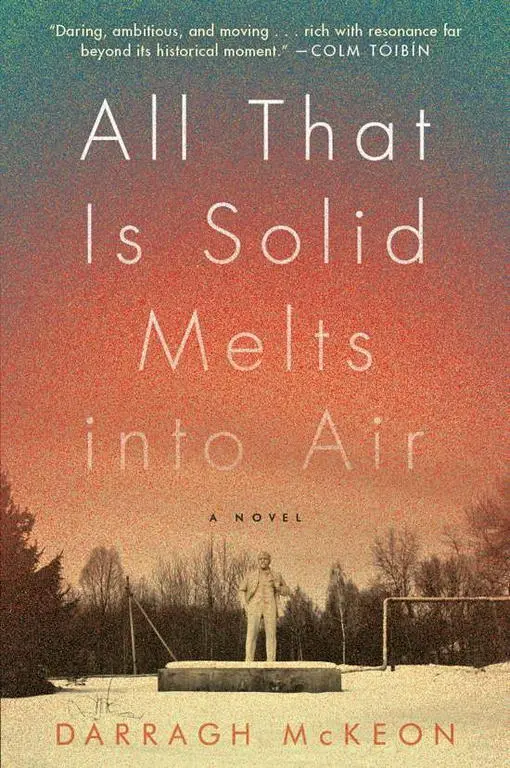
- Название:All That Is Solid Melts into Air
- Автор:
- Издательство:HarperCollins
- Жанр:
- Год:2014
- Город:New York
- ISBN:978-0-06-224687-5
- Рейтинг книги:3 / 5. Голосов: 1
-
Избранное:Добавить в избранное
- Отзывы:
-
Ваша оценка:
All That Is Solid Melts into Air: краткое содержание, описание и аннотация
Предлагаем к чтению аннотацию, описание, краткое содержание или предисловие (зависит от того, что написал сам автор книги «All That Is Solid Melts into Air»). Если вы не нашли необходимую информацию о книге — напишите в комментариях, мы постараемся отыскать её.
And in a village in Belarus, a teenage boy wakes to a sky of the deepest crimson. Outside, the ears of his neighbor's cattle are dripping blood. Ten miles away, at the Chernobyl Power Plant, something unimaginable has happened. Now their lives will change forever.
An end-of-empire novel charting the collapse of the Soviet Union,
is a gripping and epic love story by a major new talent.
All That Is Solid Melts into Air — читать онлайн бесплатно полную книгу (весь текст) целиком
Ниже представлен текст книги, разбитый по страницам. Система сохранения места последней прочитанной страницы, позволяет с удобством читать онлайн бесплатно книгу «All That Is Solid Melts into Air», без необходимости каждый раз заново искать на чём Вы остановились. Поставьте закладку, и сможете в любой момент перейти на страницу, на которой закончили чтение.
Интервал:
Закладка:
His finger has healed, which is a relief to all. Though there’s a swelling around the area of the fracture, like a huge, dormant boil. A physiotherapist in the next building showed them some finger-strengthening exercises, a series of bends and waggles which Yevgeni performed with religious devotion before bedtime.
They bought him a keyboard in the summer, one that sits on two metal trestles. A man that Alina does laundry for, a truck driver, smuggled it back from Berlin. Alina gave him two months free laundry for it, in addition to three months of Maria’s wages, most of what she had saved up since she arrived. But when he brought it in the door and set it up and Yevgeni sat down to play for the three of them, Maria couldn’t but feel a swelling pride, couldn’t think of anything else she’d like to spend her money on, a satisfaction that lasted for perhaps five minutes, until the neighbours started banging on the door, threatening to call the building superintendent, have them kicked out. It hasn’t made a sound in four months. They tried various strategies to appease the neighbours. They brought vodka and sausages around to those closest, but when others heard about the windfall, they wanted their share. People at the far end of the building started to complain, even though they’d have to strain to hear even the faintest traces of a note. So they stopped giving out gifts. They would not be blackmailed. Such behaviour from grown adults.
So the genius plays with no sound, which, at first, she thought a picture of impotence. Now, even though it no doubt hinders his advancement, she thinks it’s glorious. Sometimes Maria arrives home and sees him in the living room, her bedroom, and he’s flowing to the music, doing all the dips and turns of head and drops of delicate hands that she sees in the concert pianists, and at first she thought he was copying them, emulating them in the same way that kids take on the celebrations of footballers. After watching him though, on separate occasions, watching him when he doesn’t know anybody is looking, she realizes he’s doing it of his own accord, dancing internally as he presses down on the dull plastic keys.
But all has not been so smooth recently. His tempo is beginning to drift. It’s a slight quirk that seems to be growing exponentially. The auditions for the central school of the Conservatory are next April, and Yevgeni’s training has come unstuck. There’s a tautness in the household. Mr. Leibniz has asserted that the boy would either grow out of his musical difficulties or fall deeply into the disordered void; there’s no way to train it out of him. “Music is a sensual medium,” he says, “his style cannot be counted back to purity.” Maria passed the bathroom the other night and saw Alina gripping the taps, leaning back on her heels, head on the sink rim. Of course, if he doesn’t get in the first time he can always reapply the next year, but the boy doesn’t deal well with failure. Maria thinks that if he doesn’t succeed initially, he won’t get in. He has a fiery will. He blazes in his pursuit of the music. He’s not one of those vapid automatons she sees when they go to a recital there, when they sit in that pale-green room and watch stooped men with silver-tipped canes greet each other and assess the performer’s pedigree as if they were a racehorse. Afterwards each musician receives their applause utterly devoid of appreciation, bending as though their body has finally refused to carry itself upright.
They look at their audience and see only judgement. They proclaim in silence to the room that they’re talentless, worthless. If only you knew the paltry depths of my ability. How painful it is even to stand here and receive such graciousness, how utterly unworthy I am . So excruciating that they can barely keep their eyes open. It’s all such bullshit. Every one of them has an ego the size of that barge of an instrument they play. Maria always feels the urge to walk up to the podium, grab them by the shoulders, and shake them till their teeth rattle. Precious little orchids.
Her favourite thing about the Conservatory is to stand outside it, especially on weekdays—though she hasn’t done this since she moved to the outskirts of the city—when the students are practising and the windows over the courtyard are all thrown open and a great clatter emerges. All these styles and tempos and tones competing with each other. All that sweat being expended. You feel as if you’re standing in front of a great cauldron of creativity. All that discordance so full of life, so utterly at odds with the translucent figures that sit up on the rostrum at the recitals.
No, Yevgeni is definitely not of that mold, and it’s another thing she loves about him. There are tantrums. Sometimes after lessons he locks himself into the bathroom and refuses to come out. He throws things at walls. He bites his keyboard, bites his knuckles, pulls at his hair, kicks doorframes and lampposts, a tumult of rage inside the kid.
And yet there’s a joy to his playing; she delights in his fingers. Yevgeni has the lightest fingers. They skip along his knee while he watches TV. He often eats dinner with one hand, drumming into the tablecloth with the other. Sometimes they brush their teeth in the bathroom together and he hums scales as he does so. He jumps from foot to foot, singing each note in an almost perfect pitch, at least to Maria’s untrained ears. Occasionally he even sits at her old typewriter, working the keys to a hammered frenzy, and she likes the sound of this too, the rhythm of who she used to be, given voice to the wider world once more.
Symphonies are running on the record player every waking moment. Debussy accompanies her as she clips her toenails, Mendelssohn guides the spoon as she heats beans.
There’s a small tuxedo in Alina’s closet and a bow tie with a tiny circumference. They attend competitions in regional halls in the sleet and hail, Mr. Leibniz in the back row swaying his stick from side to side in a disciplined rhythm. The child at a piano bringing them there. A child in a mini-tuxedo.
Maria keeps him on her knee and guides his path through long division, adjusting his deviant numerals, reminding him how to fit the figures into their blue-ruled boxes. She lays out the numbers in neat columns and double-rules the answer line at the bottom. She double-rules it because this is what she’s always done. An unthinking practice passed down through the generations.
Yevgeni has a jar of pencils on the table, which she finds immensely comforting. Bunched pencils bring reassurance. The rubber at the top is often bitten off. She can see where he has made indentations in the metal bracket with his teeth. He sits on her knee and finishes his homework, and then Maria flicks his hair back from his forehead, kisses the peak of his skull, sends him to wash his teeth, and looks at him as he goes out the door.
There was a child of her own once, or the early configuration of a child or a potential child. But she couldn’t bring herself to have it. She didn’t want it in this world. And its departure was followed a few months later by the departure of her husband. After the procedure, Maria believed that if they had taken an X-ray of her, there would be a single line denoting her outer shell, and nothing else. The doctors would see her as she was, just a thin film of skin, no organs or intestines or blood flow. A single, contoured line. She often still thinks these thoughts, feels these feelings: her child’s absence, her husband’s absence. So many empty spaces in her life. And perhaps, she thinks, that’s why she feels such delight when she watches Yevgeni sway along a soundless keyboard. It dignifies that which is not there. It reminds her that life can be experienced in ways that she has never contemplated.
Читать дальшеИнтервал:
Закладка:
Похожие книги на «All That Is Solid Melts into Air»
Представляем Вашему вниманию похожие книги на «All That Is Solid Melts into Air» списком для выбора. Мы отобрали схожую по названию и смыслу литературу в надежде предоставить читателям больше вариантов отыскать новые, интересные, ещё непрочитанные произведения.








Обсуждение, отзывы о книге «All That Is Solid Melts into Air» и просто собственные мнения читателей. Оставьте ваши комментарии, напишите, что Вы думаете о произведении, его смысле или главных героях. Укажите что конкретно понравилось, а что нет, и почему Вы так считаете.