Jack Cox - Dodge Rose
Здесь есть возможность читать онлайн «Jack Cox - Dodge Rose» весь текст электронной книги совершенно бесплатно (целиком полную версию без сокращений). В некоторых случаях можно слушать аудио, скачать через торрент в формате fb2 и присутствует краткое содержание. Год выпуска: 2016, Издательство: Text Publishing Company, Жанр: Современная проза, на английском языке. Описание произведения, (предисловие) а так же отзывы посетителей доступны на портале библиотеки ЛибКат.
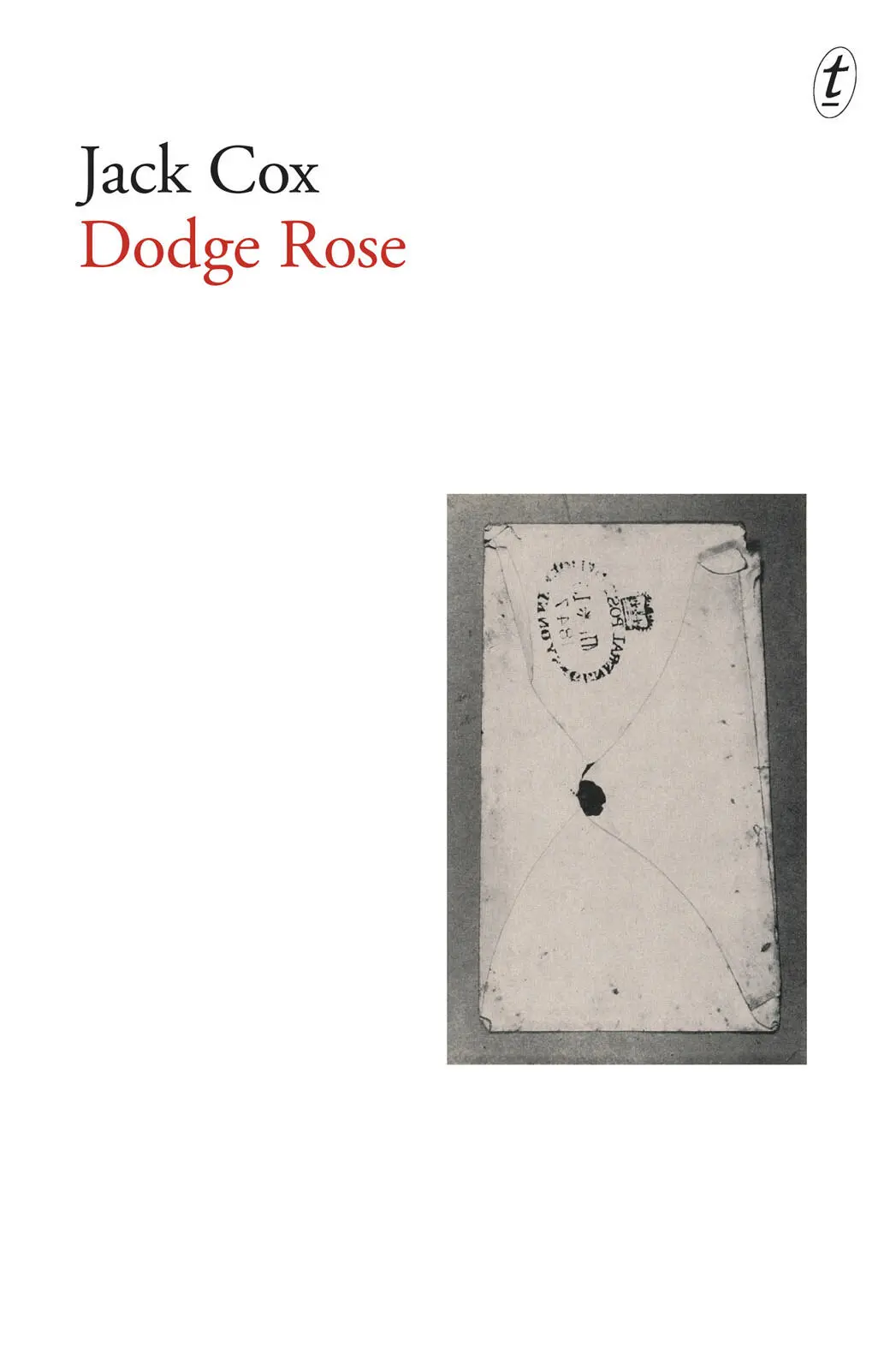
- Название:Dodge Rose
- Автор:
- Издательство:Text Publishing Company
- Жанр:
- Год:2016
- ISBN:нет данных
- Рейтинг книги:4 / 5. Голосов: 1
-
Избранное:Добавить в избранное
- Отзывы:
-
Ваша оценка:
Dodge Rose: краткое содержание, описание и аннотация
Предлагаем к чтению аннотацию, описание, краткое содержание или предисловие (зависит от того, что написал сам автор книги «Dodge Rose»). Если вы не нашли необходимую информацию о книге — напишите в комментариях, мы постараемся отыскать её.
Dodge Rose "The most exciting new fiction by a young Australian in years."
Dodge Rose — читать онлайн бесплатно полную книгу (весь текст) целиком
Ниже представлен текст книги, разбитый по страницам. Система сохранения места последней прочитанной страницы, позволяет с удобством читать онлайн бесплатно книгу «Dodge Rose», без необходимости каждый раз заново искать на чём Вы остановились. Поставьте закладку, и сможете в любой момент перейти на страницу, на которой закончили чтение.
Интервал:
Закладка:
The Health Act, 1958, Victoria: property may exist in a lock of hair or in nightsoil.
Your gilded pills. Don’t get me started on Victoria. Solo cedit. It’s Yarmouth versus France, de meuble en immeuble etc. I do not intend perishing in the abyss of nonsense. Our bell, book and candle is the fundamentum divisionis. I’ve watched too many movies. But quibbles and the larger part of the almost innumerable channels into which the effectively mythical and undeniably nicht festen Grund of the really universal position of private ownership flows aside, afloat as we are in the modesty of your explicit predicament, I would eventually like to draw your attention as we are swept heretofrom towards the more dispersive spheres of jurisprudence to the desirability of apprehending something of the distinction between real property and personal property, as it is therein one encounters the peculiarity, je baise mes mots, of the situation pertaining to the Colony of New South Wales. Difficile est. Do not think that through the mere process of elucidation I exaggerate those incoherencies adhering in many a mechanical affinity that, automatonlike, continues to function in the absence of more than a soul. They present nonetheless no deficiency of occasions to take fright. When Forbes ruled in 1825 that no grant from the Crown is good, unless the Great Seal be affixed to it, and it also be of record, the portent of Dr. Wardell’s response for the Australian deserves neither to be dismissively calqued from the distended lines of the extra-quotidian persona of journalistic declarators, assuming one knows the Chief Justice’s reply, nor merely felt in the lightning-like apperception of something profoundly amiss, viz. if something is not done somewhere to ratify all the grants and leases which the Crown has hitherto made, it strikes us, (assuming the dictum of the Chief Justice to be law) that there is no legal title to a foot of land in the colony, but arrested rather in what he does not say. In 1829, another dry year, the same Forbes was successfully petitioned by pastoralists for a suspension of quit rents, when an overwhelming number of actions to recover debt began to pour into this Court, resulting in the Bankruptcy Legislation, which removed associated prison sentences, and generally loosened restrictions on debtors, such as to allow them, item verbatim, a fresh start (an imperial statute of 1813 had put land in New South Wales in terms of debt recovery on the same footing as personal chattels, allowing a creditor to take possession of all of a debtor’s lands, whereas in England, where the prejudice was for the conservation of title, it was only half), Governor Darling reacted to the situation in Sydney, where the greater part of land was held by leases from the Crown or by urban squatters, by proclaiming, with the unanimous approval of the Executive Council, that on application, a grant in fee simple would be issued, on conditions prescribed, to every person, or his lawful representative, who, on or before 30th June 1823 (a period when every rural grantee was required to keep and, nota bene, clothe a convict for every one hundred acres, which may stand as an illustration of the asymmetry arising between the country leasehold in New South Wales and the large English estate, a formal conflict that culminated in the British Government Crown Land Sales Act, passed the same year as the Waste Lands Occupation Act, which was itself helped in by an alliance of squatters and a London-based cohort of wool-importing firms, land appearing to the concerned parties in the form of a commodity that, unlike salt, tended to perish under monopoly), was bona fide in possession of a tenement by lease from the Government, whether it had expired or not, or who occupied any allotment of land in town not hitherto alienated by the Crown, and not specified, in an Order of even date, as ‘parcels of land in the town of Sydney reserved for public purposes.’ You will allow me the mise en abîme. In the absence of lacunae I find there is only one way to extricate: reach further back and see where it leads. Dig in, please, there are almost no surprises. One parcel of land reserved for public purposes took in three and a quarter acres of the Government Domain, he indicated generously, leased in 1802 by King (the Governor, not the alleged Joseph or the supposed deceased Nicolo) to John Palmer, the Colony’s first commissary, in exchange for a Lumber yard in the heart of the town held by Palmer of a very limited duration. Now, this change of hands may not represent such a Sea Mystery At Our Back Door as the ten thousand acres granted to Forbes himself, of which Darling, facing the for him rather regular accusation of abuse of prerogative, said, with malicious veracity perhaps, I have merited reproof by allowing myself to be betrayed into a belief that this 10,000 Acres given to him by my Predecessor, was intended as an equivalent for some Land, which his Mother was to transfer to Government at Bermuda, but since the Domain lease was for five years with a prospective lease of another sixteen, it was certainly against the instructions of the Home Government, which in 1801 ordered no land reserved for government purposes to be leased for more than five. The imminent expiry of the lease notwithstanding, Palmer erected two kinds of windmill and a large bake-house on the land close to the frontage, but by the time the Governor whose name would be given to the street that forms that frontage decided to use the parcel for an extension of his official residence, the lease had already been transferred with improvements, for a substantial consideration, first to Robert Campbell, then, by him, to Fairlie & Co. of Calcutta. In 1814 Macquarie communicated to the outfit’s Sydney agent his intention to pay for the reprisal, and in 1815 demolished the wooden windmill and the bakery, with, however, the question of compensation remaining almost in abeyance until the arrival of Governor Bourke, who had his own plans to build a new Government House on the top portion of Palmer’s original lease, where the dismantled stone windmill had since been converted into living quarters for Government-men and a tool house, as was attested by the Assistant Superintendent of Botanical Gardens, who was also asked, though he could not say why they had been destroyed, nor why the men had left the place, to prove that he had planted trees on the land for Government in 1832, the matter of reprisal having reached litigation after the current claimant to the parcel, one Mr. Steele, answered the Governor’s offer of compensation by placing a lock on the Domain gate. What are robber gangs, except little kingdoms? That is mind you a real question I intend to answer. Evidently it is the tension between the different forms of property represented by leasehold and freehold, not their underlying dynamic, that is novel here. If the feudal jurist already sticks on to pure monetary relations the labels supplied by feudal law, the Statute of Tenures, which, after the English Civil War, did away with the old taxes and obligations once due to the Crown by tenants in capite, that is, those who were supposed to hold land directly from the Crown, and initiated a system whereby all freehold or fee simple estates were created by the Crown in the form of free and common socage, causing a distinction to emerge between real and personal property as relating to the nature of a tenant’s rights to that property, the former generally taking the form of land not because it describes it but rather the nature of the right to it, with freehold a form of real property, or chattel real, and leasehold a form of personal property, or chattel, freehold, being inheritable, coming to be called a freehold of inheritance, thus marking the domestic as well as territorial basis upon which that circle of interest revolved, land being difficult to alienate, title depending on an unbroken chain leading back to good root of title, insofar as it was a step towards the full right of alienation however, did little to mask the advance of the notorious patriciate of money, and with the princes in France, who were similarly allied, the bourgeois reveals himself as the very paleographic origin of the aristocrat: as any amateur belles-lettriste will tell you, the particule is not proof of noblesse but rather the sign of the franc alleu. One was named after one’s holding, and the branches of a single family were distinguished by varied desinence. On the other hand, if the calibrations of the freehold are at last vainly intended to still so many teeth in the corporate clock of the English landed gentry, in the colony of New South Wales, where land is principally divided between small urban freeholders and large leaseholds, it is the former that appear to be vulnerable, the latter purchases for entrenchment. The courts here increasingly appear to be out of joint. I wouldn’t take one of those, in some ways we are further from the ocean than you might think. Above all perhaps, the somewhat redundant interests of government and large landholder appear to be eliciting a conflicting tendency towards both an exacerbation of the old arbitrary powers vested in the Crown as the ultimus heres and a new practice of immediately handling land as goods of exchange. More than one contradiction undoubtedly exists where the law pertaining to leasehold, falling as personal property on the side of what was generally considered to be moveable in the distinction that prevailed in England by the end of the seventeenth century, but which was increasingly felt to be irrelevant here, leasehold having become the chief form of holding land by the 1840s, can supply a certain Windeyer, defending his client against an accusation of intrusion on his own land issued by the Attorney General in New South Wales in 1847, the coherent and even compelling argument that to maintain the grant of Crown land with all its statutory reservations and restrictions would be to maintain all the old principles of feudal slavery which the Statute of Charles II abolished. The question of reservations in fact, throwing up as Windeyer argued the distinction between dominion and ownership, and hence the question of the Crown’s radical title, opened on to what undoubtedly is that highest of contradictions that is constitutional monarchy, where, under fealty, to cite veritas non auctoritas as, between ourselves, goes without saying, it almost appears that the power of the crown is the power of private property. I hardly need to insist that those who took up the omnipresent atom of the latter to examine it, found the slightest agitation sufficed for this incensed and practically neutral power from whom the tenant in capite pretends to hold his lease to appear enthron’d in the marketplace, reemerging upon the field of law as no more ut ita dicam than the negative earth of the capite censi, which may yet be the expression of au bout du fossé with a vengeance, for that other, rational pole of the system, drawn upon as this was to define moveable property rights not only on the continent, where the Roman code was the basis for all law, but also, crucially, by our own forebears, could name such a but for vacancy precisely because it never vested private property in the state, taking the basis of private property to be a factum and not a right. Such a very gap in nature is the reason that Blackburn can decide in 1889 to address the question of whether the colony was previously settled or not as one of law as opposed to fact, a decision congruent with a set of prescriptions of which Blackstone, who, with Coke, developed the modern notion of property in land, helping to turn usages into properties which could be rented, sold or willed, noted, Pleased as we are with possession, we seem afraid to look back to the means by which it was acquired, as if fearful of some defect in our title; or at least we rest satisfied with the decision of the laws in our favour. As our great colleague in Kaliningrad used to say, you must not take it too far. Or as R. Torrens’ own ink-stained March fly is made to say for us, A banker’s fortune, consisting of paper, cannot be taken at all, without the taker’s submitting to the conditions of production and intercourse of the country taken; whereas obviously, if the taker assigns another value to that indiscernible country or paper, he need not enter into the conditions of the former to any extent, which thus become utterly annihilate, English law providing for the table-biting circumstance whereby it may be brought within cognizance by its own fiction if not actually. Windeyer’s client, who we must admit was not up to his reputation, was accused of nothing less than fraudulently intending the disinherision of Our Said Lady the Queen. He had leased a part of a sixty acre grant in Newcastle given to Arthur Charles Fitzroy Dumaness, by the Crown, on the part and in the voice of the Crown it is provided nevertheless, and we do hereby reserve to ourselves all such parts and so much of the said land as may hereafter be required for a public way or ways, . and also all stone and gravel, . and all land within one hundred feet of high water mark, . and also all mines of gold and silver, and of coals with full and free liberty and power to search for, dig, and take away the same. Sic ob cit, ladies. See I do deal in small change; se tutto il co. I will repeat, au pied de cette mouche, that when the defendant mined for coal, the Crown, in the person of the Attorney General, held that the coal mines and veins of coal were in the hands and possession of Our Said Lady the Queen, and at last Held , the reserve created an exception in the grant, and therefore that the veins of coal, being severable from the land, remained as a corporeal hereditament in the Crown, and were properly the subject of an information of intrusion, if I haven’t got that the wrong way around. Windeyer, identifying a form of tenure that had been abolished, indeed argued that property in England before the Norman conquest was effectively allodial , and that the Statute of Charles II returned it, except for the retention of the fiction as to all lands being held from the Crown, to its former state. Brown’s excavations, like the coal anciently buried to mark boundaries but preserving them even beneath the movements of successive epochs, brought suddenly into the light of the Southern Hemisphere the very internal limits of English feudal proprietary right as it lay across statutory and common law by the middle of the nineteenth century, so that, for the case in question, it was possible to cite statutes as old as the said subdivisional King of England and his collaterally milling daughter casting doubt upon the power of the Crown to make reservations, as well as numerous precedents for the Crown’s right to do so, as William and Mary reserving all idols above a certain size in New England — one could, as remains current, have gone back to Domesday, to the county of the Axton Hundred for instance, to take a random page, quidquid dignum memoria, thrice valued in the record between the English and the French reeve who holds it at farm, where it is forbidden to prune or exfoliate whatever falls in the King’s way, whether the responsible roots were to come out in Whitham, Milton-Under-Wychwood, Taddington, Nether Cott, Old Cleeve, Exton or Ixhill, Ash, Dodingtree, Fleamdyke, or Bagstone Hundred, if not less fantastically, in Kent, the same Hundred liable to render food and drink to the sovereign en route, over and above the fact that, though not a farm, and lacking the fairly controversial addition of swine, it already produced 40,000 herrings a year for the monks of the Archbishop, though paronyms are not precedent, and I have made the experience in myself that you can have too many cooks, notably in orig., though I will point out inter alia abundantibus that to bite here into the cindery apple of belongings is to touch on that not altogether far from contemporaneous distinction whereby, egg, cheese and bread being abscendens from lordship, these are defined as passing through a field of useless lordship, indeed each fleetingly non valet ova duo, and therefore not of personal servitude, which requires that salva rei substantia maneat, but rather of abuse: absit omen, lex cessat , and I will get there too, to the front door — but one is less than astonished to learn that the sitting judge held the opinion upon the law upon the question that it was quite simply that the Queen would continue seised or possessed of this land, and, at appeal, together with his colleagues, decided outright to omit a variety of topics introduced in aid of them with which we have as judges, nothing to do, and which were indeed of too popular a character, merely, to justify further notice by us, as they were pleased to have it printed. The Attorney General had after all been alerted as to Brown’s activities by the Commissioner of the Australian Agricultural Company, subject to a grant of one million acres for the cultivation and improvement of waste lands in New South Wales and for other purposes relating thereto. I hope I have answered my question now. But as to the question of the overlooked distinction between ownership and dominion, the difficulty pointed to in this case arose precisely from the fact that what in England had effectively become a legal fiction, that is, that all land was held in deference to the Crown, was treated here as sied a mainmise in living memory, resting on the premise that New Holland and what was associated with it at the moment of settlement was virgin country, or at least that the droits of the soil and all lands in the colony had, jure coronae, become vested immediately upon settlement in the King. Whether or not one might wish to imagine it implying the recognition of a sort of use in fact, and in a frail case being o’ercounted, between abandoning plans to build a penal colony on the South West African Skeleton Coast, and directing the establishment here with all its shape and internal consistency, the British Government’s Committee of Transportation also let fall the provisions initially laid in place for buying or leasing land from the natives. Now if it is property which stretches and indeed ends up twisting like the ribbon in your typewriter, no I beg your pardon you are out of ribbons I can see that, what Forbes in a letter recalled Burke referring to as the chief security between a country and her colonies, light as silk, but strong as links of iron, that is, the similarity of institutions, if the essence of fealty is the fusion of property and sovereignty, one can well appreciate the sitting judges’ insistence on the abruptness of a case that raised, in 1829, incidentally, and I admit quite irrelevantly, the same year from which the Solicitor-General promised to prove to the court hearing R. v Steele that the government had been in possession of what we know as the Botanic Gardens in the Domain, a question of criminal jurisdiction implicitly skipped over five years earlier in a general discussion pertaining to trial by jury, though no doubt appearing to Forbes’ own mind on the occasion of a signal murder case only two years earlier, as well as on their unpreparedness as on the informal nature of their remarks, Forbes finding that it may be a question of doubt, whether any advantages could be gained, without previous preparation, by ingrafting the institutions of our country, upon the natural system which savages have adopted for their own government, that nature prompts them to disdain the interposition of a race of people whom they find fixed in a country to which they did not originally belong, with Dowling recognising the implications for property disputes, an evocation from which with genuine abruptness he breaks off: in raising the lex loci , supposing that the analogy with what had hitherto been its scope failed, thus describing an exceptional limit to jurisdiction within the colony itself, he had indeed just pulled the cloak from beneath his feet, for, mutandis mutatis, so-called unoccupied land came under the scope of the English legal phenomenon of waste lands and that was in the Crown. What is exactly the same thing, the man in question, whom the court thus refrained from trying for the murder of one of his own people, on the presumption that he possessed what it and its dependents had given up, the following year, at the head of his tribe, accompanied the police to the bloody puddle of Van Diemans Land . (They could not try him as their ancestors would have tried a pig, and thus assigned him the place of the animal in their system.) Forbes partially recovered such excess within a few years’ time, when he explicitly distinguished between the limits of settlement and of the colony, ascribing to the former the extent of police protection, and setting down that those settling without its limits were, if wanting Government permission, acting illegally, but if Lord Glenelg shared a sense of the great importance that land sales by the natives not be tacitly assented to, and indeed what went down over Melbourne was a vacant gesture, legally invalid in at least one direction, contrabanded, I beg your pardon, I’m not sure if that is a correct use of the word, prohibited in reasonable time by the colonial government, for if there must be ritual, and if the deed that resulted from the dubious advice of Mr. Gellibrand was in fact an earthy throwback to the source of the Latin participle, which preserves the trace of a period before the Norman conquest, the growth of writing and the use of the wax seal, when the document evidenced rather than embodied a transaction, it failed, comparable in this too to Windeyer’s plea, in the face of such authority as could be accumulated from the experience in North America, or the fact that occupation did not imply ownership, or the unreserved right to alienation, the Government simultaneously desired nothing more than that, on the elided fringe of big business, the squatters be as true to themselves, as Government to the undisclosed buttons of town and civic institutions, and if that returns us to Forbes’ and Dowling’s preliminary skirting, providing the outlines of a perfectly circular argument with its proper supplement, so that none of my learned friends has succeeded in cracking it, that is because it is none other than the very vinculum of our bovine right, but never forget that the court’s evocation of a doctrine of which the Government had had no need to get started, expressed what was at that moment actually beginning to be felt to be the case for both sides, for if the one was made to feel it in the most brutal way, for the other, and in it orbi, it said perfectly clearly more than it had ever meant to, the flagrant if misrecognised tenor of which one is permitted to glimpse in all its vividness in the anxiety surrounding the same inconsistencies where they appeared as the shock received by legal categories finally found incapable of administering to current modes of production, and which, comme de rigueur, with that end of the jumelles front and forward, would be mended as well as for the said infant colony to be set en marche before the century was out. A tout bon compte: nine years after the question of the interest rate was settled by a committee established in the wake of Macdonald v Levy, in order, in part, to hear the opinions of representatives from financial, commercial and pastoral interests, including the globally inaccurate claim on the part of Dr. Wardell that, respecting money, nothing finds its own level more readily and with greater certainty, and the solid and amusing contribution from J.B. Montefiore to the effect that the rise in capital, the so called seed-corn of industry, resulting from a fixed interest rate, would stimulate the economic development of the Colony, and despite the continued antagonism of Justice Burton, whose losing battle in despising what he felt to be repugnant to the laws of England, may be gleaned from the eager tone of the complaint issued in the Australian , that his cant about the sin of Usury we utterly despise, for money is as much an article of commerce as sugar, tea, or tobacco (wine, oil, tobacco, sheets fabric, 1689) that is, nine years after the decision responsible in large measure for a considerable increase in investment in the pastoral industry, in 1843, the Liens on Wool Bill, which allowed pastoralists to mortgage a wool clip while still on the sheep’s back, elicited the same complaint from Secretary of the State Lord Stanley, who forewarns, not textually that they will Run all into sheep where they can, keeping only such other Cattle as are necessary, then they will be their own merchants , but that it will give unwonted facilities for borrowing money, and increasing the evil of excessive credit, which criticism, together with the Bill’s precedent, that is, for mortgaging the stock of the estates, namely, according to Hastings Elwin, Negroes, in Antigua for instance, which shows how close geography can lie to history, where he says they are real estate, and are literally walking freeholds, indicate the path taken by legal reform as it emerged from the conflict between the preservation of inherited territorially vested interests and land appearing for the first time in its true form as void of value per se. One can see how far we have come from the chiromatic residue where The Atlas , promoting the case for Liens on Wool, and bemoaning the distinction inherited between real and personal property, springing out of a state of feudal tenure, almost every vestige of which is claimed to have long since passed away, affirms that those who have become large purchasers of land have found that real property is in New South Wales the most illusory of all possessions, evoking the legal corollary of the division between real and personal property, which is to say the division between law and equity. Now, in consideration of the question of joint tenancy, it is through equity, not common law, which recognises a single possessor of title only, that such a form of ownership is made possible, creating as it did a trust, with the property vested in a trustee, on behalf of a beneficiary, to whom the trustee had certain obligations, the Achilles’ heel of which, aliter conflict of interest, having been pinned down in England in 1726 when the Lord Chancellor ordered Mr. Sandford to disgorge the profits made on the lease of a market to his once infant beneficiary, because, failing to renew the child’s lease, he had it himself. If we are accustomed to see the odd hero even of our time swindled out of a large property by his guardian in this way, suits in equity were relatively infrequent during the first decade in the life of this Court, and their hearing apt to be intermittent and protracted, consisting as they did of a Bill, an Answer, and perhaps, in addition, a Reply, and perhaps a Rejoinder, as in Simeon Lord v The Executors of the Will of D’Arcy Wentworth, where the Answer alone used up sheets which laced together measured thirty-two feet, and where ten years elapsed before the case brought by Sarah Howe, widow of George Happy alias Happy George, printer of the first book and pardoned robber, against the last minute beneficiaries of land and printing paper, that is, Underwood, Robinson, and ‘their confederates’, was resolved, but the division itself marked the so-called legal landscape to the quick. The systemic hurdles to making a secure profit on land that has changed hands, notably the difficulties bound up in the possession of good title, were eventually felt to be an impediment to the progress of our disembark’d generation. Conveyancing under the common law system required a new deed to be drawn up every time a lot was sold or mortgaged, establishing proof of title demanding a tedious search for and examination of a whole chain of discrete documents; a complicated and expensive system without guarantee from the State, there not even existing a statutory requirement for registering all deeds, and even then insinuation, as it used to be called, had to be paid for. By the 1840s the four families crouching spread-eagle over most of New South Wales had their cronies in the executive to thank but to what, Robert Lowe was asked by the Select Committee of the Administration of Intestate Estates in 1854, fifteen years after Darling’s open grant, did he attribute the fact that even in the most important streets in Sydney there are patches of land not occupied, or not improved. Chiefly to a want to title, Lowe replied. The deep uncertainty about the suitability of the existing legal apparatus for securing title in the colony appears forcefully in the first outline of the court rules concerning probate as it is drawn up in a letter drafted by Chief Justice Dowling and Justices Burton and Stephen to Governor Gipps, their purpose being to point out that, whereas in England there was very little in the way of deceased estates appearing with no one to claim them, a great number of persons have died in different parts of this extended territory, with its widely scattered population, without either relative or friend; but with, occasionally, a considerable amount of property, surrounded by convicts (or those who have been so) if not in their actual care, making it necessary to prevent that the property of such persons shall be taken possession of, if not stolen or wasted, (as it assurably would be) by the dissolute and dishonest. Are you following me. Eliza must have signalled. The question of the management of intestate estates, a concern that all too naturally began to peak with the discovery of gold in 1851, for in the following ten years the population increased threefold, while in less than half that time business in the Department of Intestate Estates increased fivefold, turned not only on the ability or inability of the Court to intervene in the absence of an heir, all witnesses to the Committee agreeing that in such cases the land should escheat to the parens patrice, though the basic role of the colonial judiciary in respect to any case in which provisions had to be made for the transferal of a deceased estate was wanting fleshing out, as was apparent in the case of the affairs of Thomas Campbell, who in 1830 left most of his estate to relatives in Great Britain and Ireland but failed to nominate, in writing, an executor, so that a petition to the Court on the grounds that one had been verbally nominated as such was met by an order that the will be deposited in the Court Registry, an authority from the Court to the Registrar, associated with the petitioner Captain Robert Robison, directing them to collect, discover and hold the effects of the deceased, subject to all further Orders of the Court — with an instruction to report, with as little delay as possible, upon the state and condition of the estate, and, in case the same or any part thereof be exposed or liable to waste, further to report what parts may be so liable — and how far there may be immediate and pressing demands upon the estate, and any other matters of moment, but turned also on the possible removal of an heir, who was advantaged by the law of primogeniture, but who might be unascertainable, and moreover against whose interests there was a moral argument, in favour of the labourer to whom the land in question had been, in the words of Justice Stephen, what canvas is to the painter, for, there being, in English law, no absolute land ownership, an owner, for instance, being restricted to transfer life-interest to a purchaser who merely became tenant per autre vie, the period of limitations for actions to be effective could be extended for those under the disability of lunacy, infancy, coverture or absence beyond the seas, and here, anticipating the same reform that would wipe away the uncertain purchase of interminable research and silence those revendications that threatened, or so the fear ran, to issue from under the most eccentric weeds, subsuming the antinomy of interests under the unique pressure of the Government Seal, one might recall G.K. Holden seeing no just reason why an antipodean heir, whose existence is likely to be unknown and even undiscoverable here, should have a double time allocated him for raking up the ashes of his genealogy, to the prejudice of parties who have bought and improved the land, while he, one might as well add, is moved by no more than that unholy effervescence in the very need that he in dem Mund nimmt, indeed, to get a proper handful of this picnic, forgive me my forensic roots, the justice in the risk that land improved to a hundred-fold its original value, may excite the cupidity of an heir whose connection with the forgotten owner would never have been otherwise thought of, and who gains his first intelligence of the prize from an advertising attorney speculating on his share of the spoil —
Читать дальшеИнтервал:
Закладка:
Похожие книги на «Dodge Rose»
Представляем Вашему вниманию похожие книги на «Dodge Rose» списком для выбора. Мы отобрали схожую по названию и смыслу литературу в надежде предоставить читателям больше вариантов отыскать новые, интересные, ещё непрочитанные произведения.









Обсуждение, отзывы о книге «Dodge Rose» и просто собственные мнения читателей. Оставьте ваши комментарии, напишите, что Вы думаете о произведении, его смысле или главных героях. Укажите что конкретно понравилось, а что нет, и почему Вы так считаете.