Chinelo Okparanta - Happiness, Like Water
Здесь есть возможность читать онлайн «Chinelo Okparanta - Happiness, Like Water» весь текст электронной книги совершенно бесплатно (целиком полную версию без сокращений). В некоторых случаях можно слушать аудио, скачать через торрент в формате fb2 и присутствует краткое содержание. Год выпуска: 2013, Издательство: Mariner Books, Жанр: Современная проза, на английском языке. Описание произведения, (предисловие) а так же отзывы посетителей доступны на портале библиотеки ЛибКат.
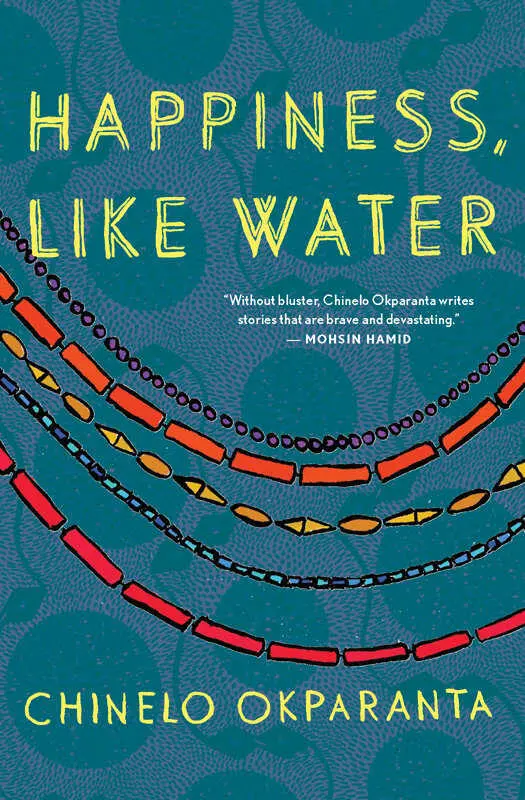
- Название:Happiness, Like Water
- Автор:
- Издательство:Mariner Books
- Жанр:
- Год:2013
- ISBN:нет данных
- Рейтинг книги:4 / 5. Голосов: 1
-
Избранное:Добавить в избранное
- Отзывы:
-
Ваша оценка:
Happiness, Like Water: краткое содержание, описание и аннотация
Предлагаем к чтению аннотацию, описание, краткое содержание или предисловие (зависит от того, что написал сам автор книги «Happiness, Like Water»). Если вы не нашли необходимую информацию о книге — напишите в комментариях, мы постараемся отыскать её.
Here are Nigerian women at home and transplanted to the United States, building lives out of longing and hope, faith and doubt, the struggle to stay and the mandate to leave, the burden and strength of love. Here are characters faced with dangerous decisions, children slick with oil from the river, a woman in love with another despite the penalties. Here is a world marked by electricity outages, lush landscapes, folktales, buses that break down and never start up again. Here is a portrait of Nigerians that is surprising, shocking, heartrending, loving, and across social strata, dealing in every kind of change. Here are stories filled with language to make your eyes pause and your throat catch.
introduces a true talent, a young writer with a beautiful heart and a capacious imagination.
"Intricate, graceful prose propels Okparanta’s profoundly moving and illuminating book. I devoured these stories and immediately wanted more. This is an arrival." — NoViolet Bulawayo
"Okparanta's prose is tender, beautiful and evocative. These powerful stories of contemporary Nigeria are told with compassion and a certain sense of humor. What a remarkable new talent." — Chika Unigwe
"A haunting and startlingly original collection of short stories about the lives of Nigerians both at home and in America.
is a deeply affecting literary debut, the work of a sure and gifted new writer." — Julie Otsuka
Happiness, Like Water — читать онлайн бесплатно полную книгу (весь текст) целиком
Ниже представлен текст книги, разбитый по страницам. Система сохранения места последней прочитанной страницы, позволяет с удобством читать онлайн бесплатно книгу «Happiness, Like Water», без необходимости каждый раз заново искать на чём Вы остановились. Поставьте закладку, и сможете в любой момент перейти на страницу, на которой закончили чтение.
Интервал:
Закладка:
There is a folk tale that Mama used to tell me when I was still in primary school. She’d tell it in the evenings when there was not much else to do, those evenings when NEPA had taken light away and there was no telling when they’d return it. I’d sit on a bamboo mat, and she’d light a candle, allow its wax to drip onto the bottom of an empty can of evaporated milk, a naked can, without its paper coating. She’d stick the candle on the wax and allow it to harden in place. And then she’d begin the story.
In the dim candlelight, I’d observe the changes that took place on her face with each turn of her thought. Soft smiles turned to wrinkles in the forehead, then to distant, disturbed eyes which then refocused, becoming clear again like a smoggy glass window whose condensation had been dispelled suddenly by a waft of air.
The folk tale was about an imprudent little boy, Nnamdi, whose wealthy father had been killed by a wicked old man who envied his wealth. Having killed Nnamdi’s father, the wicked old man steals all of the family’s possessions so that Nnamdi and his mother are left with not even a small piece of land on which they can live. And so it is that they make their new home in the bush. There they find a two-month-old goat kid, a stray, with a rope around its neck. Nnamdi’s mother ties the goat to a tall iroko tree. Still, they continue to eat the green and purple leaves of the plants in the bush for food, because Nnamdi’s mother decides that they are to save the goat. It will grow, she says, and when it does she will sell it for so much money that they will be able to move out of the bush, or at least to build a nice house for themselves there.
But one day, foolish Nnamdi leads the goat by its rope into the market place, and he sells it to a merchant who gives him a bagful of what the boy assumes is money. But when he returns to the bush, to his mother, Nnamdi opens the bag to find several handfuls of udara seeds, some still soggy, coated thinly with the flesh of the fruit.
His mother, angry at him not only for selling the goat, but also for doing so in exchange for mere seeds, furiously tosses them into the bush. The next morning, Nnamdi finds that a tall udara tree has grown, taller even than the iroko, so tall that its tips reach into the soft white clouds in the sky.
Nnamdi climbs the tree against his mother’s wishes. In the uppermost branches, he finds a large, stately house-in-the-sky. He parts the branches, those thin stalks at the tip of the tree, and pushes through the rustling leaves. He arrives at an open window and enters the house that way. First he calls out to see if anyone is home. Once. Twice. There is no response.
There is a large table not far from the window. Nnamdi walks to the table. It is covered with a white cloth fringed with silk tassels. Nnamdi runs his fingers across the tassels. In the air, there is the scent of something savoury, a little curried, perhaps even a little sweet. Nnamdi follows the scent into the kitchen and there, on the stove, the lid of a large pot rattles as steam escapes from beneath. Nnamdi lifts the lid and breathes in the savoury scent. And then he sees it, through the doorway of the kitchen, in the parlour: a lustrous cage sitting atop a white cushion. The cushion is nearly as tall as he is. Inside the cage is a golden hen, perched on the top half of the hutch. All over the parlour floor, he sees coins, glistening like the cage. Glistening like the hen.
Nnamdi goes into the parlour. He climbs the cushion and takes the hen. By one wall of the parlour, lined on the floor, are half a dozen small bags. Nnamdi peeks into them and sees that they are filled with more gold coins. He ties some of the bags around his waist, others he fastens to the hem of his shorts. He removes his shirt and makes a sack out of it. He slings the sack across his chest and carefully places the golden hen inside.
The wicked old man returns in time to see Nnamdi climbing down the udara tree. He pursues the boy, catching him just as Nnamdi leaps from one branch to the next, catching him by the bag of coins that is fastened to his shorts. But Nnamdi manages to escape the old man’s grasp. He wriggles away, leaving the old man with just the bag of coins.
Nnamdi takes off once more, gains ground, and finally lands safely in the bush. In fact, he gains so much ground that he is able to begin chopping down the udara tree before his pursuer has made it past the halfway point. Feeling the sudden swaying of the tree, the wicked old man scrambles back up to his home in the clouds before the tree falls. But he scrambles back without his golden hen, and with only that one bag of coins.
The story always stopped there, and then I’d pester Mama to tell me more. ‘What about the rest?’ I’d ask. Did the hen continue to produce the gold coins? If so, for how much longer? And what did Nnamdi and his mother do with the coins? Did they build for themselves a huge mansion right there in the bush? Or did Nnamdi give all the coins away like he did with the goat? Did he perhaps even give the hen itself away? Did they all live happily ever after?
‘There’s no rest,’ Mama would say. Or sometimes, ‘The rest is up to you.’
That night, my final night in the inn, I sit on my bed and I recall every twist of that folk tale. I think of crude. And I think of gold. And I think of crude as gold. I imagine Nigeria — the land and its people — as the hens, the producers of the gold. And I think that even when all the gold is gone, there will always be the hens to produce more gold. But what happens when all the hens are gone, when they have either run away or have been destroyed? Then what?
The next day, I collect my paperwork from the embassy, and hours later, I head back to Port Harcourt to pack my bags. The bus bounces along the potholed roads, causing my head and heart to jolt this way and that. But I force my eyes shut as if shutting them tight will prevent me from changing my mind, as if shutting them tight will keep regret from making its way to me.
Shelter
It wasn’t that Mama never tried to take us away. There was that once she did. We were on Buswell Street then. I was in middle school, merely eleven or twelve years old.
We used to watch that old television, the one with the broken antenna, which stuck up weakly like the tentacles of an injured animal. That day E.T . was showing on the screen, his eyes big and blue. Wrinkled E.T., looking like an overgrown lizard.
I was gawking at the screen when I heard the jingling of Papa’s keys. The door flung open. He entered, went straight to their room. Suddenly his voice was booming, and Mama’s little voice was countering; but it was hardly a counter at all.
When she finally came out of the room, there was blood dribbling down one side of her lips. Papa followed her, shouting and flailing his hands. I watched them both from where I sat, afraid to go between them and all his anger.
She went into the kitchen. He followed her. I stood up from where I sat and followed them both. I stopped at the entrance of the kitchen, that doorway without a door, just like the doorway leading from the parlour into the kitchen of our old Port Harcourt house. I continued to watch.
At the sink, he hovered above her, muttering now, no longer shouting. Perhaps speaking that way was the best he could do to gain back control of his anger. He spoke that way as she turned on the tap, and as she bent her head towards the running water. He was still speaking that way as she washed the blood off her face. But then he lost control once more, and the muttering turned back to shouting.
She straightened up and made to walk away, but he closed the space between them, grabbed her by the shoulders, then by the hair, pushed and pushed so that eventually she was down on her knees. I rushed into the kitchen then, wriggling my little body between them, screaming and screaming for him to let go. Eventually he did.
Читать дальшеИнтервал:
Закладка:
Похожие книги на «Happiness, Like Water»
Представляем Вашему вниманию похожие книги на «Happiness, Like Water» списком для выбора. Мы отобрали схожую по названию и смыслу литературу в надежде предоставить читателям больше вариантов отыскать новые, интересные, ещё непрочитанные произведения.








Обсуждение, отзывы о книге «Happiness, Like Water» и просто собственные мнения читателей. Оставьте ваши комментарии, напишите, что Вы думаете о произведении, его смысле или главных героях. Укажите что конкретно понравилось, а что нет, и почему Вы так считаете.