John Domini - Bedlam and Other Stories
Здесь есть возможность читать онлайн «John Domini - Bedlam and Other Stories» весь текст электронной книги совершенно бесплатно (целиком полную версию без сокращений). В некоторых случаях можно слушать аудио, скачать через торрент в формате fb2 и присутствует краткое содержание. Год выпуска: 2015, Издательство: Dzanc Books, Жанр: Современная проза, на английском языке. Описание произведения, (предисловие) а так же отзывы посетителей доступны на портале библиотеки ЛибКат.
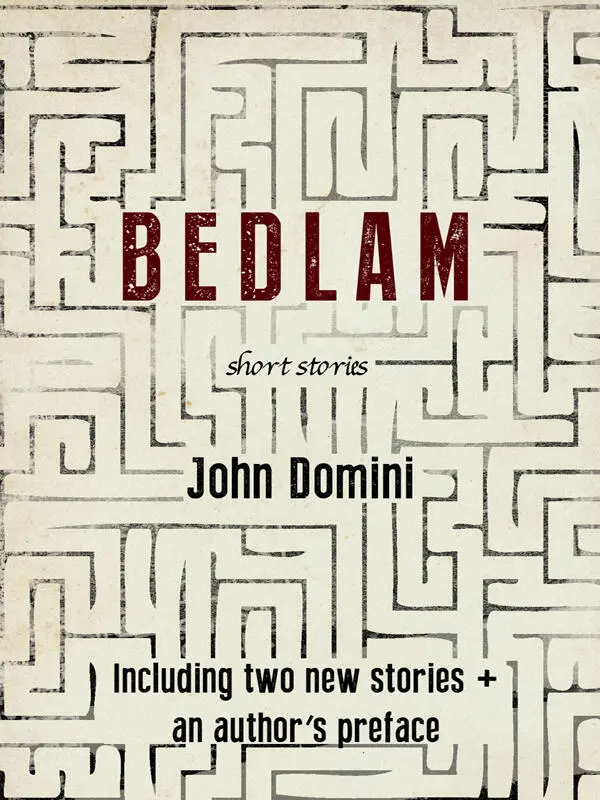
- Название:Bedlam and Other Stories
- Автор:
- Издательство:Dzanc Books
- Жанр:
- Год:2015
- ISBN:нет данных
- Рейтинг книги:4 / 5. Голосов: 1
-
Избранное:Добавить в избранное
- Отзывы:
-
Ваша оценка:
Bedlam and Other Stories: краткое содержание, описание и аннотация
Предлагаем к чтению аннотацию, описание, краткое содержание или предисловие (зависит от того, что написал сам автор книги «Bedlam and Other Stories»). Если вы не нашли необходимую информацию о книге — напишите в комментариях, мы постараемся отыскать её.
Bedlam and Other Stories — читать онлайн бесплатно полную книгу (весь текст) целиком
Ниже представлен текст книги, разбитый по страницам. Система сохранения места последней прочитанной страницы, позволяет с удобством читать онлайн бесплатно книгу «Bedlam and Other Stories», без необходимости каждый раз заново искать на чём Вы остановились. Поставьте закладку, и сможете в любой момент перейти на страницу, на которой закончили чтение.
Интервал:
Закладка:
“So, Henry. You can see my position, I hope. I’ve got to know what you’re going to do with the extra time that you couldn’t do already.”
“Well I’m not chasing after anything impossible,” Pinnerz said. “Honestly. All we’ve got now is a tooth and a bit of that jaw, but with a human skeleton just one more bone is usually enough to make a, a more precise identification.”
“Or you could find nothing. You could waste a day.”
“Well there are the property records, too. If we don’t at least take the time to look them over, then that day’s work’s been wasted.”
“Wasted?” Bud tipped his head slowly towards first one ear, then the other, as if the next words required special balance. “You said your son didn’t do the work.”
“I said he didn’t work out . He did the work.”
“Don’t start shouting, Henry. I get enough of that around here already.”
Like that, Pinnerz decided to talk. Where had keeping secrets got him? Where, except stumbling into one wrong move after another? He wasted a moment freeing his shirt from the splotches of sweat across his back, but he’d made up his mind already. Because no matter how carefully he controlled the story — no matter how much he made it seem as if the story was only between the girl and his son — talking would get some part of it off his chest at least.
“Okay.” He squatted for the first time. “Okay, you might as well know. You see I’ve got this research assistant this summer. A woman. A girl, I mean; she’s my son’s age. She’s 23. Ah. And so you see Tripp — that’s my son — well he’s her age, like I say, and she’s, she’s not bad-looking.”
“No kidding,” the talker in the crew said. “She’s the blonde, right? The one with the hair always blowing in her face. She hardly ties it back even when she’s over there working. And she’s got—”
“Quiet,” Bud said. “I want to hear this.”
In fact all the men were looking at Pinnerz. But before he continued he squinted back towards the dig a while, forearms on knees and one set of knuckles grinding against the other palm. A pause long enough for one of the crew to choke on his coffee and thickly spit.
“So yesterday,” Pinnerz said at last, “I, I sent them over to the state records office. I sent them both over there. Ah. I sent them in order to get whatever material he, ah, in order to find whatever material they might find that could help us. I mean we have to know who owned this property to begin with. And then also since this used to be shoreline here, well I don’t want to get your hopes up but these could be Indian bones. These could be 400, 500 years old.
“Anyway I, I sent my son and this girl over. To find out. And, ah. I don’t know if you’ve ever seen a records office, but I’ll tell you, it’s just a big empty library. Essentially. It’s just, the stacks. These rows and rows of shelves and nobody ever there to bother you.”
A couple chins started to rise. Some candy-stained teeth were showing.
“Well so midway through, ah, sometime yesterday afternoon, I have to go over there. To the state records office. And there they tell me, my son and this girl—”
The talker in the crew, his Mediterranean eyebrows and cheekbones emphasized by his glee, clenched both hands into fists and slapped the inside of one wrist against the back of the other rhythmically.
Pinnerz managed a small grin himself. “Need I say more?”
End of the card game. Helmets came off, faces cracked wide with laughter. A couple men even massaged their bald spots or, with goofy smiles, hooked the front scoops of their undershirts and yanked them down to reveal tattoos of stubby threatening knives or hearts fat as balloons. “Henry,” the foreman kept saying, “Henry.” A better relief than any breeze Pinnerz might have caught earlier. With the men laughing, he could wind up the story as fast and sloppily as he wanted. He could say that, since the state was paying for this project, it wouldn’t have been wise to let his son hang around after a scene like that. Nobody was going to forget a scene like that. So the boy had been asked to skip town; so the crew’s noise eased again as they followed his logic, the sniggers and chesty hoots drowned out by the traffic that went on circling just beyond the dry plywood walls round their excavation.
And the girl? someone asked
“Well I, I do need a research assistant.”
“Henry, Henry.”
“And of course the money’s an obstacle for her. The summer’s almost over and a girl in her position doesn’t have many options.”
Spoken like he was sorry. His wild story had resolved itself as an ordinary problem of hard cash, sorry. And the crew had quieted. The foreman even looked at his watch. But Bud’s half-smile showed more lip, and the corners of his eyes more white.
“You know,” the foreman said, “I useto have a place up in New Hampshire. Wasn’t much I mean, but my grandparents useto farm and we had the barn converted like. Well that didn’t work out after the divorce. Henry here being divorced, he’ll understand.”
Pinnerz understood; now the foreman had to have his turn.
“Before me’n’Charl, before we went our separate ways so to speak, my Eddie was up there practically every weekend, I mean all year round, up in that barn with a different girl every weekend. Regular cathouse we were running. So then about two months after I had to sell — and I don’t mind telling you that was some kind of shock, letting go of the place. I had to just sit and look at the papers for a whole weekend I think before I could sign ’em finally. But anyway like I was saying, two-three months go by after we sell. And then I get this phone call, from the police up there. It seems my Eddie broke in. They’d changed the locks on him but he broke in. And him and some girl, up there—”
Bud nodded the conclusion. His crew didn’t so much laugh as shake their heads noisily, hitching their boots in closer, hooking their elbows round their knees. Pinnerz stayed in his squat and kept his eyes on his folded hands.
“You know just last Saddy,” the talker said, “I was up by the rotary there, the one by Tufts there, when these two girls, I swear to God they looked like college girls, they—”
“Save it, Rudy,” the foreman said. Bud was crumpling his coffee cup unnecessarily, folding it into something hard and wrinkled as a chip of granite. Pinnerz noticed that the black man in the crew was already on his feet. “We’ll have time for that kind of story at lunch.”
Careful now. The space here at the top of the chimney was small as anywhere else, the bricks round his bubble as toothy and close as anywhere else. Pinnerz held his place while the men rose and chucked their papers past him into the nearest can. When he stood, likewise, he ignored them. Only after the archaeologist had stretched two ways and squinted back at his dig once more, after the black man and another worker had pulled on their gloves and wrestled one shoulder each under a massive loop of black cable — only then did Bud step deliberately into Pinnerz’s line of sight.
“So it’s your professional opinion,” the foreman began, “that them bones might be Indian bones.”
No such luck. Pinnerz would have liked this to be an older skeleton, and not only because a native American drew more attention in the field. Also an Indian could be anyone. This sense of possibility would always tickle at Pinnerz, whenever he worked with preliterate cultures. An opening in the past that seemed as large sometimes as the opening beyond his own future. But no; these bones were more recent. That very night, in his study, Pinnerz was astonished to discover that in fact he might know the corpse’s name. The records his son had dug out the previous afternoon revealed, after an hour’s cross-checking between old maps and new, that for thirty-two years this land had been used as a fitting-yard by one of the shipbuilders who thrived during the generation just after the Revolution. Thomas Handesyd Perkins. And like most Brahmins the man had been a tyrant when it came to keeping the books, insisting on the same careful records for slaves and indentures as for ship’s rigging and townhouse improvements. So, with that much to help date the findings made at the same level as the bones, the key for Pinnerz became the fragments of a pelvis his students had unearthed that afternoon. They’d never have found it if he hadn’t gotten them the additional time. First dusting the new bit of skeleton once more, Pinnerz now took a good half-hour working it over with a pair of calipers, and he checked each measure against the appropriate graph. No question, then. This had been a woman. Judging from the tooth and mandible found earlier, she’d been young, less than twenty-five; judging from the soil at the site, she’d lain underwater, kept from rising possibly by some length of rope or chain like those that had turned up throughout the old fitting-yard. Back to Perkins’s records. About midnight, just as the aches were starting to close round his spine, Pinnerz found her. An Irish indentured girl assigned to the dockside kitchens, Mary Chasuble or Chaseable. The name in either case no doubt had been invented, once she’d come to this country, so that she might have that much more of a fresh start. “Dissap’d,” the record read. “Thot Drown’d or run away. 21 Sep 1799. Ag’d 19 or 20.”
Читать дальшеИнтервал:
Закладка:
Похожие книги на «Bedlam and Other Stories»
Представляем Вашему вниманию похожие книги на «Bedlam and Other Stories» списком для выбора. Мы отобрали схожую по названию и смыслу литературу в надежде предоставить читателям больше вариантов отыскать новые, интересные, ещё непрочитанные произведения.





Обсуждение, отзывы о книге «Bedlam and Other Stories» и просто собственные мнения читателей. Оставьте ваши комментарии, напишите, что Вы думаете о произведении, его смысле или главных героях. Укажите что конкретно понравилось, а что нет, и почему Вы так считаете.