Russ Franklin - Cosmic Hotel
Здесь есть возможность читать онлайн «Russ Franklin - Cosmic Hotel» весь текст электронной книги совершенно бесплатно (целиком полную версию без сокращений). В некоторых случаях можно слушать аудио, скачать через торрент в формате fb2 и присутствует краткое содержание. Год выпуска: 2016, Издательство: Soft Skull Press, Жанр: Современная проза, на английском языке. Описание произведения, (предисловие) а так же отзывы посетителей доступны на портале библиотеки ЛибКат.
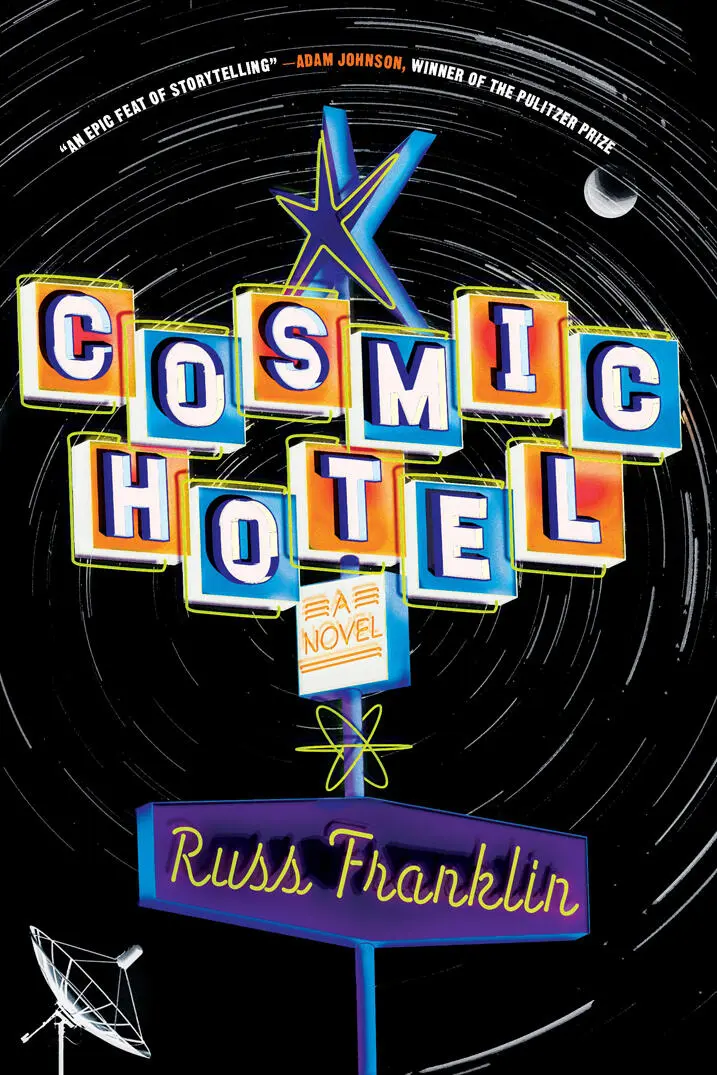
- Название:Cosmic Hotel
- Автор:
- Издательство:Soft Skull Press
- Жанр:
- Год:2016
- ISBN:нет данных
- Рейтинг книги:3 / 5. Голосов: 1
-
Избранное:Добавить в избранное
- Отзывы:
-
Ваша оценка:
Cosmic Hotel: краткое содержание, описание и аннотация
Предлагаем к чтению аннотацию, описание, краткое содержание или предисловие (зависит от того, что написал сам автор книги «Cosmic Hotel»). Если вы не нашли необходимую информацию о книге — напишите в комментариях, мы постараемся отыскать её.
Van Ray shows up broke with his pregnant ex-wife astronaut in tow, claiming to have discovered a big secret that will change their lives forever; a new discovery guaranteed to change him from “science famous” to “famous famous.”
With his family together for the first time in years, Sandeep must juggle his father’s scientific search, his mother’s failing business and the tension of having family all together for the first time in decades.
Cosmic Hotel — читать онлайн бесплатно полную книгу (весь текст) целиком
Ниже представлен текст книги, разбитый по страницам. Система сохранения места последней прочитанной страницы, позволяет с удобством читать онлайн бесплатно книгу «Cosmic Hotel», без необходимости каждый раз заново искать на чём Вы остановились. Поставьте закладку, и сможете в любой момент перейти на страницу, на которой закончили чтение.
Интервал:
Закладка:
He was wrapping up the reading, “The universe itself is a wonder but often completely unfascinating to ordinary people, and therefore they want to believe in little green men, monsters, or God. .”
Here, in the video, he does a double take, adjusts his glasses with his knuckle.
He said she mouthed words at him, holding an unlit cigarette beside her head and he recognized Ruth Christmas. Her gorgeous dark hair was gone.
Van Raye stopped the reading midsentence and tried to hear what she was saying. Here was his most recent ex-wife.
“I’m sorry, darling?” he asked.
Annoyed, she spoke louder from the thin audience, “I have something for you.” There was percolating from the coffee boiler in back, and the shifting of the few people in the audience to see who was interrupting.
Van Raye cleared his throat. “Wonderful,” he mumbled.
He found the place in the book and wrapped up, “Why do human beings find such outrageous beliefs comforting? Can they not find satisfaction in reality? Has reality not served them well? Why isn’t the neutrino, which can pass through matter, not as exciting as a ghost?”
CHAPTER 19
To write this book, I have researched websites and personal blogs of people who attended some of the public events of his book tour, and I have noticed that quite a few of the women posing with him have their hands on his stomach.
The reception at his university that night Ruth showed up was in a room adorned with portraits of dead university presidents. He signed all twelve books presented to him in the same way:
On the night
of the noisy coffee maker.
Van Raye
Ruth, who sat at a table by herself, watched people posing with him, and she said she felt at ease for the first time since she’d returned to Earth, watching him with his arm curled around the book, trying to pay attention to the people he was signing for, but his eyes kept finding her, her fake smoking an unlit cigarette.
When the caterers were clearing away the one table of food, he went to her and stood without speaking.
She said, “Not a big crowd, huh? It’s a sad thing when people no longer find you interesting. If only they knew what you’ve found.”
“Let’s keep quiet, shall we? When did you get back?” He straightened his posture and asked the bartender for a beer, got it and guided her away. He swigged from his Heineken and smiled at a couple with their coats over their arms, wanting to talk to the author before they left, but he turned his back to them.
“This is my home,” Ruth said. She touched her head as though she could fix the stubble of hair. “What? You don’t want to see me?”
“I didn’t say that.” A server came and put a new Heineken on the table and took the empty bottle from Van Raye.
“Should you be doing that?” she asked, pointing to the beer.
“You knew all along I didn’t have a problem.”
Three years ago he’d shown up to a department meeting with ice cubes in a glass of Guinness beer. When asked by the chairman what he was drinking, Van Raye had told him it was iced coffee. The department had formed an intervention (not including Ruth who was training in Houston) and gave him the ultimatum that it was AA or face serious reprimands. AA seemed like such a commitment that Van Raye had quit drinking, and in the last several years he’d gotten into the habit of not drinking, and he’d kept on not drinking until now.
Now he tried to look at Ruth, put the Heineken bottle to his lips. He’d forgotten the perfect click a Heineken bottle makes when it touches your incisors . No other beer bottle is made so perfect , he thought. Also the hissing foam in the mouth. That sounded like a large audience applauding. He took swigs just to hear applause.
He felt electricity when he touched the sleeve of Ruth’s insulated parka as he swallowed and thought about her body beneath it. He remembered her strong legs and her daringness in bed, the way she would hop around. Now she stank a little.
“Would you like to go back to my place?” he asked.
“I was surprised to find that it was still your place.”
“It’s still my house,” he said. “Barely. Is that yours?” He pointed at the radio in the chair beside her.
“Yes,” she said without taking her eyes off him. “I have to tell you something: I’m pregnant.”
There was the sound of bottles being placed on the serving cart, the last caterer walking across the room.
“Oh,” he said, thinking. “How long have you been back?”
She pulled the sleeve of the parka to see her watch. “Ten days. I think. I lost track.”
“That was fast,” he said.
She narrowed her eyes and waited for him to think.
“Oh,” he said. “Up there?”
She nodded.
“Is that why you came back down?”
“It played a part in my decision, yes.”

They left the auditorium, walking through the sculpture garden, “The Gates of Hell” illuminated by spotlights.
They walked through the dry lakebed toward home, Van Raye with two beers in his sweater’s pockets stretching the fabric, bottles tapping against his thighs. Above the trees was a dome of light pollution cast from the university golf course’s arc lights.
“Let’s see,” Ruth said counting the brighter stars with her finger. “Now where is it?”
“Don’t point,” he said.
“There are the twins. There’s Capella,” she said, her hand held straight out, “so I’d follow it east. It would be about. . there, third star down. There’s a planet there full of life. Chava Norma!”
“Don’t say it out loud, please,” he said.
They were on a small pedestrian bridge. Van Raye glanced to see only a student walking through the grass using her open laptop like a flashlight, illuminating the ground before her.
“Please don’t be flippant about this,” he said. “I’m not ready for anyone to know.”
“Why not?” she said.
“Soon,” he said. “But I have things to do first.”
Moonlight highlighted the lakebed’s grass. He took a breath. “Sometimes I don’t believe it’s real,” he said. “What if I made it all up in my mind?”
“You’re forgetting I heard it too,” she said. “I’m not crazy.”
She stopped and put the radio on the railing of the bridge. She unhooked the gold latch on the front of the radio and lifted the front cover to reveal the old radio dial. She extended the antenna and turned it on, illuminating the eight bands on the dial.
“You don’t think you can. .” he started. “That’s not possible.”
Big band music played until she pushed the button for the dial labeled NIGHTS & EVENINGS and then there was the whining of white noise. She dialed through voices, Spanish and more Spanish, an Australian calling out numbers, then more music, and she fine-tuned to a silence among the chaos and then a humming interlaced with a pattern of clicks like a needle stuck at the end of a record.
“My God,” he said sitting back on the railing. “How?”
“The space station’s high gain is still trained on it. When I fell to Earth, I made sure it would keep tracking. It’s broadcasting down to old Cold War repeaters, which in turn broadcasts it over Earth.”
“We shouldn’t do that,” he said.
“Why? It’s hidden in plain sight. Do you think anyone knows what this is? The telemetry of your signal isn’t there, only the sound. Does it sound a little like a didgeridoo to you?”
“No,” he said.
She took out a plastic lighter, lit the cigarette.
“Should you be doing that ?” he asked, pointing to the cigarette. “If you are pregnant.”
Читать дальшеИнтервал:
Закладка:
Похожие книги на «Cosmic Hotel»
Представляем Вашему вниманию похожие книги на «Cosmic Hotel» списком для выбора. Мы отобрали схожую по названию и смыслу литературу в надежде предоставить читателям больше вариантов отыскать новые, интересные, ещё непрочитанные произведения.





![Benjamin Franklin - Memoirs of Benjamin Franklin; Written by Himself. [Vol. 2 of 2]](/books/747975/benjamin-franklin-memoirs-of-benjamin-franklin-wr-thumb.webp)
![Benjamin Franklin - Memoirs of Benjamin Franklin; Written by Himself. [Vol. 1 of 2]](/books/748053/benjamin-franklin-memoirs-of-benjamin-franklin-wr-thumb.webp)
Обсуждение, отзывы о книге «Cosmic Hotel» и просто собственные мнения читателей. Оставьте ваши комментарии, напишите, что Вы думаете о произведении, его смысле или главных героях. Укажите что конкретно понравилось, а что нет, и почему Вы так считаете.