Gabriel Blackwell - Madeleine E.
Здесь есть возможность читать онлайн «Gabriel Blackwell - Madeleine E.» весь текст электронной книги совершенно бесплатно (целиком полную версию без сокращений). В некоторых случаях можно слушать аудио, скачать через торрент в формате fb2 и присутствует краткое содержание. Год выпуска: 2016, Издательство: Outpost19, Жанр: Современная проза, на английском языке. Описание произведения, (предисловие) а так же отзывы посетителей доступны на портале библиотеки ЛибКат.
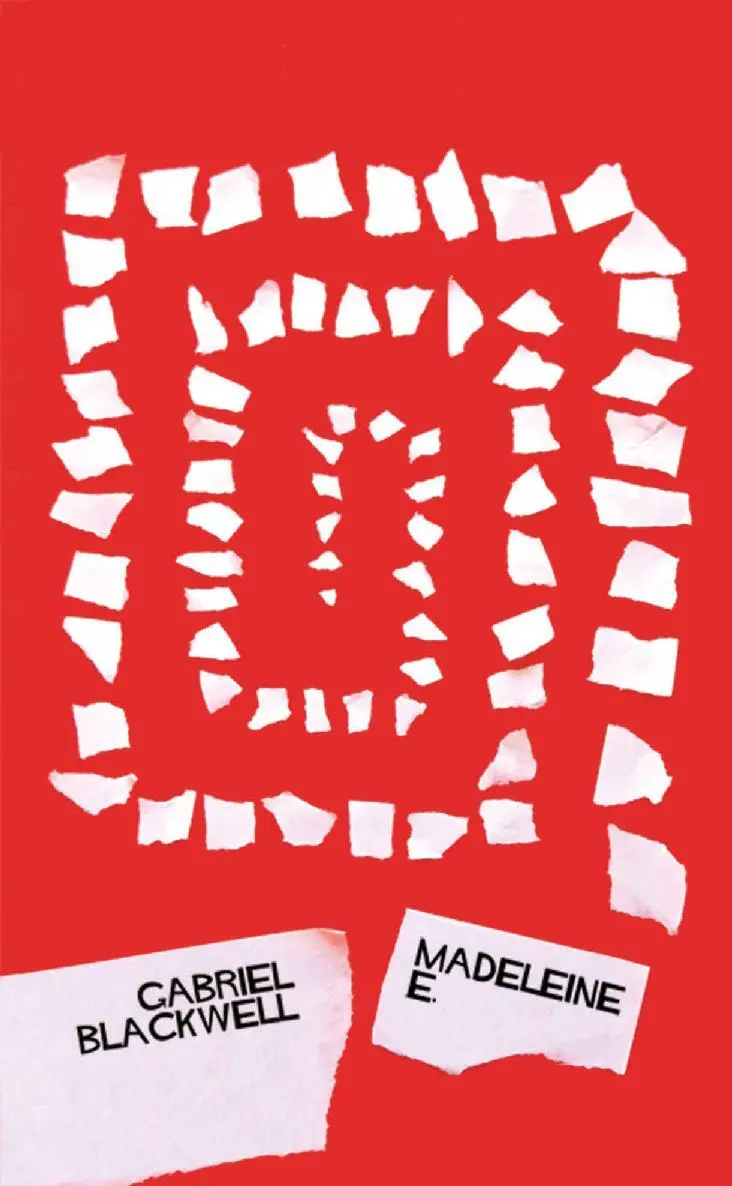
- Название:Madeleine E.
- Автор:
- Издательство:Outpost19
- Жанр:
- Год:2016
- ISBN:нет данных
- Рейтинг книги:4 / 5. Голосов: 1
-
Избранное:Добавить в избранное
- Отзывы:
-
Ваша оценка:
Madeleine E.: краткое содержание, описание и аннотация
Предлагаем к чтению аннотацию, описание, краткое содержание или предисловие (зависит от того, что написал сам автор книги «Madeleine E.»). Если вы не нашли необходимую информацию о книге — напишите в комментариях, мы постараемся отыскать её.
Madeleine E. — читать онлайн бесплатно полную книгу (весь текст) целиком
Ниже представлен текст книги, разбитый по страницам. Система сохранения места последней прочитанной страницы, позволяет с удобством читать онлайн бесплатно книгу «Madeleine E.», без необходимости каждый раз заново искать на чём Вы остановились. Поставьте закладку, и сможете в любой момент перейти на страницу, на которой закончили чтение.
Интервал:
Закладка:
(Wilde, Gray )
…
Fabrice comes to visit, and talks to me about the book I’m writing. He fixes on the construction of the chapter about the Night of the Long Knives: this series of phone calls, according to him, evokes both the bureaucratic nature and the mass production of what will be the hallmark of Nazism — murder. I’m flattered but also suspicious, and I decide to make him clarify what he means: “But you know that each telephone call corresponds to an actual case? I could get almost all the names for you, if I wanted to.” He is surprised, and responds ingenuously that he’d thought I’d invented this. Everyone finds it normal, fudging reality to make a screenplay more dramatic, or adding coherence to the narrative of a character whose real path probably included too many random ups and downs, insufficiently loaded with significance. It’s because of people like that, forever messing with historical truth just to sell their stories, that an old friend, familiar with all these fictional genres and therefore fatally accustomed to these processes of glib falsification, can say to me in innocent surprise: “Oh, really, it’s not invented?”
(Laurent Binet, HHhH )
…
I bring up my trip to San Francisco during dinner. My wife and I sit facing the television; she’s on the couch, I’m in my chair. She has been ignoring me all night. When I tried to give her a kiss after she got home, she leaned over to open the oven door. When I tried to give her a hug, she twisted away to clean off a plate. She has checked her cell phone more times than I can count. She has gone into our bedroom to charge it, gone into our bedroom to get it, partly charged. Now we are sitting down. She is eating, with her iPad in front of her and the tv playing something neither one of us is watching. When I mention the man again, I see that, rather than ignoring me, she has been shaking with anger. She looks up from her plate, straight at the tv. She says we couldn’t afford the trip in the first place. She doesn’t make enough to support us both much less pay for me to go on vacations without her, and now that I’m home, when I should be looking for work, I’m obsessing over this. whatever this is. She is sick of it. When she says this, she looks me right in the eye. She is angry. She is so angry I am scared. Not that she would do anything violent, but I’m scared that I’ve crossed some line, that we’ve crossed some line.
What is it about the eye that communicates so much of what we’re feeling? What physically, objectively, changes when we think we see emotion in another person’s eyes? Does it have to do with the pupil? With the shape of the eye (i.e., with how open or closed it is, whether the top eyelid is more closed than the bottom one or vice versa, what position the eyebrow’s in, etc.)? Or do we really somehow see through the eye into the soul? My wife’s eyes are focused on my own. Her eyelids aren’t closed, but her eyebrows are very, very close to her eyes, nearly folding over her top eyelids. Her pupils seem almost to have disappeared. The rest of her face remains completely still. I am finding it difficult to keep looking. It is uncomfortable. I am self-conscious. If I believe in what I’ve been saying, I should maintain eye contact. Maybe it’s not the eyes that express emotion, I think later, but their reflection in the perceiver’s eyes.
…
[INT. Livery Stable (DAY)]
…
How can you tell the main character of a story? By the number of pages devoted to him? I hope it’s a little more complicated than that.
(Binet, HHhH )
…
To influence a person is to give him one’s own soul. He does not think his natural thoughts, or burn with his natural passions. His virtues are not real to him. His sins, if there are such things as sins, are borrowed. He becomes an echo of someone else’s music, an actor of a part that has not been written for him. The aim of life is self-development. To realize one’s nature perfectly — that is what each of us is here for. People are afraid of themselves, nowadays. They have forgotten the highest of all duties, the duty that one owes to one’s self.
(Wilde, Gray )
…
I am too much concentrated on myself. My own personality has become a burden to me. I want to escape, go away, to forget.
(Wilde, Gray )
…
It’s not fair. It wasn’t supposed to happen this way. It shouldn’t have happened.
(01:15:12)
…
[INT. Church Tower (DAY)]
…
The measure of a man’s greatness would be in terms of what his work cost him.
Wittgenstein once told someone.
(David Markson, The Last Novel )
…
The guilty. may flee when no one pursues.
(Dick, Scanner )
…
I myself, I am not a character in this novel; I am the novel.
(Dick’s Author’s Note, Scanner )
…
Scottie: If I could just find the key, the beginning, and put it together.
Madeleine: To explain it away.
(01:04:23)
…
It’s too late, there’s something I must do.
(01:14:37)
…
Elster assumes Scottie will not follow Madeleine up the steps. He knows Scottie’s medical history. He knows of Scottie’s phobia. But what if Scottie follows Madeleine up the steps? As difficult as it would be, it isn’t impossible. What if he makes it to the top? In the novel, there is a physical barrier, a locked door. Flavierès (the novel’s Scottie) would have to climb out a window and then around the outside of the tower to get to Madeleine. In the movie, there is only Scottie’s fear to stop him.
…
There is a scene (is this the right word?) in the game Legend of Zelda: Majora’s Mask in which the player’s avatar is first doubled, then trebled, then quadrupled, playing one, two, three, and then four instruments at once, in four different forms. One of the conceits of the game is that there are masks that not only disguise the player but actually give him a different form altogether, transforming him into a different creature with extrahuman abilities (to breathe underwater, fly in the air, or walk through lava), and here, in this scene, all four forms are in play at the same time. Once the player has completed all four transformations and played the song in its entirety, the reward is, perhaps unsurprisingly, yet another mask, a mask that resembles exactly the original bearer of the mask, a character named Gorman, who gives the player the “Gorman Mask.” Putting the mask on, the player becomes Gorman. Why, one wonders, would someone carry a mask that looked exactly like himself? What advantage could that possibly give him? And yet, playing this section of the game, I was reminded that I had once asked for just such a thing from my wife, seeing it advertised by a company in Japan that made masks from photographs. My wife would not buy it for me, because, she told me, it would be frightening, and disturbing. Why would I want such a thing, she asked. It would not look like me, even though (because?) it would be designed to look like me.
…
So much of being a writer is, I think, about identity.
(Zambreno, Heroines )
…
In Adolfo Bioy Casares’s The Invention of Morel , the scientist Morel says, “Until recently science had been able to satisfy only the senses of sight and hearing, to compensate for spatial and temporal absences.” This idea, that recordings can “compensate” for “absences,” is one that originated with Thomas Edison, inventor of both the phonograph and the Kinetoscope. Edison designed the phonograph with the idea that it would be a kind of alternative to a live performance. It was not supposed to be a historical record of that performance, it was supposed to be a new performance itself — a phonograph of a trumpet, for instance, would stand in for that trumpet in a concert, the rest of the orchestra playing their parts and the phonograph playing its. But recordings are not compensations for absence. They can’t be. They’re something else. They are things. To see a recording as a compensation for absence makes the whole project seem noble, in a way: Even when its subjects have gone, the recording persists as though they hadn’t. Edison was trying to invent immortality. He intended his phonograph not as a method of archiving or disseminating sound but of producing it; the recording was the person whose voice it rendered. The idea is flawed at its core, and Edison eventually abandoned it, but it persisted nonetheless.
Читать дальшеИнтервал:
Закладка:
Похожие книги на «Madeleine E.»
Представляем Вашему вниманию похожие книги на «Madeleine E.» списком для выбора. Мы отобрали схожую по названию и смыслу литературу в надежде предоставить читателям больше вариантов отыскать новые, интересные, ещё непрочитанные произведения.






Обсуждение, отзывы о книге «Madeleine E.» и просто собственные мнения читателей. Оставьте ваши комментарии, напишите, что Вы думаете о произведении, его смысле или главных героях. Укажите что конкретно понравилось, а что нет, и почему Вы так считаете.