Paul Beatty - The White Boy Shuffle
Здесь есть возможность читать онлайн «Paul Beatty - The White Boy Shuffle» весь текст электронной книги совершенно бесплатно (целиком полную версию без сокращений). В некоторых случаях можно слушать аудио, скачать через торрент в формате fb2 и присутствует краткое содержание. Год выпуска: 2001, Издательство: Picador, Жанр: Современная проза, на английском языке. Описание произведения, (предисловие) а так же отзывы посетителей доступны на портале библиотеки ЛибКат.
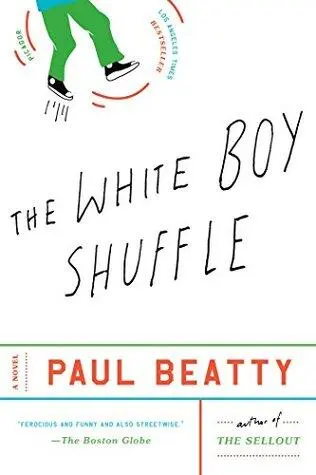
- Название:The White Boy Shuffle
- Автор:
- Издательство:Picador
- Жанр:
- Год:2001
- ISBN:нет данных
- Рейтинг книги:3 / 5. Голосов: 1
-
Избранное:Добавить в избранное
- Отзывы:
-
Ваша оценка:
The White Boy Shuffle: краткое содержание, описание и аннотация
Предлагаем к чтению аннотацию, описание, краткое содержание или предисловие (зависит от того, что написал сам автор книги «The White Boy Shuffle»). Если вы не нашли необходимую информацию о книге — напишите в комментариях, мы постараемся отыскать её.
The White Boy Shuffle — читать онлайн бесплатно полную книгу (весь текст) целиком
Ниже представлен текст книги, разбитый по страницам. Система сохранения места последней прочитанной страницы, позволяет с удобством читать онлайн бесплатно книгу «The White Boy Shuffle», без необходимости каждый раз заново искать на чём Вы остановились. Поставьте закладку, и сможете в любой момент перейти на страницу, на которой закончили чтение.
Интервал:
Закладка:
That first day Nick and I went to the park, about fifty players were standing in the hot sun, waiting their turn to play. When the game in progress ended, Scoby walked onto the court, touched his toes, alternately lifted his feet by the insteps until his heels touched his butt, and waited for whoever had winners to tell him who else was on his team. There was some unspoken protocol at work, and Nicholas apparently had diplomatic status. Soon a huge crowd gathered around the sidelines. Right from the start there was an intensity on the court that hadn’t been present in the previous game. Players who usually spent most of their precious court time arguing and disputing every call were silent and stealing glances at Scoby whenever they made a shot or did something particularly impressive. Scoby’s pregame announcement — “Niggers who come here for the attention best to leave now” — seemed to have had some effect.
I watched Nicholas play a few games and tried to figure what the big deal was. His team always won, but it wasn’t like he was out there performing superhuman feats. He didn’t sprout wings and fly, he didn’t seem to have eyes in the back of his head. There was always someone who jumped higher than he could, handled the ball better. Nick would make five or six baskets and that was it.
After winning his fourth straight game, he told me to walk over to the basket and dunk the ball.
“Huh?”
“Do what you did at school the other day.”
I walked under the basket with my brand-new ball cradled under my arm and flushed the electric orange orb through the hoop with two hands. A tall boy wearing a dark gray T-shirt that read “Wheatley High Varsity Basketball” in faded green letters sauntered over to me and started to small-talk.
“You know Scoby?”
“We go to Manischewitz together.”
“Your name Gunnar Kaufman?”
“Uh-huh.”
“You wrote that poem?”
“Mmmm-hmmm.”
“You wanna run?”
In as low a voice as I could muster, I said, “Yeah.” I had a rep before I ever played a game at the park, although I wasn’t sure exactly what for.
We played until nightfall. During what was shaping up to be the last game of the evening, it became impossible to see the basket farthest away from the streetlight. It was as if we were playing at the lunar surface during the half-moon. One side of the court was in complete darkness and the other fairly well lit. The score was tied at ten-ten and someone suggested we call the game a draw on account of darkness before someone got hurt. Scoby said, “Next basket wins.” My team had the ball and we were shooting at the visible basket. The high schooler in the gray shirt took a short shot that circled around the rim and fell out, right into Nick’s hands. Scoby took two speed dribbles, losing the man who was guarding him, and headed upcourt. When he crossed half-court he disappeared into the darkness, then quickly reappeared in the light without the ball. A second later you heard the crashing of the chain net as the ball arced through it.
“Game.”
Skipping the ball through my legs, imitating the moves I’d seen during the course of the day, I rounded the corner onto Sherbourne Drive and realized what Scoby’s rep was for: he never missed. I mean never.
five
SUMMER BEFORE my first year of high school was the summer niggers stopped sitting next to each other in the movies. We jaywalked, spit on the sidewalk, broke curfew, but strictly abided by the unwritten law prohibiting black boys over fifteen from sitting next to each other in the dark. One yawning unoccupied chair always belied our closeness, separating us like a velvet moat filled with homophobic alligators and popcorn as we solved cinematic mysteries with deductive street-smart reasoning.
“The pockmarked motherfucker from the country club gots to be the killer.”
“Nigger-ro, is you crazy? It’s the lefthanded honey with the juicy Maybelline lips and the fucked-up German accent. It’s always the foreigner. Kill again, you sexy thing, you.”
“Both you Sherlock Holmes cokeheads are wrong, it’s the Doberman pinscher. The mutt is hypnotized by the psychologist to kill on his say-so. Didn’t you see the bloody paw prints?”
In the past three years me, Nicholas, and Psycho Loco had become a heroic trio of sorts. We were the Three Musketeers, all for one and one for all, sipping watery lemon-lime soda from the same straw, galavanting in the streets, sounding off like wind chimes in the city breeze. By high school I was no longer the seaside bumpkin, clueless to the Byzantine ways of the inner city. But I hadn’t completely assimilated into Hillside’s culture. I still said “ant” instead of “awwwnt” and “you guys” rather than “y’all,” and wore my pants a bit too tight, but these shortcomings were forgiven because I had managed to attain a look. My sinewy physique drew scads of attention. I’d be on the bus or standing in line at the store and strangers would come up to me and knowingly nod their heads as if we shared some secret. The more straightforward ones would speak up and interpret my dreams for me.
“You play ball? Don’t say no, you got that look. I can tell by your calves. Skinny, powerful legs and the way you walk. Pigeon-toed, small ass ’n’ all. You ain’t nothing but a ballplayer.”
Despite the pigeonholing, it was fun to answer the inquiries and watch the populace swoon.
“How tall are you?”
“Six-five, baby, six-five.” I’d exaggerate by an inch and a half.
Not everyone was enamored of my height and athletic ability. There were those who didn’t care that I’d spent hours in the city’s gyms and parks perfecting my game. Not that I had ever asked anyone to care, but to some ghetto subcultures I was nothing more than a tall wise-ass punk who deserved a serious comeuppance.
Whenever I stopped to listen to the street-corner sermons of the all-albino brothers and sisters of NAPPY (New African Politicized Pedantic Yahoos), the speakers always singled me out as a traitor to my race, the dreaded heretic of the nation of sun people. After prophesying the founding of New Africa, a glorious day when the United States government would turn over five southern states to legions of turbaned pink-eyed heliocentrists, their leader, Tasha Rhodesia, would defiantly ask, “Any questions from the unbelievers?”
I’d raise my hand with a puzzled look on my face. A look that differed from my basketball mien, a look that said, “Maybe if I heard the right syllogism I’d make a worthy convert?”
Tasha Rhodesia would wave a light-skinned arm lined with copper bracelets cast from precious African metals ceremoniously over the crowd. “You, the proud young warrior, obviously of Watusi stock — what white propaganda infests your fertile African mind?”
“How can a bunch of people such as yourselves, who give themselves names like Wise Intelligent, P-Knowledge, and Erudite Judicious, be so fucking stupid?”
In Afrocentric slapstick, an offended neophyte would smush a bean pie in my face and banish me from the promised land.
Then there were the bands of bored Bedouins who roamed Hillside, silently testing my resolve by lifting their T-shirts, revealing a bellybutton and a handgun tucked in their waistband. “S’up, nigger?”
In response I’d lift my T-shirt and flash my weapons: a paperback copy of Audre Lorde or Sterling Brown and a checkerboard set of abdominal muscles. “You niggers ain’t hard — calculus is hard.”
“All right, Gunnar, you keep talking smack. Psycho Loco ain’t going to be around forever.”
My friendship with Psycho Loco did have its perks, but Scoby was right, Psycho Loco asked for a lot of favors. My back yard became a burial ground for missing evidence; warm guns and blood-rusted knives rested in unmarked graves under little mounds of dirt. I had nightmares about the ghosts of convenience-store clerks and ice-cream-truck drivers floating among the fruit trees, stuffing their puncture wounds with rotted fruit poultices.
Читать дальшеИнтервал:
Закладка:
Похожие книги на «The White Boy Shuffle»
Представляем Вашему вниманию похожие книги на «The White Boy Shuffle» списком для выбора. Мы отобрали схожую по названию и смыслу литературу в надежде предоставить читателям больше вариантов отыскать новые, интересные, ещё непрочитанные произведения.






Обсуждение, отзывы о книге «The White Boy Shuffle» и просто собственные мнения читателей. Оставьте ваши комментарии, напишите, что Вы думаете о произведении, его смысле или главных героях. Укажите что конкретно понравилось, а что нет, и почему Вы так считаете.