Paul Beatty - The White Boy Shuffle
Здесь есть возможность читать онлайн «Paul Beatty - The White Boy Shuffle» весь текст электронной книги совершенно бесплатно (целиком полную версию без сокращений). В некоторых случаях можно слушать аудио, скачать через торрент в формате fb2 и присутствует краткое содержание. Год выпуска: 2001, Издательство: Picador, Жанр: Современная проза, на английском языке. Описание произведения, (предисловие) а так же отзывы посетителей доступны на портале библиотеки ЛибКат.
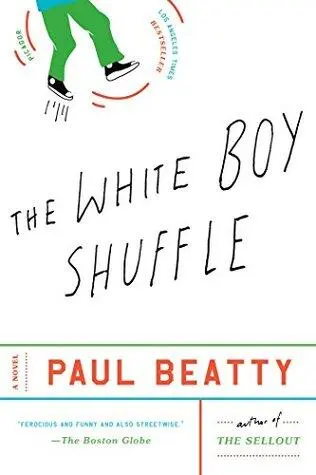
- Название:The White Boy Shuffle
- Автор:
- Издательство:Picador
- Жанр:
- Год:2001
- ISBN:нет данных
- Рейтинг книги:3 / 5. Голосов: 1
-
Избранное:Добавить в избранное
- Отзывы:
-
Ваша оценка:
The White Boy Shuffle: краткое содержание, описание и аннотация
Предлагаем к чтению аннотацию, описание, краткое содержание или предисловие (зависит от того, что написал сам автор книги «The White Boy Shuffle»). Если вы не нашли необходимую информацию о книге — напишите в комментариях, мы постараемся отыскать её.
The White Boy Shuffle — читать онлайн бесплатно полную книгу (весь текст) целиком
Ниже представлен текст книги, разбитый по страницам. Система сохранения места последней прочитанной страницы, позволяет с удобством читать онлайн бесплатно книгу «The White Boy Shuffle», без необходимости каждый раз заново искать на чём Вы остановились. Поставьте закладку, и сможете в любой момент перейти на страницу, на которой закончили чтение.
Интервал:
Закладка:
Whenever Manischewitz Junior High trundled onstage, our hiking boots clomped between deliveries and our baggy jeans hindered our emotive histrionics. When we stumbled over a line of Shakespearean blather, the judges looked down at their score sheets with self-satisfied smirks, tapped their pencils, and stared at us with bored expressions masquerading as smug impartiality. Paul Robeson was turning over in his grave.
By the time Scoby’s turn to recite came, we had managed to cultivate an atmosphere of good-natured white liberal pity among the audience. Scoby shakily introduced his monologue; “ Othello, act one, scene three. After plotting with Cassio to kill Othello, Iago…” Then Nicholas, choking on the patronizing sympathy, began. “Thus do I ever make my fool my purse … ummm…” He froze. Gathering his wits, he waved his arm majestically across his chest. “Thus do I ever make my fool my purse … fuck.”
The crowd started cheering him on as if he were one of those kids stricken with cystic fibrosis taking his first baby steps on a telethon at two o’clock in the morning: “Come on, guy, you can do it.” Two white girls, one of whom had just nailed Desdemona minutes earlier, boldly strode onstage and massaged Scoby’s rock-hard hypertensive shoulders and whispered honey-voiced encouragement in his ear: “You can do it, big boy.” Nicholas blurted out a spiritless “Thus do I ever make my fool my purse…” that died as soon as it left his lips. He slunk off the stage, his face hidden in his hands, his ears ringing with a deafening applause for failing. The defeated Manischewitz Drama Club sank in our seats and drowned under a tidal wave of shame.
A booming announcement from the emcee jolted the crowd from its collective condescension. “Next up, Manischewitz’s Gunnar Kaufman as Iago, Othello, act two, scene one.” I sauntered onto the stage and squinted into the spotlight, never feeling more misplaced, more burdenish, mo’ niggerish. I found it difficult to breathe. I was growing allergic to the powdery mask of Elizabethan whiteface. I could hear Scoby whimpering in the back as I cleared my throat.
“I’m junking Iago’s envy-laden ‘What a stupid moor-ronic nigger this Othello is’ speech for a less traditional bit from King Lear, act two, scene two. Note how the fusion of Goneril’s vile lackey Oswald and the loyal Kent’s lines give the monologue a self-hating and introspective spin.” Gazing directly at the judges, I grabbed my dick and ripped into my makeshift monologue. “What dost thou know me for? A knave, a rascal, an eater of broken meats; a base, proud, shallow, three-suited, hundred-pound, filthy, worsted-stocking whoreson … one-trunk-inheriting slave … beggar, Nigger … I will beat you into clamorous whining if thou deny’st the least syllable of thy addition.” I walked off the stage into a stunned auditorium of dazed crash dummies adrift in post-car-accident silence. At the top of my voice I yelled, “Is everyone all right? Anyone hurt?”
On the ride home Scoby saved me a seat in the back of the bus. I sat next to him, and like two shock absorbers we bounced up and down in the initial stages of lifelong friendship.
“Gunnar, you a crazy nigger.”
“Yeah, I guess so. Nick, where you be at lunchtime? I be looking for your ass, but I can never find you.”
“Monday meet me at the wine vats near the back gate.”
When Monday’s lunch bell rang I tore out of class and ran to the back gate to meet Scoby. He was already there with nine boys and one girl silently huddled about a tape deck. Those who weren’t lacing their sneakers and adjusting sweatbands were whipping a basketball around with a sharp crispness that seemed to singe the hands of whoever was on the receiving end. One boy was pulling on tube sock after tube sock until his feet looked as if they were encased in plaster casts. He winced as he placed his padded feet in a pair of hightop sneakers. I turned to the kid and said, “How many pairs of socks do you have on?”
“Seven.”
“Why?”
“For good luck, stupid.”
“Oh, yeah, right. Sure. My bad, I should’ve known.”
Nicholas Scoby peeked around the corner of the wine vats and said, “Okay, Mr. Uyeshima isn’t looking, let’s go.” The chainlink fence groaned and sagged under the weight of ten kids scaling it like boot camp Marines. From the other side Scoby looked back at me with a pained expression. “Yo, cuz, the radio.” I tossed the radio over and began climbing, catching my pants leg in the barbs at the top of the fence. None of the kids had bothered to wait for me; they were running down Airdrome Avenue, heading for the park.
“Kaufman!” It was Mr. Uyeshima, the dean of boys, yelling and blowing his whistle. He marched toward me, swinging his paddle. I flung myself onto the sidewalk, ripping my pants in the process, and ran after the rest of the gang.
I caught up with them at the park. There wasn’t much time and they were in a hurry to get started, kissing their talismans and pleading with Nicholas, “Scoby, fuck that nigger, let’s play.”
“Chill.” Nick Scoby turned toward me, whisking the ball behind his back and through his legs and looking me in the eye. “C’mon, Gunnar. It’s us five. Me, you” — he quickly pointed out three other boys — “Dontévius, Snooky, and Spoon.”
The kid who had painstakingly put on all those socks whined, “What about me? That’s fucked up. That skinny mark motherfucker can’t even play no ball.”
“Look, Patrick, sub for Spoon every six baskets.”
Patrick was right, of course. I’d never played a game of basketball in my life and told Nick so.
“Nick, I ain’t no ballplayer.”
“I know you ain’t. I seen you looking at those sonnets, drool dripping out your mouth. You either a poet or a homosexual.”
“Oh shit, that’s fucked up. Why can’t I be both?”
“True. Well, you can be a ballplayer too. If you want to hang with me, you’re gonna have to play ball. Awwright? Press the play button.”
I pressed the tape deck’s play button and a deep bass line rumbled over the blacktop. The music set the tempo and provided the ballplayers with a grooveline around which to improvise. They spun, twisted, lunged, and chased each other from pole to pole as I ran in circles, determined to stay as far away from the ball as possible and still look busy.
The Santa Monica school district didn’t have a physical education curriculum. Participation in organized sports was looked down on as the taboo dominion of society’s underprivileged. During Proletarian Pastimes Week, instead of playing sports we learned the rules. Ms. Cegeny had a nephew who was the UCLA basketball team’s manager. After he explained to us the intricacies of handing out towels to sweaty giants and the importance of liquid electrolyte replacement, he taught us the game, using two wastepaper baskets and a globe.
I jogged near the sidelines, trying to recall the nephew’s lessons. The other kids ran purposefully up and down the court. Adrianna Carros put Scoby on her hip, pump faked, spun left, and smartly banked the ball in the basket.
1. Double Dribble — No dribbling with two hands.
2. Foul — Touching an opposing player with ball results in a defensive foul.
3. Traveling —?
I remembered the UCLA team manager had had trouble explaining traveling, saying it was a vague rule that was often dependent on the referee’s interpretation. Deciding that visual demonstration would best explain the ambiguous violation, Ms. Cegeny’s nephew grabbed the globe firmly between two hands and ran about the room feigning a dribbling motion. Suddenly he stopped and jumped high in the air without shooting the metallic earth into the trash basket. When he landed he said, “If you do that, you’ve traveled.”
Читать дальшеИнтервал:
Закладка:
Похожие книги на «The White Boy Shuffle»
Представляем Вашему вниманию похожие книги на «The White Boy Shuffle» списком для выбора. Мы отобрали схожую по названию и смыслу литературу в надежде предоставить читателям больше вариантов отыскать новые, интересные, ещё непрочитанные произведения.








Обсуждение, отзывы о книге «The White Boy Shuffle» и просто собственные мнения читателей. Оставьте ваши комментарии, напишите, что Вы думаете о произведении, его смысле или главных героях. Укажите что конкретно понравилось, а что нет, и почему Вы так считаете.