Judith Hermann - Where Love Begins
Здесь есть возможность читать онлайн «Judith Hermann - Where Love Begins» весь текст электронной книги совершенно бесплатно (целиком полную версию без сокращений). В некоторых случаях можно слушать аудио, скачать через торрент в формате fb2 и присутствует краткое содержание. Год выпуска: 2016, Издательство: Clerkenwell Press, Жанр: Современная проза, на английском языке. Описание произведения, (предисловие) а так же отзывы посетителей доступны на портале библиотеки ЛибКат.
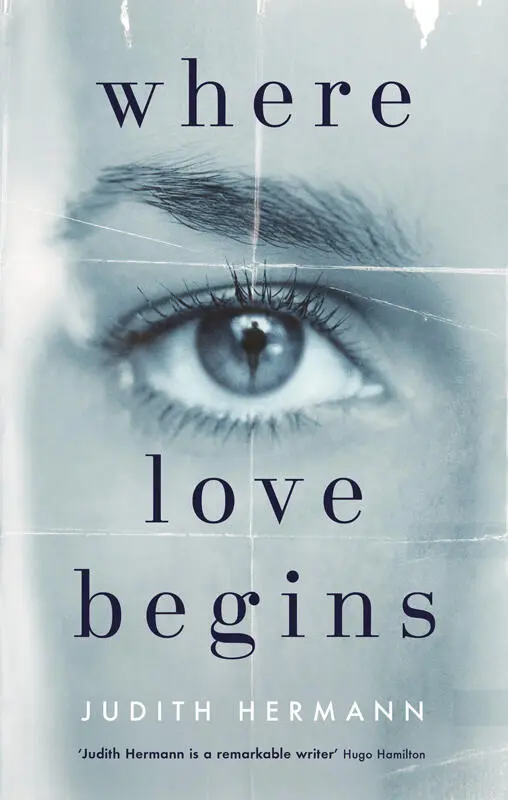
- Название:Where Love Begins
- Автор:
- Издательство:Clerkenwell Press
- Жанр:
- Год:2016
- ISBN:нет данных
- Рейтинг книги:4 / 5. Голосов: 1
-
Избранное:Добавить в избранное
- Отзывы:
-
Ваша оценка:
Where Love Begins: краткое содержание, описание и аннотация
Предлагаем к чтению аннотацию, описание, краткое содержание или предисловие (зависит от того, что написал сам автор книги «Where Love Begins»). Если вы не нашли необходимую информацию о книге — напишите в комментариях, мы постараемся отыскать её.
Her life is happy and unremarkable, but she is a little lonely-her husband travels a lot for work and so she is often alone in the house with only her daughter for company. One day a stranger appears at her door, a man Stella's never seen before. He says he just wants to talk to her, nothing more. She refuses. The next day he comes again. And then the day after that. He will not leave her in peace. When Stella works out that he lives up the road, and tries to confront him, it makes no difference. This is the beginning of a nightmare that slowly and remorselessly escalates.
Where Love Begins
Where Love Begins — читать онлайн бесплатно полную книгу (весь текст) целиком
Ниже представлен текст книги, разбитый по страницам. Система сохранения места последней прочитанной страницы, позволяет с удобством читать онлайн бесплатно книгу «Where Love Begins», без необходимости каждый раз заново искать на чём Вы остановились. Поставьте закладку, и сможете в любой момент перейти на страницу, на которой закончили чтение.
Интервал:
Закладка:
This here. Gesturing at the box.
There’s nothing about Ava in this, Jason says. He’s reading as he says it; he’s reading the page with the ant-like writing, shaking his head as he reads; he says, Disgusting, there’s something disgusting about it. It’s probably good that you don’t want to read it. There’s nothing in here about Ava and nothing about you. Nothing really about you.
What would a sentence about me be, Stella wonders. A sentence about me that would mean something to you, and the impossibility of finding an answer to this question is clear and stark. She thinks, I’m actually a mythical figure for Jason. A mythical figure. There’s nothing that he could say about me really, no description that could apply to me.
Stella gets up. Now Jason is holding the photo and looking at it with a critical expression. He says, My goodness. This is the last straw, isn’t it.
He holds up the photo; shows it to Stella as if assuming that she hadn’t seen it yet. He looks at Stella, he sees that she is pale, but she doesn’t seem pale enough for him to reach out to her, to touch her.
He says, I’ll go by there. Tomorrow. Tomorrow I’ll go over there.
He says, You were there already, weren’t you. Passed by his place, didn’t you.
No, of course not, Stella says. I haven’t gone by his place.
As far as she can remember, this is the first time she has ever lied to Jason.
Thirteen
Jason takes Ava to her kindergarten on Stella’s bicycle. He comes back, spends an hour at his desk with the door closed, looking through his mail and telephoning. Then, taking a garden chair to the edge of the meadow, he sits down there with his back to the house.
He brushes his hand from the back of his neck over his head, a gesture Stella loves — not that she would ever have told him that. She assumes that if she told him he would no longer do it.
*
She’s sitting at her desk upstairs in her room, writing a letter to Clara — the entire garden smells like a greenhouse, and in the evening the rabbits venture out of the field; Jason is back; I live like a war bride; you know, don’t you, what I feel like? What is your life like, and how far removed is that life from the life we imagined ten years ago, and does it even matter — She can hear Jason downstairs in the kitchen; the refrigerator door opening and closing again; he moves the chairs closer to the table and puts the dishes into the dishwasher that Stella never uses, and turns it on; then he sweeps the sunroom. He takes the bottled water crates out and sets them next to the car; goes back into the hall, closes the front door behind him, stands in the hall doing nothing; maybe he’s looking through the little window at the garden. He goes back through the living room into the kitchen and seems to stop and hesitate next to Stella’s armchair with all the books around it; if he were observant, he’d be able to see that Stella hasn’t sat in that armchair for the last two weeks, not really read anything in it for two weeks; the pile of books is completely neglected; how observant is Jason actually, and which book is Stella trying to read just now in spite of everything; I’m trying to read a book by an author in which there actually are sentences like: A man in love walks through the world like an anarchist, carrying a time bomb. There’s nothing more to do in the kitchen. Jason clears his throat; there’s a note of warning in it. Then at last he comes up the stairs, stops at Stella’s door, and says, Am I bothering you.
No, Stella says.
She puts the pen down on the paper and turns to face him.
*
Jason is sitting on the guest bed, his back leaning against the wall, his legs crossed, a rare visitor. Stella stays at her desk; suddenly she finds it odd to see Jason in her room surrounded by things that belong to her: on the same bed — under the shelf attached to the wall on which there sat a porcelain cardinal bird next to a snow globe, a golden Buddha, and a row of pebbles from the Black Sea — the bed on which, day after day, she had fallen into restless sleep at noon in the apartment she shared with Clara ten years ago. Stella’s bookshelf, Stella’s desk, her pens and candles, to Jason some surely foolish-seeming incense sticks, the pearl necklaces around the chair leg, the bird feather on the wall, and the orange cloth clamped for the last two weeks into the window frame and tied around the window handle, an orange cloth with white peacocks on it. Stella suspects that at some point Jason made contact with all this, made contact with Stella’s world. As if he’d been on an expedition, maybe it was arduous, painfully slow. Has he, leaning back on her bed, arms crossed over his chest, and eyes almost closed, arrived now? Would he like to stay, or would he like to travel onward, or go back again, or somewhere else. Stella sees Jason’s — to her beautiful and unapproachable — face. She feels that she can’t change anything in his movements, wherever they will lead, forward or back, and surprisingly, this is bearable.
I’ll just walk over there, Jason says.
He sits up, rubs his eyes.
He looks at Stella, he looks past her; he says, Is that all right with you? I’d just walk over there again.
Yes, Stella says. She smiles in a way that feels strange even to herself. She’d like to say, I’m sorry, but she feels that this sentence can’t encompass the extent of what it is that she’s sorry about; actually she doesn’t even know what exactly she’s sorry about. Is it an imposition for Jason to go over there? To deal with Mister Pfister because she has to deal with him?
It would be better if he stayed here. Stayed with her.
Well, see you then, Jason says.
See you soon, Stella says.
*
She waits in the garden. On the chair where Jason had been sitting. Noontime is very quiet. It’s getting hot. In one of the other gardens a lawn mower starts up, and far away a child calls. Butterflies startle up from the lawn, the sky is grey. Someone rides past the house on a bike. Stella yawns.
After a while Jason comes back. He says, He wasn’t there. Or he didn’t open the door; that could be it too, but I think he wasn’t there. What a neglected hovel.
Jason looks around, looks at his own house as if he were comparing it. From the outside, the effect of a window with broken shells lying on its sill. Empty bottles by the terrace door, Ava’s jacket hanging over a spade handle.
Stella says nothing.
Nor does she say, I knew he wouldn’t be there. It was obvious that he wouldn’t be there.
Mister Pfister will never be there when Jason goes over there. He isn’t answerable to Jason; he’ll never be at home, never open his door to Jason.
*
But she runs into him when she goes shopping the following day. Early in the evening, at the shopping centre, at the checkout in the supermarket. She went there by bicycle, intending to buy milk, eggs, alphabet noodles, butter, nothing else; she decides to take a shopping basket instead of a cart, is walking to the turnstile through which you go to get inside the shop, when she sees Mister Pfister standing at the last cash register.
Hard to believe that he goes shopping. Gets hungry, wants to buy himself something to eat. Says please and thank you, good day, goodbye.
It’s the first time Stella has seen him outside. In everyday life, there he stands, waiting in the queue at the checkout counter next to a cigarette machine under a monitor on which a weather forecast alternates with advertisements for car-body paint shops; in the background, the labyrinth of grocery shelves, pyramids of water melons, references to products, and over it all, hellish music. He’s got the things he wants to buy assembled in a cardboard box; he holds the box to his chest, moves one mechanical step forward in the queue, a man like all the others, Mister Pfister exists.
Читать дальшеИнтервал:
Закладка:
Похожие книги на «Where Love Begins»
Представляем Вашему вниманию похожие книги на «Where Love Begins» списком для выбора. Мы отобрали схожую по названию и смыслу литературу в надежде предоставить читателям больше вариантов отыскать новые, интересные, ещё непрочитанные произведения.








Обсуждение, отзывы о книге «Where Love Begins» и просто собственные мнения читателей. Оставьте ваши комментарии, напишите, что Вы думаете о произведении, его смысле или главных героях. Укажите что конкретно понравилось, а что нет, и почему Вы так считаете.