Sophie Hannah - Hurting Distance
Здесь есть возможность читать онлайн «Sophie Hannah - Hurting Distance» весь текст электронной книги совершенно бесплатно (целиком полную версию без сокращений). В некоторых случаях можно слушать аудио, скачать через торрент в формате fb2 и присутствует краткое содержание. Год выпуска: 2010, Издательство: Penguin Group USA, Inc., Жанр: Современная проза, на английском языке. Описание произведения, (предисловие) а так же отзывы посетителей доступны на портале библиотеки ЛибКат.
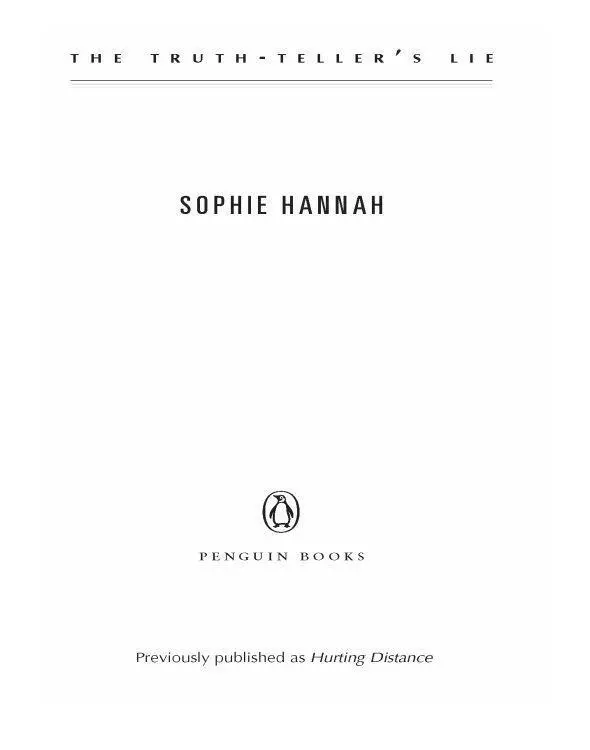
- Название:Hurting Distance
- Автор:
- Издательство:Penguin Group USA, Inc.
- Жанр:
- Год:2010
- ISBN:нет данных
- Рейтинг книги:4 / 5. Голосов: 1
-
Избранное:Добавить в избранное
- Отзывы:
-
Ваша оценка:
Hurting Distance: краткое содержание, описание и аннотация
Предлагаем к чтению аннотацию, описание, краткое содержание или предисловие (зависит от того, что написал сам автор книги «Hurting Distance»). Если вы не нашли необходимую информацию о книге — напишите в комментариях, мы постараемся отыскать её.
compelling.”— “As . . . Agatha Christie gleefully trampled on that sacrosanct rule of the mystery novel to ‘play fair with the reader,’ the power this novel packs derives from narrators who play fast and loose with what they know. . . . The solution is a stunner.”— “Spine-tingling.”—
(top pick)
“A tautly claustrophobic spiral of a story.”— “Clever and original. . . . She has a brilliant new career ahead of her.”— “A splendid crime-psychological thriller. . . . A book so well-plotted and so well-written deserves to have its surprises kept intact.”— “Riveting reading.”— A serial rapist relies on successful career women’s shame to insulate him from punishment. Then one of them sets out to find her missing lover, a married man, and in so doing exposes a sinister plot.
Sophie Hannah
Little Face
Hurting Distance
Hurting Distance — читать онлайн бесплатно полную книгу (весь текст) целиком
Ниже представлен текст книги, разбитый по страницам. Система сохранения места последней прочитанной страницы, позволяет с удобством читать онлайн бесплатно книгу «Hurting Distance», без необходимости каждый раз заново искать на чём Вы остановились. Поставьте закладку, и сможете в любой момент перейти на страницу, на которой закончили чтение.
Интервал:
Закладка:
Naomi would string me up from the nearest lamp post. That was the second time Simon had heard the word ‘lamp post’ in a very short space of time. He’d said it himself, first time round, talking about Gibbs’ stag night, the one Sellers had forgotten to arrange. Simon had wondered why Gibbs cared so much—a sane man would want to avoid being stripped and tied up, which seemed to be what happened at these—
Simon’s heart screeched to a stop. Then it started with a hefty jolt. Bloody hell, he thought. Bloody, bloody hell.
He excused himself and left the room, his mobile phone already in his hand. A few things were becoming horribly clear; the least important of these was that, from now on, the whole team would have to look back on Chris Gibbs’ weeks-long huff as something to be grateful for, however unpleasant it might have been while it lasted.
24
Saturday, April 8
‘I’M GOING TO pull over at the next services,’ says Charlie Zailer. Then, as an afterthought, ‘All right?’ Her voice sounds choked. She doesn’t look at me, hasn’t since we set off. She faces straight ahead as she talks, as if she’s using a hands-free mobile phone, speaking to someone far away.
‘I’ll stay in the car,’ I tell her. I want to close myself in, put a metal box around my body so that I’m invisible. This was a mistake. I shouldn’t be here. How do I know she’s telling the truth about the man and wherever it is we’re going?
If I’m going to see him again, it shouldn’t be on his territory. It should be at a police station, in a line-up. Panic starts to chew at the corners of my mind. This feels wrong. I ought to tell Sergeant Zailer to stop the car and let me out now, here, on the hard shoulder. It was a bright day when we set off, but we’ve been driving for an hour, and the sky in this part of the country is light grey with darker grey jagged patches scrawled across it. The wind is hissing, blowing the rain diagonally across the windscreen. I picture myself cold and drenched by the side of the road, and say nothing.
The faint, rhythmic beat of the indicator makes me look up. We pass blue signs with slanted white lines: three, two, one. Motorway language. You once told me you find motorways relaxing, even if the traffic’s stalled. ‘They have a special rhythm,’ you said. ‘They go somewhere.’ The intense look in your eyes; was I capable of understanding this thing that was so important to you? ‘They’re like magic, like a yellow-brick road for adults. And they’re beautiful.’ I pointed out that most people wouldn’t agree. ‘Then they’re fools,’ you said. ‘You can keep your listed buildings. There’s no sight more impressive than a long, grey strip of motorway stretching into the distance. There’s nowhere I’d rather be. Apart from here with you.’
I push the thought from my mind.
Sergeant Zailer drives faster than she should into the service-station car park. I stare at my lap. If I allow myself to look out of the window, I might see a red lorry that looks a bit like yours. If I go inside, I might see a food court that resembles the one at Rawndesley East Services. My breath stops in my throat when it occurs to me that here, too, there might be a Traveltel.
‘You should come in, get a coffee, stretch your legs,’ Sergeant Zailer says gruffly, climbing out of the car. ‘Go to the toilet.’ The last few words are faint, carried away by the wind.
‘What are you, my mother?’
She shrugs and slams the door. I shut my eyes and wait. Thinking is impossible. I try to point a spotlight at my brain and find it empty. After a few minutes, I hear the car door open. I smell coffee and cigarettes; the combination makes me feel sick. Then I hear Charlie Zailer’s voice. ‘The man who raped you is called Graham Angilley,’ she says. ‘He’s Robert’s brother.’
Bile rises in my throat. Graham Angilley. Where have I heard the name Angilley before? Then it comes to me. ‘Silver Brae Chalets,’ I manage to say.
‘The theatre where you were, where the audience was . . . it wasn’t a theatre. It was one of the chalets.’
This makes me open my eyes. ‘It was a theatre. There was a stage, with curtains.’
‘Each of the chalets has its master bedroom on a mezzanine floor. It’s like a room without walls, a high square platform that you could easily mistake for a stage. And there are wooden railings around the mezzanine, with curtains, to give the bedroom more privacy.’
As she speaks, I can see it. She’s right. That’s the detail I couldn’t quite remember about the curtains—I knew there was something. They didn’t fall down from the ceiling. They were attached to a sort of rail. If I hadn’t been tied to the bed, if I’d stood up, I’d have been able to peer over the top.
Silver Brae Chalets. In Scotland. A real place, where people go for their holidays, to have fun. Where I wanted to take you, Robert. No wonder you were so shocked and upset when I told you I’d booked it.
‘Yvon, my best friend, designed their website,’ I say. ‘There were no wooden railings between me and the audience. Just a horizontal metal rail, going round three sides of the stage.’
‘Maybe each chalet’s slightly different,’ Sergeant Zailer says. ‘Or maybe the one you were in was unfinished.’
‘It was. The window I looked through—there was no curtain there. And the skirting boards were still bare wood, not painted yet.’ Why has this not occurred to me before?
‘What else can you tell me?’ Sergeant Zailer asks. ‘I know you’ve been withholding something.’
I stare at my hands in my lap. I’m not ready. How does she know Graham Angilley’s name? Has she been to Silver Brae Chalets? Something feels not quite right.
‘Fine,’ she says. ‘Let’s talk about the weather, then. Shit, isn’t it? I’m surprised you make a living out of sundials, in this country. Anyone ever invents a raindial, they’ll make a mint.’
‘There’s no such thing.’
‘Yeah, I know that. I was talking crap.’ She lights a cigarette, opening the window a fraction. Cold rain slices in through the rectangular slit, hitting me in the face. ‘What do you think of sundials that don’t tell the time, ornamental ones?’
‘I object to them,’ I tell her. ‘It doesn’t take that much longer to make a proper dial. A sundial that doesn’t tell the time isn’t a sundial. It’s just a piece of junk.’
‘They’re cheaper than real ones.’
‘Because they’re rubbish.’
‘My boss wants one for our nick. He wants a real one, but the powers-that-be won’t let him spend the money.’
‘I’ll make him one,’ I hear myself saying. ‘He can pay me whatever he can afford.’
Charlie Zailer looks surprised. ‘Why would you do that? Don’t say as a favour to me—I won’t believe you.’
‘I don’t know.’ Because if I promise to make something for your boss, I will have to survive this trip. If I talk as if I believe I’ll survive, then maybe I will. ‘What sort does he want?’ I ask.
‘One that can go on the wall.’
‘I’ll do it for free if you’ll take me to the hospital again to see Robert. I have to see him, and they won’t let me in without you.’
‘He told you to leave him alone. And he’s a rapist. Why do you want to see him?’
She will never guess. Nobody could guess the truth, apart from me. Because I know you so well, Robert. However you feel about me, I do know you well.
‘Juliet Haworth wasn’t involved in organising the rapes,’ I say. ‘Whether they were . . . done for some kind of perverted pleasure or whether money was made out of them . . . whatever. Juliet has nothing to do with it.’
Читать дальшеИнтервал:
Закладка:
Похожие книги на «Hurting Distance»
Представляем Вашему вниманию похожие книги на «Hurting Distance» списком для выбора. Мы отобрали схожую по названию и смыслу литературу в надежде предоставить читателям больше вариантов отыскать новые, интересные, ещё непрочитанные произведения.




Обсуждение, отзывы о книге «Hurting Distance» и просто собственные мнения читателей. Оставьте ваши комментарии, напишите, что Вы думаете о произведении, его смысле или главных героях. Укажите что конкретно понравилось, а что нет, и почему Вы так считаете.