Роберт Фиш - Rough Diamond
Здесь есть возможность читать онлайн «Роберт Фиш - Rough Diamond» весь текст электронной книги совершенно бесплатно (целиком полную версию без сокращений). В некоторых случаях можно слушать аудио, скачать через торрент в формате fb2 и присутствует краткое содержание. Город: Garden City, N.Y., Год выпуска: 1981, ISBN: 1981, Издательство: Doubleday, Жанр: Современная проза, на английском языке. Описание произведения, (предисловие) а так же отзывы посетителей доступны на портале библиотеки ЛибКат.
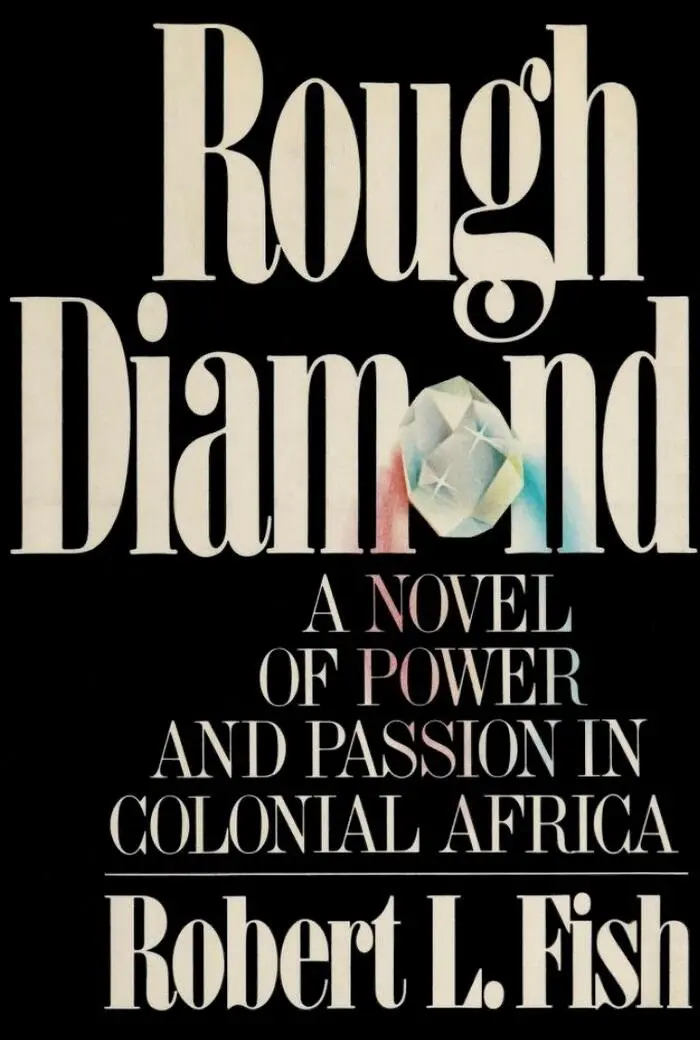
- Название:Rough Diamond
- Автор:
- Издательство:Doubleday
- Жанр:
- Год:1981
- Город:Garden City, N.Y.
- ISBN:978-0-385-15648-6
- Рейтинг книги:5 / 5. Голосов: 1
-
Избранное:Добавить в избранное
- Отзывы:
-
Ваша оценка:
Rough Diamond: краткое содержание, описание и аннотация
Предлагаем к чтению аннотацию, описание, краткое содержание или предисловие (зависит от того, что написал сам автор книги «Rough Diamond»). Если вы не нашли необходимую информацию о книге — напишите в комментариях, мы постараемся отыскать её.
Young Barney Barnato had nothing to lose when he abandoned his squalid existence in London’s East End and set out for the Dark Continent to make his fortune. He built an empire and became a threat to the ruthless Cecil Rhodes, who scorned the pauper-turned-tycoon and tried at every turn to destroy him.
But the ghetto Jew proved to be more than a match for the snobbish Rhodes, who had bought himself a title and craved total control of the diamond trade, where millions were made and lost overnight.
Barnato’s struggle, which took him from unbearable poverty to unimagined riches, from loveless slums to the loving arms of a beautiful woman, always stalked by the malevolent Rhodes, makes for a riveting novel blending history with fiction in the frontier days of nineteenth-century empire building.
Rough Diamond — читать онлайн бесплатно полную книгу (весь текст) целиком
Ниже представлен текст книги, разбитый по страницам. Система сохранения места последней прочитанной страницы, позволяет с удобством читать онлайн бесплатно книгу «Rough Diamond», без необходимости каждый раз заново искать на чём Вы остановились. Поставьте закладку, и сможете в любой момент перейти на страницу, на которой закончили чтение.
Интервал:
Закладка:
“I am still absolutely amazed,” said Beit, addressing Rhodes who sat at the head of the table, “that you and Barnato have never met in person.” Beit was a short, rotund man with a happy disposition; he had been the leading trader in diamonds in Kimberley until Barney Barnato had overtaken him, but that fact had never dampened his good humor, nor did it in any way interfere with his meeting with Barnato when the need arose. He would even visit Barney at the Paris Hotel on occasion for dinner, mainly because he enjoyed Fay Barnato’s company. “After all,” he went on, “the two of you are the biggest factors in the business today.”
Rhodes shrugged. “There has never been any reason for me to meet the man as far as I could see,” he said, and leaned back in his chair, a large stoop-shouldered man with sharp hooded eyes that constantly went from face to face around the table. “He’s not my type of person,” he added, and fell silent, reaching for his whiskey glass, letting the others voice their opinions before he rendered the final decision.
“Well, I think it’s time to talk to him now,” Rudd said. He was sitting to the left of Rhodes, tilted back in his chair, a large cigar between his teeth. “Since he took over Kimberley Central and merged it with Barnato Mining, he’s taking more diamonds out of the mines than anyone else. Hell, we control the selling output of three mines, De Beers, Bultfontein, and Dutoitspan, and Barnato with half of the Kimberley hole is making us look sick.” He wiped ash from his cigar and returned it to his lips. “If he ever gets his hands on the other half, he could bankrupt us by flooding the market.”
“He got a big jump on us and everyone else in getting decent equipment to mine the blue ground,” Beit pointed out.
“That was a long time ago. Water over the dam,” Rudd said evenly. “You can’t cut your whiskey with it today.”
“He was also the first one to sink shafts and put through galleries to the blue, to get away from flooding,” Beit went on.
Rudd looked at him and nodded. Of all the others on the board of directors, Rudd liked Beit the best. He also thought that Beit had the best mind among them, and would have made a better chairman than Rhodes, although he also knew that Beit would have refused the position had it been offered him. “Everything you say is true, Alfred,” he said evenly, “which only makes the problem more acute. We lost a year to him back in ’seventy-seven and ’seventy-eight and we’ve never caught up. Between what’s in his safe and what he’s already shipped to London, Barnato probably has enough diamonds all together to put the entire market on the skids if he wants to. What he’s been releasing, added to our own releases, has already depressed the market. Try to picture what it would be like if he dumped the whole kit and caboodle.”
“Not to mention the illicit stones they say he handles,” Pickering said. Rhodes’ secretary was a smooth-faced young man in his late twenties, with a fair complexion and hair the color of mealie silk. No sooner had he spoken than he looked at the head of the table as if for confirmation from his boss, but Rhodes remained listening with no expression at all on his face.
“Let’s not get off on that tangent,” Rudd said sharply. “There’s no proof at all that Barnato deals in stolen stones, and if he did it would only make the situation worse.”
“So what’s the answer?” It was Dr. Jameson speaking. He was a handsome swashbuckling type in his early thirties with a swarthy complexion and black curly hair, a relative newcomer to Kimberley. His interest in diamonds was quite superficial; he had never been in a diamond mine and never intended to be in one if he could help it. His directorship was due principally to the fact that he was Rhodes’ personal physician and was a friend of the other directors. The small investment he had made in De Beers shares was merely the excuse the others had needed to invite him on the board. That investment had paid the doctor handsome dividends until the drop in diamond prices; now that investment could even be in jeopardy. He stared across the table. “Well, Rudd?”
“There’s only one answer that I can see,” Rudd said. “If you can’t beat ’em, join ’em, as some great philosopher once said.”
“Dumping diamonds would hurt Barnato as much as us,” Pickering pointed out, and once more instantly looked at Rhodes to get his reaction. Again there was no sign from the expressionless face.
Beit looked at Pickering with a look that had more pity in it than censure. “He’d only dump them until we were bleeding at the pores,” he said. He had understood Rudd’s point perfectly. “When our shares fell to next to nothing on the London Exchange and the Paris Bourse, he’d buy us out for the price of cheap gaspers.”
“And we’d all go back to learning how to use a pick and shovel,” Rudd said glumly.
“I agree with Charles,” Beit went on, looking at the head of the table. “You’ve simply got to talk to the man, Cecil. You’re the major stockholder and the chairman. We all know, and have known for a long time, that the only way to keep the diamond market on an even keel, the only way to prevent the bottom from dropping out, is to have the release of all diamonds in the hands of one group, who would release enough stones to satisfy the market but not so much as to glut it and cause prices to go down. That’s been obvious for years. Things can’t go on the way they’ve been going. It’s foolish to have the equivalent of anarchy in this business when to all intents and purposes there are only two major parties left. Let the two parties come to an understanding, and everyone will benefit.”
There was silence. Rhodes waited, looking around the table, but no one spoke. After all, there was little reason to discuss an established fact. At last he drained his glass and nodded, not necessarily in agreement, but because he was now prepared to speak.
“Suppose,” he said slowly, “that we could get Robinson’s shares in his Standard Company, and Baring-Gould’s shares in the French Company. Think of it! We’d have half the Kimberley hole. Add that to what we already control, and let the little Jew have the rest!”
Beit reddened. He was Jewish, and although he was used to being put in a different category from Barnato in Rhodes’ mind, he still resented the other’s language.
“Just how would we get control?” he asked, trying to sound merely curious instead of negative. “We’re all agreed that Barnato has built up a fortune these last three or four years, enough to enable him to dump diamonds if he feels like it. We haven’t. If we start bidding for the Robinson and the Baring-Gould properties, bidding against Barnato — because obviously he’s not going to stand still and let us buy half of Kimberley — the price will simply go up and up until it could break both of us. And it would undoubtedly break us first. But just suppose” — he dropped his voice a bit so that the attention needed to hear him made the attention needed to understand him that much more acute — “just suppose we came to an agreement with Barnato! Suppose we could get Barnato to agree to ration his output, or to sell his stones through us? Then how could Robinson or Baring-Gould stand against us? Whether we bought them out or not would be immaterial; we could force them to either sell their stones through us or sell them at prices we determined. They’d have no choice, because we could put them out of business whenever we wished. What they would really do,” he added in a conversational tone of voice, “would be to sell out, because they are both intelligent men.” He smiled. “Sell out, that is, at our price, not at the exaggerated price that would be the result of a fight between Barnato and us.”
Читать дальшеИнтервал:
Закладка:
Похожие книги на «Rough Diamond»
Представляем Вашему вниманию похожие книги на «Rough Diamond» списком для выбора. Мы отобрали схожую по названию и смыслу литературу в надежде предоставить читателям больше вариантов отыскать новые, интересные, ещё непрочитанные произведения.



Обсуждение, отзывы о книге «Rough Diamond» и просто собственные мнения читателей. Оставьте ваши комментарии, напишите, что Вы думаете о произведении, его смысле или главных героях. Укажите что конкретно понравилось, а что нет, и почему Вы так считаете.