Richard Powers - Bewilderment
Здесь есть возможность читать онлайн «Richard Powers - Bewilderment» весь текст электронной книги совершенно бесплатно (целиком полную версию без сокращений). В некоторых случаях можно слушать аудио, скачать через торрент в формате fb2 и присутствует краткое содержание. Город: New York, Год выпуска: 2021, ISBN: 2021, Издательство: W. W. Norton & Company, Жанр: Современная проза, на английском языке. Описание произведения, (предисловие) а так же отзывы посетителей доступны на портале библиотеки ЛибКат.
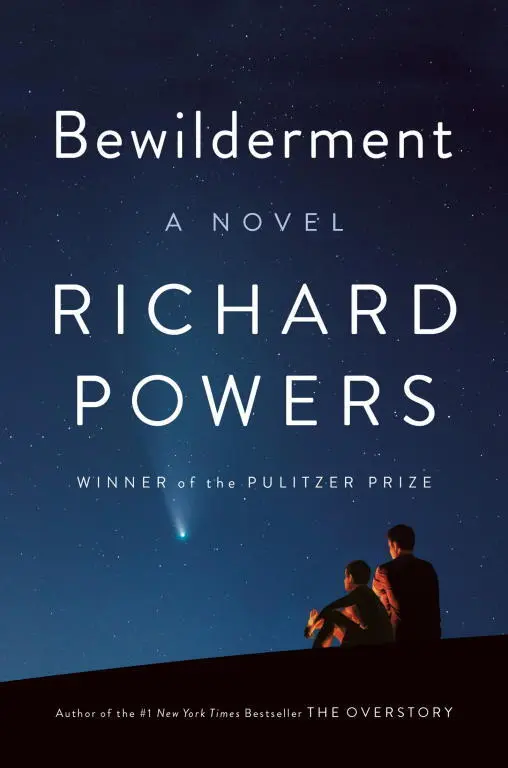
- Название:Bewilderment
- Автор:
- Издательство:W. W. Norton & Company
- Жанр:
- Год:2021
- Город:New York
- ISBN:978-0-39388-114-1
- Рейтинг книги:4 / 5. Голосов: 1
-
Избранное:Добавить в избранное
- Отзывы:
-
Ваша оценка:
Bewilderment: краткое содержание, описание и аннотация
Предлагаем к чтению аннотацию, описание, краткое содержание или предисловие (зависит от того, что написал сам автор книги «Bewilderment»). Если вы не нашли необходимую информацию о книге — напишите в комментариях, мы постараемся отыскать её.
best-selling author of
. Named one of the Most Anticipated Books of 2021 by
,
,
,
,
,
,
,
,
,
, and
The astrobiologist Theo Byrne searches for life throughout the cosmos while single-handedly raising his unusual nine-year-old, Robin, following the death of his wife. Robin is a warm, kind boy who spends hours painting elaborate pictures of endangered animals. He’s also about to be expelled from third grade for smashing his friend in the face. As his son grows more troubled, Theo hopes to keep him off psychoactive drugs. He learns of an experimental neurofeedback treatment to bolster Robin’s emotional control, one that involves training the boy on the recorded patterns of his mother’s brain…
With its soaring descriptions of the natural world, its tantalizing vision of life beyond, and its account of a father and son’s ferocious love,
marks Richard Powers’s most intimate and moving novel. At its heart lies the question: How can we tell our children the truth about this beautiful, imperiled planet?
Bewilderment — читать онлайн бесплатно полную книгу (весь текст) целиком
Ниже представлен текст книги, разбитый по страницам. Система сохранения места последней прочитанной страницы, позволяет с удобством читать онлайн бесплатно книгу «Bewilderment», без необходимости каждый раз заново искать на чём Вы остановились. Поставьте закладку, и сможете в любой момент перейти на страницу, на которой закончили чтение.
Интервал:
Закладка:
Robbie was right: we needed universal mandatory courses of neural feedback training, like passing the Constitution test or getting a driver’s license. The template animal could be a dog or a cat or a bear or even one of my son’s beloved birds. Anything that could make us feel what it was like to not be us.
-
HE DROPPED A GLASS BOWL on the kitchen tiles. It shattered into pieces. One sliver cut his bare heel as he jumped back. A year ago, he would have spun out in tears or rage. Now he simply grabbed his hurt foot and held it in the air. Oh, snap! Sorry, sorry! After we washed and bandaged him, he insisted on sweeping up his mess. A year ago, he wouldn’t have known where to find the broom.
“Impressive, Robbie. Like you’re coming at this whole life thing with a totally different game plan.”
He burrowed a slo-mo fist into my soft underbelly and laughed. Actually? It’s kind of like that. Old Robin would be all: Waaah! He pointed up at the ceiling. New Robin is up there, looking down on the experiment .
He tented his hands in front of his lips. It was the funniest gesture, like he was channeling Sherlock Holmes. Like he and I were old dudes, reflecting on the long and winding road that had deposited us in front of a fireplace in the common room of an assisted living facility. Remember how Chester would tear up a book or pee on the carpet? You couldn’t really get mad at him because, he was just a dog, right?
I waited for him to complete the thought. But it turned out the thought was already complete.
-
I BROUGHT ROBBIE IN for his last training of the summer. By then the whole lab was in awe of him. Ginny gave Robbie comics and took me down the corridor, out of earshot. She stood shaking her head, not sure how to say what she needed to. “Your son. I just. Love your son.”
I grinned. “Me, too.”
“He’s getting amazing. When he’s around, I feel, I don’t know…” She looked at me, her eyes at a loss. “Like I’m a little more here? He’s contagious. A viral vector. We all feel happier when he’s here. We all start looking forward to him two days before he comes in.” Embarrassed but happy, Ginny backed away and returned to the training.
I watched the session from the control room. Robin had become a virtuoso. His pleasure was proportionate to the ease with which he animated his screen on nothing but thought. He and the AI improvised a duet, each harmonizing with the other. I looked on from the outside, unable to hear a note of the unfolding symphony. Robin’s face ran the gamut of squints, scowls, and smirks. He seemed to be chattering with someone in a language that had only two native speakers.
I’d seen this before. Robin was almost seven. He and Alyssa were doing a jigsaw puzzle on a folding card table, under a brass elbow lamp. The pieces were large and their count was low. Aly could have done the whole thing by herself in two minutes. But she was holding back, slowing down, keeping him in the game, making an evening of it. And he repaid her in all the colors of a child’s delight. The two of them played off one another, amusing themselves with silly anatomical descriptions of the pieces they were looking for, racing each other to the shrinking pool of candidates. Four months later, Aly would be gone. That evening disappeared with her, until it came back to me unbidden as I watched Robin playing with her all over again.
Currier asked me to join him in his office. I sat across his desk, separated from him by a mound of spiral-bound papers. “Theo, I need to ask a favor.”
The man had given me priceless free therapy. He’d turned Robin around and staved off who knows what disasters. Technically, I probably owed him a favor.
Currier toyed with an elaborate Japanese wooden puzzle box that only opened to a long ritual of memorized steps. “We think we might have something viable. A significant treatment modality.” I nodded and held still, like Chester when Aly read him poems. “And your son is our most powerful argument. He has always been a high-performing decoder. But now…” Currier set down the half-completed puzzle box. “We’d like to start putting the word out.”
“You’ve been publishing all along, haven’t you?”
He smiled at me the way my father used to when I swung hard and popped it up. “Sure we have.”
“And conferences? Colloquia?”
“Of course. But now we’re fighting to keep our funding.”
“Tell me about it.” After a dozen glory years, astrobiology was going begging. But it surprised me to hear that even Currier’s practical science was strapped for cash. I’d never imagined that all research would have to show a profit. But then, I’d also never imagined that the Secretary of Education would cut funding from grade schools that taught evolution.
Currier’s eyes asked for forgiveness in advance. “We need to think about technology transfer while we can. This is a technology very worth transferring.”
“You want to license it.”
“The entire process. As a highly adaptable mode of therapy for multiple psychological disorders.”
My son didn’t suffer from a disorder . “Just tell me the favor.”
“We’re showing the work at professional gatherings. To journalists and people in private industry. Can we include a clip of him?”
I stumbled on private industry . I don’t know why. Everything on this planet had been commodified, long before my time. Currier wouldn’t meet my eye. The Japanese puzzle box had his full attention. “We can use the videos of the trainings we’ve been making since the beginning.”
I couldn’t recall his having mentioned video to me. I must have agreed to it, on some form.
“He’d be anonymized, of course. But we’d like to mention what makes his progress so singular.”
Boy learns bliss from his dead mother.
My brain was too slow for the rash of calculations. I believed in science. I wanted Robin to be part of some larger useful thing. I wanted people to see what was happening to him. He might become a virus of well-being, like Ginny said. But this plan of Martin’s tripped a warning buzzer.
“That doesn’t sound very safe.”
“We’d be showing two minutes of pixilated and voice-altered video to researchers and health professionals.”
I felt petty and superstitious. Worse: self-serving. Like I’d had the meal and now refused to pay my share of the check. “Can you give me a couple of days?”
“Certainly.” He was more relieved than felt right. Perhaps to ingratiate me, he asked, “Does he glow as much at home as he does in the lab?”
“He’s been beatific for weeks. I can’t remember the last time he had a fit.”
“You sound mystified.”
“Shouldn’t I be?”
“Imagine what he’s inhabiting.”
“I’d like to do more than imagine.”
Currier frowned, not getting me.
“I’d like to train as well.” I’d become more and more obsessed with the idea after each of Robin’s sessions. I needed access to my dead wife’s mind.
Currier’s frown turned to an embarrassed grin. “Sorry, Theo. I’m afraid I wouldn’t be able to justify the cost of that. Right now we’re struggling to pay for the legitimate experiment.”
Flustered, I veered away. “I wanted to ask… The more Robin trains, the more he resembles Alyssa. The way he taps on his temple and chews on the word actually… it’s eerie. He’s learned half the birds Aly knew.”
The idea amused him. “I assure you. He can’t get that from the training. He can’t get anything from her brain print at all except a feel for that one emotional state of hers that he’s learning to emulate.”
Читать дальшеИнтервал:
Закладка:
Похожие книги на «Bewilderment»
Представляем Вашему вниманию похожие книги на «Bewilderment» списком для выбора. Мы отобрали схожую по названию и смыслу литературу в надежде предоставить читателям больше вариантов отыскать новые, интересные, ещё непрочитанные произведения.


Обсуждение, отзывы о книге «Bewilderment» и просто собственные мнения читателей. Оставьте ваши комментарии, напишите, что Вы думаете о произведении, его смысле или главных героях. Укажите что конкретно понравилось, а что нет, и почему Вы так считаете.