Richard Powers - Bewilderment
Здесь есть возможность читать онлайн «Richard Powers - Bewilderment» весь текст электронной книги совершенно бесплатно (целиком полную версию без сокращений). В некоторых случаях можно слушать аудио, скачать через торрент в формате fb2 и присутствует краткое содержание. Город: New York, Год выпуска: 2021, ISBN: 2021, Издательство: W. W. Norton & Company, Жанр: Современная проза, на английском языке. Описание произведения, (предисловие) а так же отзывы посетителей доступны на портале библиотеки ЛибКат.
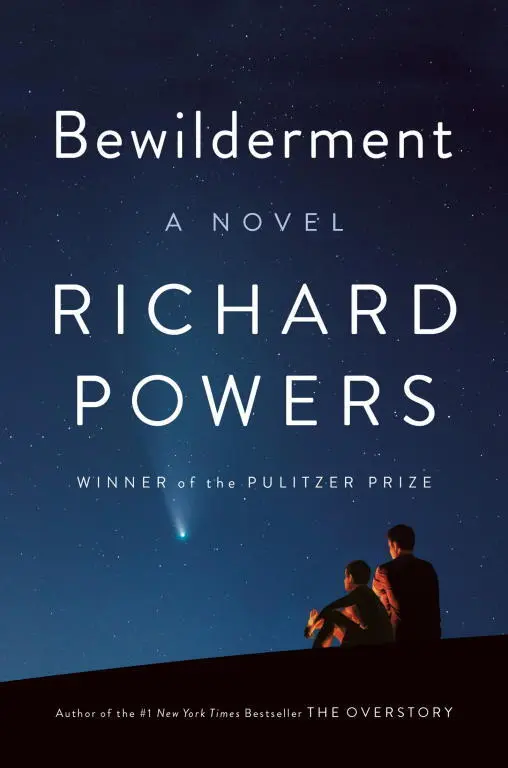
- Название:Bewilderment
- Автор:
- Издательство:W. W. Norton & Company
- Жанр:
- Год:2021
- Город:New York
- ISBN:978-0-39388-114-1
- Рейтинг книги:4 / 5. Голосов: 1
-
Избранное:Добавить в избранное
- Отзывы:
-
Ваша оценка:
Bewilderment: краткое содержание, описание и аннотация
Предлагаем к чтению аннотацию, описание, краткое содержание или предисловие (зависит от того, что написал сам автор книги «Bewilderment»). Если вы не нашли необходимую информацию о книге — напишите в комментариях, мы постараемся отыскать её.
best-selling author of
. Named one of the Most Anticipated Books of 2021 by
,
,
,
,
,
,
,
,
,
, and
The astrobiologist Theo Byrne searches for life throughout the cosmos while single-handedly raising his unusual nine-year-old, Robin, following the death of his wife. Robin is a warm, kind boy who spends hours painting elaborate pictures of endangered animals. He’s also about to be expelled from third grade for smashing his friend in the face. As his son grows more troubled, Theo hopes to keep him off psychoactive drugs. He learns of an experimental neurofeedback treatment to bolster Robin’s emotional control, one that involves training the boy on the recorded patterns of his mother’s brain…
With its soaring descriptions of the natural world, its tantalizing vision of life beyond, and its account of a father and son’s ferocious love,
marks Richard Powers’s most intimate and moving novel. At its heart lies the question: How can we tell our children the truth about this beautiful, imperiled planet?
Bewilderment — читать онлайн бесплатно полную книгу (весь текст) целиком
Ниже представлен текст книги, разбитый по страницам. Система сохранения места последней прочитанной страницы, позволяет с удобством читать онлайн бесплатно книгу «Bewilderment», без необходимости каждый раз заново искать на чём Вы остановились. Поставьте закладку, и сможете в любой момент перейти на страницу, на которой закончили чтение.
Интервал:
Закладка:
For an hour and a half, he’d been feeling his way around Aly’s limbic system. Each time he’d raised and lowered pitches or steered icons toward targets on the screen he was steering himself into the bliss that had been Alyssa’s once, years ago—a lark we’d taken part in on an otherwise ordinary day. In Robin’s head, if nowhere else, he was talking to his mother again. I needed to know what she was saying.
He saw me from across the laboratory suite. His face lit with excitement and hesitation. I saw how badly he wanted to tell me where he’d just been. But he didn’t have words for that planet.
He let go of Ginny’s sleeve and slid out from under her arm. Her professional face betrayed a stab of abandonment. Robin approached me, something new in his walk. His stride was looser, more experimental. Ten feet away he shook his head. Reaching me, he grabbed my upper arm and pressed his ear against my chest.
“Good one?” The syllables came out of me, anemic.
It was her, Dad .
I flushed in the back of my legs. It occurred to me, too late, what an overactive imagination like Robin’s might do with so rich an inkblot.
“It felt… different?”
He shook his head, not at the question but at my dissembling. We made another appointment for the next week. I chatted with Ginny and a pair of postdocs. It felt like my classic nightmare where I’m lecturing in public and only belatedly discover my skin is green. Robin patted me on the back and nudged me toward the hallway, out of the emotional incubator, into the world.
We walked to the parking lot. I peppered him with questions, everything but what I was too adult to ask. He answered with monosyllables, more stymied than impatient. Only when I put my pass in the parking garage machine and the gate lifted did he open up.
Dad? You remember that first night in the cabin, in the mountains? Looking through the telescope?
“I do. Very well.”
That’s what it was like .
He held his hands in front of his face and spread them. Some memory amazed him, either blackness or stars.
I turned on Campus Drive toward home, keeping my eyes on the road. Then, in a voice I barely recognized, the alien on the front seat next to me said, Your wife loves you. You know that, right?
-
I WATCHED FOR SOME DIFFERENCE. Maybe I cued myself, knowing whose feelings he was learning to emulate. But it seemed to take just two sessions for the black cloud he’d sunk into after his disastrous stint at the Capitol to break up into wisps of cirrus.
I came to wake him on a late June Saturday. He groaned at the shock of consciousness and sudden sun. But now, at least, he lifted his head off the pillow and grinned as he moaned.
Dad! Am I training today?
“Yes.”
Yay! he said, in a funny little voice. Because, you know, I could really use it .
“Could you use a little paddle in the boat afterwards?”
Serious? On the lake?
“I was thinking just out in the backyard.”
He growled deep in his throat and bared his teeth at me. You’re lucky I’m not a carnivore .
Choosing his clothes for the day left him wistful. Ah, this shirt. I forgot about this one. This is a good shirt! How come I never wear this shirt? He came out to the living room half-dressed. Remember that pair of furry socks Mom gave me, with separate toes, and little claws on each one? What happened to those?
The question made me flinch. I’d trained on his old brain for so long. I was sure a squall was coming. “Oh, Robbie. That was a hundred sizes ago.”
I know. Geez. I was just curious. I mean: Are they still somewhere? Is some other kid wearing them and thinking he’s half-bear?
“What made you think of those ?”
He shrugged, but not in evasion. Mom . Eerie thoughts came over me. But before I could challenge him, he asked, What’s for breakfast? I’m starving!
He ate everything I put in front of him. He wanted to know what was different about the oatmeal (nothing) and why the orange juice was so tangy (no reason). He sat at the table after I cleared it, humming some melody I couldn’t make out. The raging curiosity I felt over the source of Aly’s recorded Ecstasy that long-ago day flooded through me again. My son— her son—had glimpsed it, but he couldn’t tell me.
I took Robbie in to the neuro lab for another session with his mother’s brain print. He and Ginny fell into their familiar routine. I watched him for a few minutes as he moved shapes around on his screen by telekinesis. Then I walked down the hall and dropped in on Currier.
“Theo! What a pleasure!” He must have meant something different by the word than everyone else did. Every syllable the man spoke irritated me. I needed a stint or two in his empathy machine. “How’s the boy doing?”
I made the case for guarded optimism. Martin listened, his face reserved.
“He’s probably generating a fair amount of auto-suggestion.”
Of course Robin was auto-suggesting. I was auto-suggesting. The changes might be entirely imagined. But brain science knew that even imagination could change our cells for real.
“Is there anything new about this round of training? Changes in the AI feedback? Was Alyssa’s recording of different neural regions?”
“Different?” Currier’s shoulders rose; his mouth approximated a smile. “Sure. We’ve boosted the scanning resolution. The AI keeps learning about Robin and getting more efficient the more Robin interacts with it. And yes, Aly’s scan is of an evolutionarily older part of the brain than the target templates we worked with in the earlier session.”
“So, in other words… nothing at all is the same.” I’d asked what I came to ask. Everything except what I wanted most to know. And I was pretty sure that Currier wouldn’t be able to tell me what Aly herself had refused to say.
But then I thought: Maybe he could. The idea crept across my clammy, conductive skin. Maybe Robbie wasn’t the first to visit Aly’s brain print. But I was afraid the question might make me look crazy. Or I was too afraid of the answer to ask.
-
ROBBIE EVEN ENJOYED INFLATING THE BOAT. Usually he gave the foot pump two minutes of half-hearted kicks before giving up. That day, he didn’t even ask for help. The watercraft rose from a puddle of floppy PVC without a complaint from my son.
We put in near a sign that gave the fishing limits in Spanish, Chinese, and Hmong. Robin slipped off the dock while getting into the boat. He wailed as his shoes sank into the mud and the lake soaked up to his knees. But the instant he scrambled back into the boat, he looked at his legs, puzzled. Well. That’s weird. Getting so worked up about water .
We paddled out in the flat-bottomed dinghy, taking forever to go a hundred yards. He scoured the shore as he rowed. I should have known what he was looking for. Birds: the creatures that had kept all his mother’s demons at bay. He’d always been interested in them. But interest had turned to love, deep in his spine, as he trained on the print of her brain.
A sleek, gray form shot across our bow. He waved me to stop paddling. The first notes of distress in days tinged my son’s voice. Who is he, Dad? Who is he? I couldn’t see!
A resident so common even I knew its name. “Junco, I think.”
Dark-eyed or slate? He turned to me, sure I could tell him. I couldn’t. His mother spoke, up close to my ear. The robin is my favorite bird .
We rowed some more, the slowest form of transportation known to humankind. In deeper water, he lifted his paddle. Could you take over, Dad? I’m kind of preoccupied .
Читать дальшеИнтервал:
Закладка:
Похожие книги на «Bewilderment»
Представляем Вашему вниманию похожие книги на «Bewilderment» списком для выбора. Мы отобрали схожую по названию и смыслу литературу в надежде предоставить читателям больше вариантов отыскать новые, интересные, ещё непрочитанные произведения.

Обсуждение, отзывы о книге «Bewilderment» и просто собственные мнения читателей. Оставьте ваши комментарии, напишите, что Вы думаете о произведении, его смысле или главных героях. Укажите что конкретно понравилось, а что нет, и почему Вы так считаете.