Keith Gessen - A Terrible Country
Здесь есть возможность читать онлайн «Keith Gessen - A Terrible Country» весь текст электронной книги совершенно бесплатно (целиком полную версию без сокращений). В некоторых случаях можно слушать аудио, скачать через торрент в формате fb2 и присутствует краткое содержание. Город: New York, Год выпуска: 2018, ISBN: 2018, Издательство: Viking, Жанр: Современная проза, на английском языке. Описание произведения, (предисловие) а так же отзывы посетителей доступны на портале библиотеки ЛибКат.
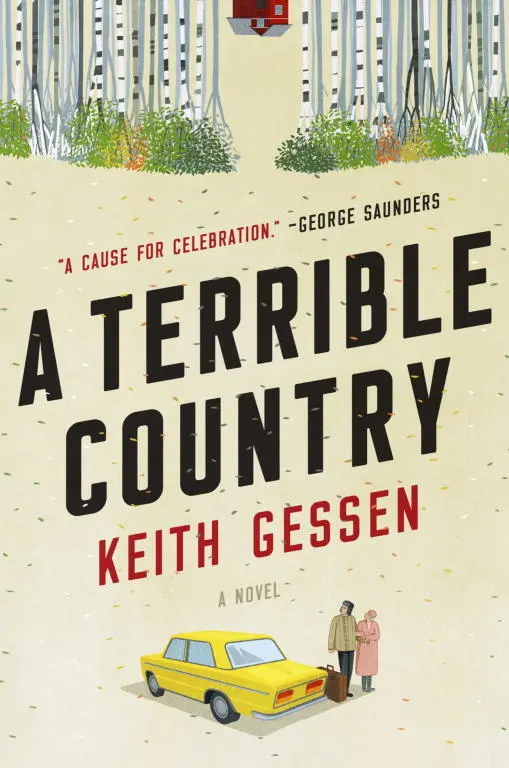
- Название:A Terrible Country
- Автор:
- Издательство:Viking
- Жанр:
- Год:2018
- Город:New York
- ISBN:978-0-735-22131-4
- Рейтинг книги:3 / 5. Голосов: 1
-
Избранное:Добавить в избранное
- Отзывы:
-
Ваша оценка:
A Terrible Country: краткое содержание, описание и аннотация
Предлагаем к чтению аннотацию, описание, краткое содержание или предисловие (зависит от того, что написал сам автор книги «A Terrible Country»). Если вы не нашли необходимую информацию о книге — напишите в комментариях, мы постараемся отыскать её.
A Terrible Country — читать онлайн бесплатно полную книгу (весь текст) целиком
Ниже представлен текст книги, разбитый по страницам. Система сохранения места последней прочитанной страницы, позволяет с удобством читать онлайн бесплатно книгу «A Terrible Country», без необходимости каждый раз заново искать на чём Вы остановились. Поставьте закладку, и сможете в любой момент перейти на страницу, на которой закончили чтение.
Интервал:
Закладка:
When we walked out together, Anton said, “He’s not going to play hockey again.”
He was right. Oleg got better and went to Spain, but his hip had taken a bullet and hockey was out.
After Oleg got shot I received an email from Dima. The other soldiers had followed Howard out of the country, for their own reasons, and Miklos the arms dealer was going to start working on renovations to his place right away. If we wanted him to buy Grandma’s apartment as well, now would be the time, before he plowed too much money into repairs. I thought about it—Oleg’s getting shot seemed like a bad omen—but I said no again. We weren’t moving Grandma.
Then we ended up moving her anyway, and it was all my fault.
I’ll start from the beginning.
In early August, Sergei wrote to the October email list to say that the union organizer jailed at RussOil’s behest had not yet been released and was now staging a hunger strike. There was nothing or nearly nothing about it in the papers—the pro-Putin papers suppressed it, and the liberal papers weren’t interested in worker struggles. “RussOil workers don’t use iPhones, so they don’t care,” Sergei wrote. Was there anything we could do, any action we could plan, that would bring attention to the plight of the RussOil workers and shame RussOil? Would anyone, he continued, be up for something in front of the RussOil headquarters near Clean Ponds? For example, what if we dressed up like injured oil workers and held signs that said something like RUSSOIL IS SUCKING THE BLOOD FROM THE RUSSIAN EARTH? Did people think that would be effective?
There was some debate about the slogan on the email list: Was it anti-Semitic, given the number of oil executives who were Jewish? Was it unnecessarily nationalistic, turning Russia into a physical body whose blood could be sucked, rather than a social compact between free people, with no particular physical manifestation, or anyway not in the sense of some sacred “Russian” land? But there were also more serious, strategic objections. RussOil was one of the nastiest players on the Russian political scene—they came out of the criminal 1990s and then adapted brilliantly to the kleptocratic aughts. They were well connected to both the mob and the Kremlin and the general prosecutor. On top of that, they were still very angry about their bulldozer and it was rumored that they’d been the driving force behind the prosecution of Mayhem. “We might be walking into a shitstorm,” wrote Boris.
People were not insensitive to this argument—maybe we should put it off, or do something less confrontational?
But the more I thought about it, the more I wanted us to do it. I had been living for a year—and, more to the point, my grandmother had been living for years—in the shadow of that giant RussOil building. Every time she saw it she was reminded of what they’d done to her beloved husband. Fuck those guys, I thought, and for the first time ever, I wrote to the list. I told the story of my grandmother and Uncle Lev and RussOil. I said it was one of the reasons I’d joined October. I thought we should get in their faces and tell them what we think.
I sent the email. In truth, I thought that people would express admiration for my passion and say that nonetheless I did not understand the domestic situation and that really we should proceed with caution. But that’s not what happened. My email carried the day, and we proceeded to plan the protest.
On the day of the protest, August 7, I taped a couple of pieces of paper together and made my sign (RUSSOIL SUCKS, it said, a pun). Then I went to the pharmacy where I usually bought my grandmother’s medicines and bought some bandages. My grandmother had hurt her shoulder a few years earlier and we still had the sling in the apartment. I spent some time in the bathroom dressing myself up to look like an injured worker. My grandmother came in at one point and asked what I was doing.
“I’m going to a protest,” I said.
“Oh,” said my grandmother. “OK. Be careful. The police don’t like protesters.”
And she left. A minute later she was back again.
“Andryush, are you sure you need to go to this?” she asked. “I think it’s dangerous.”
“It’s OK,” I said. “I will be careful. And Yulia is coming.”
“She is?” said my grandmother. If Yulia was coming, in her book it couldn’t be too bad.
A few minutes later, the doorbell rang and it was Yulia. She had bandaged her head and added ketchup to it. She shared some ketchup with me. We made a nice pair.
My grandmother laughed. I kissed her on the forehead and we headed out the door. It was a hot day, dry and dusty, and the sun was out. Making our way to the RussOil building in our costumes—it was a four-minute walk, and one we’d done many times—was interesting. People stared at us, trying to determine whether we were actors or performers (there were several theaters in the neighborhood) or if we’d been in a bad accident. We smiled at everyone and kept walking.
We all met up on the pedestrian strip across from RussOil—there were ten of us, in various costumes depicting various severities of injury. Sergei had a white T-shirt that was covered in something red that looked much more like blood than ketchup did. Misha asked him if it was blood and he said that it was beet juice. “Looks like blood,” Misha said admiringly.
The RussOil colossus was built back from the street so that there was a plaza in front of the building, which was elevated above the sidewalk and enclosed by a transparent and probably bulletproof fence. The entrance to the plaza was tightly guarded. Employees in suits showed their badges to get in. Because the plaza was elevated, all you saw from the sidewalk were their shoes.
“Ready?” Sergei said when we had all gathered. We were ready. We walked across the street and took up positions in a bracket shape outside the fence, thirty feet from one another, as agreed, so that technically we were not having an unpermitted public meeting, and facing outward, toward the street. Yulia and Sergei were at the hinge of the bracket, directly in front of the entrance to the plaza, with the rest of us, four in each direction, fanned out down the two intersecting streets. Our spacing meant that the last person in line was already beyond the fence, but so it goes; I decided that, as I was new to these things, I should be on the end, and so I stood 120 feet from Sergei, on Rozhdestvenskiy Boulevard.
Around the corner was Sakharov Avenue, formerly Labor Union Avenue, renamed in 1995 for the physicist and Nobel Peace Prize winner who’d tried to de-escalate the nuclear standoff between the Soviet Union and the West. On this street there stood the former Ministry of Trade, designed in the late 1920s by Le Corbusier himself, and one of the great monuments to the period of post-revolutionary modernism. In front of me was the 1890s shopping center that was now occupied by luxury apartments and that terrible store where my grandmother and I had failed to buy a sweater. A few hundred feet farther along was the Krupskaya statue and the spot where we’d had to flee the skinheads. Around the corner was the pharmacy where I suspected my grandmother had arranged with the pharmacist to give her poison.
It was all so familiar to me now.
I held my sign and looked into the faces of the people who walked past me. Most of them looked the other way, but some of them looked at us and read our signs. In general, the better dressed someone was, the more likely they were to hurry past, and the less well dressed someone was, the more likely to linger for a moment and take it in.
We weren’t there more than ten minutes before things went south. A police car arrived quickly. Two officers approached Sergei; I couldn’t hear the conversation, but presumably he explained to them that this was a legal picket. The two policemen walked away from him and got on their phones, presumably to ask for instructions. Then more policemen arrived, and they sort of fanned out around our perimeter, keeping an eye on us.
Читать дальшеИнтервал:
Закладка:
Похожие книги на «A Terrible Country»
Представляем Вашему вниманию похожие книги на «A Terrible Country» списком для выбора. Мы отобрали схожую по названию и смыслу литературу в надежде предоставить читателям больше вариантов отыскать новые, интересные, ещё непрочитанные произведения.








Обсуждение, отзывы о книге «A Terrible Country» и просто собственные мнения читателей. Оставьте ваши комментарии, напишите, что Вы думаете о произведении, его смысле или главных героях. Укажите что конкретно понравилось, а что нет, и почему Вы так считаете.