William McGivern - Savage Streets
Здесь есть возможность читать онлайн «William McGivern - Savage Streets» весь текст электронной книги совершенно бесплатно (целиком полную версию без сокращений). В некоторых случаях можно слушать аудио, скачать через торрент в формате fb2 и присутствует краткое содержание. Город: New York, Год выпуска: 1959, ISBN: 1959, Издательство: Dodd, Mead & Company, Жанр: Современная проза, на английском языке. Описание произведения, (предисловие) а так же отзывы посетителей доступны на портале библиотеки ЛибКат.
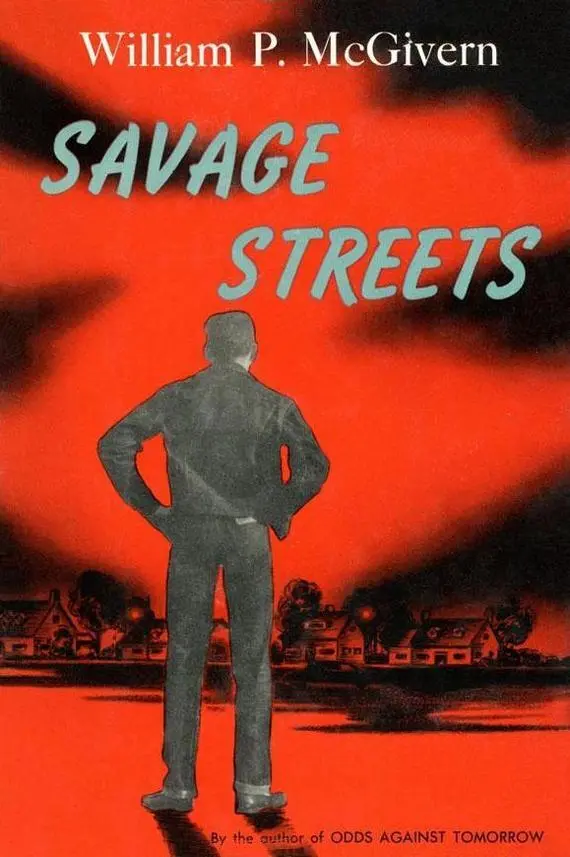
- Название:Savage Streets
- Автор:
- Издательство:Dodd, Mead & Company
- Жанр:
- Год:1959
- Город:New York
- ISBN:978-1-125-15174-7
- Рейтинг книги:4 / 5. Голосов: 1
-
Избранное:Добавить в избранное
- Отзывы:
-
Ваша оценка:
Savage Streets: краткое содержание, описание и аннотация
Предлагаем к чтению аннотацию, описание, краткое содержание или предисловие (зависит от того, что написал сам автор книги «Savage Streets»). Если вы не нашли необходимую информацию о книге — напишите в комментариях, мы постараемся отыскать её.
The adults recognized the danger signals. It was obvious their children’s values and safety were being threatened. This was a time for calmness, for issues to be clearly defined. But the parents failed to realize that their own values were also put to test in this explosive situation. A conviction of righteousness swept through the community like a grass fire, and with it an impatience with the law and a disregard for the rights of anyone beyond the threatened portals of Faircrest. What man, what individual life is ever strong enough to survive such a spell of riot?
Here, in a tense and unusual book, is a sobering picture of what could happen in any modern American community.
Savage Streets — читать онлайн бесплатно полную книгу (весь текст) целиком
Ниже представлен текст книги, разбитый по страницам. Система сохранения места последней прочитанной страницы, позволяет с удобством читать онлайн бесплатно книгу «Savage Streets», без необходимости каждый раз заново искать на чём Вы остановились. Поставьте закладку, и сможете в любой момент перейти на страницу, на которой закончили чтение.
Интервал:
Закладка:
“I’ll tell Duke you stopped by,” Mr. Resnick called to him from the porch. “Take it easy now.” He turned back into his house, his step brisk, his face set in an expression of mild contentment.
Farrell sat for a moment with the motor running, a cigarette burning away between his fingers. Barbara would be expecting him home about now, but he decided not to give up yet; there was a chance he might find Duke at the Chiefs’ clubhouse.
Sergeant Cabella had mentioned the address: the dead-storage garage on Matt Street.
The entrance to the Chiefs’ clubhouse was below street level, an unmarked wooden door at the bottom of a short flight of wooden steps. The garage was six stories high, a dark massive building with steel-shuttered windows and a network of fire escapes crawling up it in an orderly rusty growth.
Farrell hesitated an instant before descending the steps. A group of youngsters in the next block were playing stick ball, and from across the street he heard music from a radio or TV. Everything looked peaceful enough, a typical Sunday afternoon scene that could be duplicated in a thousand cities across the country, kids playing noisily along the sidewalks, dads having a beer and watching television, young girls strolling along arm-in-arm, eyes cocked for boys — it was typical and prosaic, but Farrell didn’t feel at ease. He felt out of place. The thought occurred to him that Duke and Jerry probably thought he was rich.
Farrell lit a cigarette, inhaled deeply, and went down the stone steps. But the boy who answered his knock brought an involuntary little smile to his lips; he was about fourteen, a Puerto Rican obviously, clean and small, with amusing brown eyes shadowed by heavy dark lashes. He looked like an ad for Orphan Relief, Farrell thought, innocent and wistful with his tousled curly hair and ragamuffin clothes. A cherub in sepia.
“Is Duke Resnick here?” Farrell asked him.
“I don’ know,” the boy said, slurring the words together in a liquid murmur.
Another voice — a girl’s — called sharply from beyond the door. “Enrique! Who is it?”
“I don’ know,” the boy said, shrugging and turning away from the door.
Farrell hesitated. The boy had drifted out of sight. Music was playing — a jazz record with the volume turned down — and he saw layers of cigarette smoke drifting around a naked electric light bulb. He didn’t know what to do next. Finally, irritated at his indecision, he stepped through the doorway.
A teen-aged girl sat at a bar that was made of planking supported by two high sawhorses. The Puerto Rican boy had flopped down in a sofa. There was no one else in the long, smoky room. The girl said. “Duke’s not here, if that’s what you want to know.”
“When will he be back?”
“He comes and goes. Now you see him, now you don’t. That’s Duke.”
She was doll-like in her prettiness, with a painted and petulant little mouth, bright, naughty eyes, and jagged black bangs framing a square, chalk-white face. Her clothes amounted to a uniform: glossy black loafers and white wool ankle socks, a short, tightly pegged black skirt, and a black, turtleneck sweater that stretched without a wrinkle across the gentle swell of her breasts. The harsh overhead light glinted on her ankle bracelet, and made a silvery sheen on the hairs of her slim bare legs. She was about sixteen, Farrell guessed, and probably weighed about ninety pounds.
He smiled and took off his hat; she reminded him a bit of Angey playing dress-up — far too young for the part, but disturbingly good at it nevertheless. “Would you mind if I waited for him?” he asked her.
“Be our guest,” she said, with a theatrically weary wave of her hand.
“Thanks.” Farrell sat on a stool a few feet from her and glanced around. “You’ve got a nice place here.” The room had the dimensions of a railroad car, with concrete floors and walls, and a low, plastered ceiling. The air smelled damp. There was a mirror behind the bar, several bottles of wine, and a crudely lettered sign which read: WIGWAM INN. The motif of the decor was Indian; illustrations and photographs of braves and chiefs, war parties and tomahawks were tacked to the walls on cardboard squares of uniform size.
A green curtain divided the room in two sections. In the front half, where Farrell sat, was the bar, a sofa, and a half-dozen folding chairs. Enrique hunched forward on the sofa and ignored Farrell; he was painting and retouching golf balls, taking the old ones from a bucket at his feet and placing the refurbished ones to dry on newspapers spread on the floor. He frowned at his work, turning the balls deftly with nimble fingers, squinting with a critical eye as he camouflaged cuts and flakes with a long, pointed brush. In the strong overhead light he was all dimples and curves and ringlets of glossy hair. He looked cute as a button, Farrell thought, and was probably a fine hand with a switchblade.
“Is Duke caddying today?” Farrell asked the girl.
The question obviously struck her as square; she sighed and said, “You don’t know him, I guess.”
“Not well.”
“If you knew him you wouldn’t ask if he caddied.”
“I see. He’s too smart for that, eh?”
“Head of the class, Pop. He and Jerry see that the Braves keep busy, that’s all.”
“They’re executives, eh? With an eye on the big picture?”
“What’s that mean?”
“Nothing. It’s kind of a gag.”
She looked at him curiously. “What’s your name?”
“Farrell, John Farrell. What’s yours?”
“Cleo.”
“As in Cleopatra, eh? Well, that fits.” He smiled. “She was about your age when she had Mark Antony flipping.”
She lit a cigarette and said casually, “You don’t sound so square, after all.” Her foot was swinging slowly and the light moved like quicksilver against the shining whiteness of her bare leg. Farrell suddenly felt uncomfortable; he realized with a confusing prick of guilt that he had resented her indifference to him. He hadn’t liked being called Pop and treated as a tiresome old man. The age difference wasn’t that great; and he realized that he wanted her to understand that. He wondered if she were Duke or Jerry’s girl.
“What’d you want to see Duke about?” she asked him.
“Nothing very serious. I’ll drop back another time.”
Something moved behind the curtain that divided the room. There was a sound of voices, unintelligible murmurs that occasionally rose into crooning giggles. The sound of it sent a chill down Farrell’s back. The girl smiled indulgently. “All right, calm down back there. You hear?”
The laughter came again, giddy and uncontrolled, and Enrique looked up from his work, his smooth little face hardening with anger. “Make them rupture heads shut up, Cleo.”
Cleo got down from the stool and pulled the curtain back with a swift, impatient gesture. There were two men sitting cross-legged on the floor with a bottle of wine between them. One seemed quite old, with sunken cheeks on which his beard gleamed like moss, and weak blue eyes that were bright now with a mindless confusion and anger. The other could have been anywhere from thirty to fifty. He looked like an idiot, drooling and blank-eyed, with dull blond hair covering his small head like a dunce cap made of fur. They were dressed in ragged clothing, tom, patched and filthy, secured against complete disintegration by bits of string and safety pins. Their shoes were cracked and ripped. Neither wore socks; their bare heels were black with grime.
Farrell felt his stomach him. “Who are they?” he asked the girl.
“They’re Duke’s pets, I guess you could say. They’re winos. You know? They’re like babies. Except instead of drinking milk they drink wine. That’s all they want. It’s funny.”
Читать дальшеИнтервал:
Закладка:
Похожие книги на «Savage Streets»
Представляем Вашему вниманию похожие книги на «Savage Streets» списком для выбора. Мы отобрали схожую по названию и смыслу литературу в надежде предоставить читателям больше вариантов отыскать новые, интересные, ещё непрочитанные произведения.





Обсуждение, отзывы о книге «Savage Streets» и просто собственные мнения читателей. Оставьте ваши комментарии, напишите, что Вы думаете о произведении, его смысле или главных героях. Укажите что конкретно понравилось, а что нет, и почему Вы так считаете.