Kenzaburo Oe - Somersault
Здесь есть возможность читать онлайн «Kenzaburo Oe - Somersault» весь текст электронной книги совершенно бесплатно (целиком полную версию без сокращений). В некоторых случаях можно слушать аудио, скачать через торрент в формате fb2 и присутствует краткое содержание. Жанр: Современная проза, на английском языке. Описание произведения, (предисловие) а так же отзывы посетителей доступны на портале библиотеки ЛибКат.
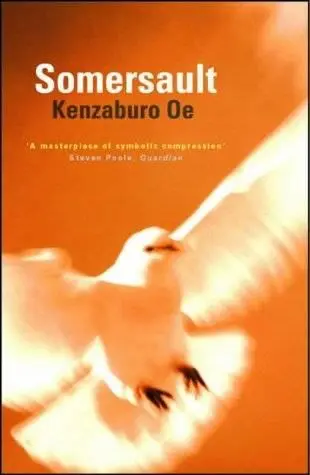
- Название:Somersault
- Автор:
- Жанр:
- Год:неизвестен
- ISBN:нет данных
- Рейтинг книги:4 / 5. Голосов: 1
-
Избранное:Добавить в избранное
- Отзывы:
-
Ваша оценка:
Somersault: краткое содержание, описание и аннотация
Предлагаем к чтению аннотацию, описание, краткое содержание или предисловие (зависит от того, что написал сам автор книги «Somersault»). Если вы не нашли необходимую информацию о книге — напишите в комментариях, мы постараемся отыскать её.
From Publishers Weekly
Nobelist Oe's giant new novel is inspired by the Aum Shinrikyo cult, which released sarin gas in Tokyo 's subway system in 1995. Ten years before the novel begins, Patron and Guide, the elderly leaders of Oe's fictional cult, discover, to their horror, that a militant faction of the organization is planning to seize a nuclear power plant. They dissolve the cult very publicly, on TV, in an act known as the Somersault. Ten years later, Patron decides to restart the fragmented movement, after the militant wing kidnaps and murders Guide, moving the headquarters of the church from Tokyo to the country town of Shikoku. Patron's idea is that he is really a fool Christ; in the end, however, he can't escape his followers' more violent expectations. Oe divides the story between Patron and his inner circle, which consists of his public relations man, Ogi, who is not a believer; his secretary, Dancer, an assertive, desirable young woman; his chauffeur, Ikuo; and Ikuo's lover, Kizu, who replaces Guide as co-leader of the cult. Kizu is a middle-aged artist, troubled by the reoccurrence of colon cancer. Like a Thomas Mann character, he discovers homoerotic passion in the throes of illness. Oe's Dostoyevskian themes should fill his story with thunder, but the pace is slow, and Patron doesn't have the depth of a Myshkin or a Karamazov-he seems anything but charismatic. It is Kizu and Ikuo's story that rises above room temperature, Kizu's sharp, painterly intelligence contrasting with Ikuo's rather sinister ardor. Oe has attempted to create a sprawling masterpiece, but American readers might decide there's more sprawl than masterpiece here.
Somersault — читать онлайн бесплатно полную книгу (весь текст) целиком
Ниже представлен текст книги, разбитый по страницам. Система сохранения места последней прочитанной страницы, позволяет с удобством читать онлайн бесплатно книгу «Somersault», без необходимости каждый раз заново искать на чём Вы остановились. Поставьте закладку, и сможете в любой момент перейти на страницу, на которой закончили чтение.
Интервал:
Закладка:
"I understand from Ikuo, Professor, that you read about our apostasy in the newspapers in America. I find this interesting, since I've never heard the reactions of intellectuals to what we did."
"The New York Times reporter who wrote the articles about Patron and you is Jewish-you can tell from the name," Kizu said. "I don't want to over- simplify his level of knowledge, but he did bring up the name of Sabbatai Zevi, a seventeenth-century figure who announced he was the Jewish Messiah but who ended up being forcibly converted to Islam by the Turks. A colleague of mine, a historian of religions, told me that, despite Zevi's apostasy, his fol- lowers continued to believe in his teachings for many years afterward, in an area stretching from Turkey and Eastern Europe to Asia Minor all the way to Russia. This made me start to wonder whether, after your Somersault, there were followers who still believed in the teachings you'd renounced and, if so, whether you and Patron were able to ignore them."
"This is precisely the area I wanted to ask you about, Professor," Guide said, in a calm, strong tone. "Ten years ago Patron and I discarded not only our followers but our teachings. On national television Patron told our fol- lowers that what we preached was rubbish and he wanted them to stop their foolishness.
"Even when he's joking around, Patron is the kind of person who only speaks what he believes is the truth. We may have been driven into a corner by circumstances, but he wasn't compelled to say things he didn't believe were true.
"I was at his side as Patron frantically considered what to do, and I racked my brain as well. And I came to the conclusion that that's all we could do. We drove ourselves to the point where there was no other possible out- come. We were dead men then, you might say. Having done our Somersault, we were like the living dead.
"Everything before the Somersault vanished for us. It was as if we were amnesiacs, bereft of any traces of our former lives. Since we'd abandoned our faith, we were nothing more than living puppets. But even puppets suffer, you know. Patron felt this, and so did I. He called it falling into hell. I agree, but at no time during these ten years did we discuss what this hell consisted of. We lived together all that time but never spoke of what was really most important.
"After our Somersault we were, as I said before, like the living dead, but you might say we were hibernating. Like sick bears who may die in their cave at any moment. Patron is a complex person, and perhaps his inner ex- perience was different. But I have never in my life experienced such a lazy decade, perhaps too lazy for our own good. If mental activity gets rid of cholesterol, our lack of activity alone was enough to make the blood vessels inside our brains so clogged they'd burst."
Dancer was standing beside Guide like a well-trained waiter, holding a flower-patterned tray level with her chest, on the tray a cup of water and various medicines. As Guide spoke about laziness, she shook her head ever so slightly from side to side. And when he paused and turned to pick up the cup of water, she rotated the tray so the pills were in front of him, as if to say, No water for you unless you take your medicine.
"What you said, Professor, is quite true," Guide said. "There are still some people who remain in the church, and some who've formed their own communal groups and continue to maintain their faith. Just before I went into the hospital, some of them got in touch with me; I had planned to meet with one group that's still within the church. I didn't tell Patron about this, but when I was released from the hospital I found out that he was communicat- ing too, on a private level, with small groups who had written directly to him.
"We haven't talked about it yet, but it would seem that, now that a de- cade has gone by, Patron's thought processes and mine are leaning in the same direction. It makes me realize what happens when two people live so closely for so long.
"At the time of our Somersault, both Patron and I hoped that the church would disappear. But soon the Kansai branch became a nonprofit founda- tion and took over. They didn't pour their energy into attacking us for our apostasy. Instead, they concentrated on defending the organization by refut- ing all the criticisms and ridicule put out by the media. But one other group that became independent after the Somersault did denounce us. And some followers were left on their own and joined groups like Aum Shinrikyo and fundamentalist Christian groups. We received communications from those men and women, too, trying to win us over to their views.
"Understandably, those people's interest in us has dissipated over the past decade, and they've stopped writing. I have no idea what's become of them. The ones we know the most about are those who formed groups out- side the church. One group, made up of women, continues to believe in Patron's teachings and, rather than criticize us, these women are trying to share our sin, if you view it as that, and the suffering that accompanies it. In fact, they see us as apostates falling into hell in order to atone for the sins of all mankind and thus summon forth salvation. They're praying for the day when we can escape our hell and return. Their prayers, I believe, consist of an attempt to visualize and truly comprehend this hell we're in. I don't know whether Patron was influenced by them to speak of us as falling into hell, or whether it was his original concept and they happened to hear of it and that's how they started speaking of it in those terms.
"Anyway, after ten years I was slowly but surely opening lines of com- munication with former believers, but I collapsed just as this opening became significant. Now that I've managed to survive and come home, I find Patron is beginning some new activities. The people he's plugged into, though, aren't former members, but people who got in touch with him only after the Som- ersault. What I find interesting is that both Patron and I see this ten-year period as a kind of turning point.
"I'm also fascinated by the idea of people continuing to believe in a false Messiah who's renounced his faith. There's the Kansai branch that's been going strong for a decade, and another group that wants to go back to the time of the Somersault and erase everything that happened. And then there are people eagerly awaiting Patron's return from the hell of apostasy. After all this time we can't just deny a connection with these men and women or with those who developed an interest in us more recently.
"I'd like to hear much more from you about this seventeenth-century Messiah and his apostasy. Would you talk to me as you did with Patron about English poetry? I know you'll need time to prepare; I'm in no hurry. It takes longer than ten years for our time in hell to end."
2
In the car on the way home, Kizu asked Ikuo, who'd been silent the whole time, what his impressions were.
"Even after I started working at the office I never had much chance to talk with Patron," Ikuo replied. "I'd heard him talk with Dancer and with Ogi, of course. When Guide was released from the hospital, though, and Dancer stayed behind to take care of the paperwork, I was alone with Guide, and later on I was asked to rearrange his room, and both times I was able to talk with him. He doesn't treat me merely as a driver hired to work there.
Since he came home from the hospital he and Patron don't seem to be doing much together, but listening to him today it's clear how important Patron is to him.
"I'd rather ask you, Professor, what you think about them, since you've had good long talks with both of them. You said Patron has a lot of charisma, but what do you make of the way he doesn't resist being called Patron? Guide, I can understand-he's Patron's guide, and the guide for those who approach him."
Читать дальшеИнтервал:
Закладка:
Похожие книги на «Somersault»
Представляем Вашему вниманию похожие книги на «Somersault» списком для выбора. Мы отобрали схожую по названию и смыслу литературу в надежде предоставить читателям больше вариантов отыскать новые, интересные, ещё непрочитанные произведения.





Обсуждение, отзывы о книге «Somersault» и просто собственные мнения читателей. Оставьте ваши комментарии, напишите, что Вы думаете о произведении, его смысле или главных героях. Укажите что конкретно понравилось, а что нет, и почему Вы так считаете.