Kenzaburo Oe - Somersault
Здесь есть возможность читать онлайн «Kenzaburo Oe - Somersault» весь текст электронной книги совершенно бесплатно (целиком полную версию без сокращений). В некоторых случаях можно слушать аудио, скачать через торрент в формате fb2 и присутствует краткое содержание. Жанр: Современная проза, на английском языке. Описание произведения, (предисловие) а так же отзывы посетителей доступны на портале библиотеки ЛибКат.
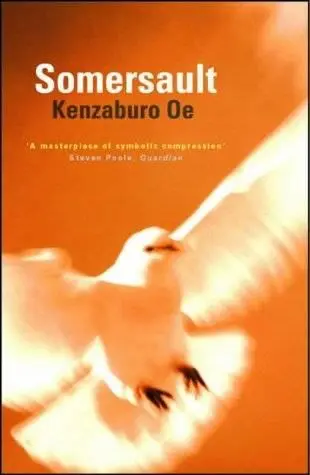
- Название:Somersault
- Автор:
- Жанр:
- Год:неизвестен
- ISBN:нет данных
- Рейтинг книги:4 / 5. Голосов: 1
-
Избранное:Добавить в избранное
- Отзывы:
-
Ваша оценка:
Somersault: краткое содержание, описание и аннотация
Предлагаем к чтению аннотацию, описание, краткое содержание или предисловие (зависит от того, что написал сам автор книги «Somersault»). Если вы не нашли необходимую информацию о книге — напишите в комментариях, мы постараемся отыскать её.
From Publishers Weekly
Nobelist Oe's giant new novel is inspired by the Aum Shinrikyo cult, which released sarin gas in Tokyo 's subway system in 1995. Ten years before the novel begins, Patron and Guide, the elderly leaders of Oe's fictional cult, discover, to their horror, that a militant faction of the organization is planning to seize a nuclear power plant. They dissolve the cult very publicly, on TV, in an act known as the Somersault. Ten years later, Patron decides to restart the fragmented movement, after the militant wing kidnaps and murders Guide, moving the headquarters of the church from Tokyo to the country town of Shikoku. Patron's idea is that he is really a fool Christ; in the end, however, he can't escape his followers' more violent expectations. Oe divides the story between Patron and his inner circle, which consists of his public relations man, Ogi, who is not a believer; his secretary, Dancer, an assertive, desirable young woman; his chauffeur, Ikuo; and Ikuo's lover, Kizu, who replaces Guide as co-leader of the cult. Kizu is a middle-aged artist, troubled by the reoccurrence of colon cancer. Like a Thomas Mann character, he discovers homoerotic passion in the throes of illness. Oe's Dostoyevskian themes should fill his story with thunder, but the pace is slow, and Patron doesn't have the depth of a Myshkin or a Karamazov-he seems anything but charismatic. It is Kizu and Ikuo's story that rises above room temperature, Kizu's sharp, painterly intelligence contrasting with Ikuo's rather sinister ardor. Oe has attempted to create a sprawling masterpiece, but American readers might decide there's more sprawl than masterpiece here.
Somersault — читать онлайн бесплатно полную книгу (весь текст) целиком
Ниже представлен текст книги, разбитый по страницам. Система сохранения места последней прочитанной страницы, позволяет с удобством читать онлайн бесплатно книгу «Somersault», без необходимости каждый раз заново искать на чём Вы остановились. Поставьте закладку, и сможете в любой момент перейти на страницу, на которой закончили чтение.
Интервал:
Закладка:
Kizu looked at the print. The background was a sculptured group like a relief of a scene from the Bible, and in the foreground there was a dark stand- ing figure, a man facing forward, arms stretched out. His eyes were brim- ming with despair and rage, his mouth like an open hole, the barely suppressed outlines of his face with its broad manly forehead and strong jaw, all of which clutched at Kizu.
"The painting is Watts's The Prophet Jonah. When I heard you were going to use Ikuo as your model for Jonah, I immediately remembered this drawing.
Because before this, even, I'd projected Ikuo onto that drawing by Watts.
"You were released from cancer, Professor," Patron went on, "and com- pleted the triptych. And when Morio saw it he said that the face in the paint- ing was the same as in The Prophet Jonah. After dinner this evening he didn't seem to be able to get this out of his mind, and as we talked about it we de- cided, finally, to go over and see the painting again tonight. I think Morio's right. Ikuo's features do look exactly like that, but that's not all there is to it.
Morio understands things through hearing, rather than visually, and he says he hears the same chords, the same dissonance, emanating from both paint- ings. You, on the other hand, Professor, are a visual person, with a painterly intuition that sees down to the core of Ikuo's being. That's where you and Watts have something in common.
"Actually, I've wanted for some time to talk with you about this. And here you are in front of us in the middle of the night. It's fitting, don't you think, to say I summoned you here? If so, Professor, then I think your-"
As if noticing that he wasn't making much sense, Patron stopped speak- ing. Kizu thought, That's right! It is right to think of him as the one who made my cancer disappear! Patron made Morio sit down on the barber chair set back near the light on the wall, and stroked back the sweaty strands of hair cling- ing to his forehead. Kizu found the scene of the three of them-two in match- ing yellow and green pajamas, one sunk back, face up in a barber chair, joined by Kizu himself in a pink and gray striped pajama top-like clowns in some old woodblock print. And, he thought, my painting of Jonah is definitely like that frontispiece of the prophet Jonah.
Before speaking, Patron waited for Kizu, who was poring over the book, to look up.
"When Ikuo first came to see me, just before I got to know you, Pro- fessor, I thought that the Jonah combined in Wolynski's words and Watts's drawing had come to life right before my eyes. When he started talking about the book of Jonah I was less surprised than struck by the feeling that it was meant to be… Ikuo's question was quite simple: Was it right to repudiate God's decision to destroy a city and his order to carry that out?
He asked this as if he were taking Jonah's place. As the Fireflies say, it was Jonah-like.
"When Guide was still alive I couldn't understand why he didn't handle this troublesome young man himself. But what Guide did was coax Ikuo into questioning me. And you wrote the cover letter for his petition to me, didn't you, Professor? I'm not sure I gave him a satisfactory reply, but at least he's still with me, trying to get his questions ultimately answered. Didn't you paint this picture sensing all this from the sidelines?"
This question-though not entirely unexpected-left Kizu at a loss for words. Patron didn't pursue the point further. The topic was deep, but his manner was serene.
"At the summer conference where we launch our new church, Ikuo isn't the only one who'll press me for an answer," Patron said. "The Tech- nicians, who wanted to reverse the Somersault so much they ended up tor- turing Guide to death, are now helping me, the one who played dumb about the whole Somersault. I have to steel myself to the fact that they're now going to turn the questions they had for Guide on me. And of course, there are the even more potentially troublesome Quiet Women ready and waiting in the wings."
Patron said all this in a burst of speech; then he stopped and, pondering something, ran his fingers through Morio's hair.
"Ah, Professor-could you pass me that book? I marked some lines in it. Jonah's finally come to Nineveh to act as a frightening prophet. Jonah curses them in the name of God, saying they will all be destroyed, so it wouldn't be surprising if they tore him limb from limb. But what about Jonah, who dared do something like that?
"However, here a great disillusionment lay waiting for him. When he saw the people of Nineveh repent, and God forgive them, he couldn't grasp the complex elusive nature of the heavenly dialectic, the workings of divine wisdom, so filled with a mysterious dissension, and the infinite, all-encompassing divine nature-so Jonah was spurred on to resistance and anger.
"And thus he spoke to God this way.
" 'Now, O Lord, take away my life, for it is better for me to die than to live.'"
"Aren't Ikuo and the Technicians and Quiet Women pressing me hard with that very same cry?
"There's another thing I'd like to say, taking off from Wolynski's theme, about Dostoyevsky. I find it fascinating that Ikuo is driven by these Jonah- like thoughts and takes so much time looking after the Fireflies. What I re- call is a passage written by Wolynski's translator, Haniya, about Aloysha's love for the boys, and the boys'
'Hurrah!' in response to this. I copied this down in the margins of this book.
"Not just Aloysha, who thirteen years hence is supposed to be crucified for being an assassin of the Tsar, but the lustful Dimitri, who carries the burden of a crime he didn't commit, as well as the Grand Inquisitor Ivan, who cries out in his thirst for life-all of them make a complete change from their positions and reach the sublime at the chorus of shouts from the boys of'Long live Karamazov!'
"Into what terrible state will our country's people have to descend in order to spark a worldwide repentance?" Patron said. "How far will Jonah have to step forward?… Oh no-this won't do at all. I've gotten so excited, Morio's having one of his attacks! Professor, let's call it a night. You can bor- row the book if you'd like."
Patron offered the book, then put his hand on the footrest of the barber chair and turned it around. He knelt down on the floor in front of Morio, who with a sweaty, stern look on his face lay slumped over, limp in the chair.
Sweat trickled down from Patron's pale neck to his back, and though he faced away from Kizu, unmoving, Kizu knew he was being urged to leave.
4
As Kizu cut across the courtyard's flagstone path, he saw a slim woman standing erect under the lamplight beyond the reviewing stands. A strange sight to see, considering the hour. Taking care not to startle her or take her unawares, Kizu deliberately rattled the loose iron railing on the stairs as he descended, and as he did so he realized that the woman was Ms. Asuka, who must have awoken at the sound he made going out and come to look for him.
Actually, when Ms. Asuka came out from behind the reviewing stands to where the lamplight reached and turned toward him, though she didn't show a bewildered smile, her body language showed she was, indeed, flus- tered, and she reluctantly raised a hand in greeting.
"Well, imagine a young woman standing all alone like this in the middle of the night, beside a mountain lake," Kizu said, answering her gesture. "No- body just saunters up here-aren't you afraid of wild animals?"
"Wolves are extinct here, and otters don't attack people," Ms. Asuka replied quietly, her voice mixed in with the hearty sound of cicadas. "I was worried about you."
"I saw a light in the chapel and went to investigate. Patron was there and we talked for a while. Ah… I see. You were imagining a depressed old man jumping in the lake? But I'm a lucky old man, whose terminal cancer has disappeared!"
Читать дальшеИнтервал:
Закладка:
Похожие книги на «Somersault»
Представляем Вашему вниманию похожие книги на «Somersault» списком для выбора. Мы отобрали схожую по названию и смыслу литературу в надежде предоставить читателям больше вариантов отыскать новые, интересные, ещё непрочитанные произведения.





Обсуждение, отзывы о книге «Somersault» и просто собственные мнения читателей. Оставьте ваши комментарии, напишите, что Вы думаете о произведении, его смысле или главных героях. Укажите что конкретно понравилось, а что нет, и почему Вы так считаете.