Kenzaburo Oe - Somersault
Здесь есть возможность читать онлайн «Kenzaburo Oe - Somersault» весь текст электронной книги совершенно бесплатно (целиком полную версию без сокращений). В некоторых случаях можно слушать аудио, скачать через торрент в формате fb2 и присутствует краткое содержание. Жанр: Современная проза, на английском языке. Описание произведения, (предисловие) а так же отзывы посетителей доступны на портале библиотеки ЛибКат.
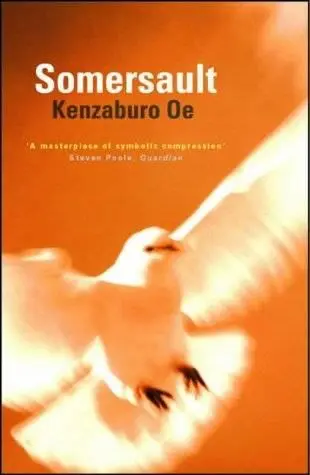
- Название:Somersault
- Автор:
- Жанр:
- Год:неизвестен
- ISBN:нет данных
- Рейтинг книги:4 / 5. Голосов: 1
-
Избранное:Добавить в избранное
- Отзывы:
-
Ваша оценка:
Somersault: краткое содержание, описание и аннотация
Предлагаем к чтению аннотацию, описание, краткое содержание или предисловие (зависит от того, что написал сам автор книги «Somersault»). Если вы не нашли необходимую информацию о книге — напишите в комментариях, мы постараемся отыскать её.
From Publishers Weekly
Nobelist Oe's giant new novel is inspired by the Aum Shinrikyo cult, which released sarin gas in Tokyo 's subway system in 1995. Ten years before the novel begins, Patron and Guide, the elderly leaders of Oe's fictional cult, discover, to their horror, that a militant faction of the organization is planning to seize a nuclear power plant. They dissolve the cult very publicly, on TV, in an act known as the Somersault. Ten years later, Patron decides to restart the fragmented movement, after the militant wing kidnaps and murders Guide, moving the headquarters of the church from Tokyo to the country town of Shikoku. Patron's idea is that he is really a fool Christ; in the end, however, he can't escape his followers' more violent expectations. Oe divides the story between Patron and his inner circle, which consists of his public relations man, Ogi, who is not a believer; his secretary, Dancer, an assertive, desirable young woman; his chauffeur, Ikuo; and Ikuo's lover, Kizu, who replaces Guide as co-leader of the cult. Kizu is a middle-aged artist, troubled by the reoccurrence of colon cancer. Like a Thomas Mann character, he discovers homoerotic passion in the throes of illness. Oe's Dostoyevskian themes should fill his story with thunder, but the pace is slow, and Patron doesn't have the depth of a Myshkin or a Karamazov-he seems anything but charismatic. It is Kizu and Ikuo's story that rises above room temperature, Kizu's sharp, painterly intelligence contrasting with Ikuo's rather sinister ardor. Oe has attempted to create a sprawling masterpiece, but American readers might decide there's more sprawl than masterpiece here.
Somersault — читать онлайн бесплатно полную книгу (весь текст) целиком
Ниже представлен текст книги, разбитый по страницам. Система сохранения места последней прочитанной страницы, позволяет с удобством читать онлайн бесплатно книгу «Somersault», без необходимости каждый раз заново искать на чём Вы остановились. Поставьте закладку, и сможете в любой момент перейти на страницу, на которой закончили чтение.
Интервал:
Закладка:
"I used this as an opportunity to drop out of college. I gave my profes- sors and parents some hackneyed yet honest excuse that there were things I needed to do in order to recover. What I needed to recover though, was that voice, one more time.
"Wandering all over Japan, putting everything I had into a search for the source of that voice, I ended up getting nowhere. But during this long journey I happened to meet you, Professor. I knew right away that you were the illustrator of The Book of Jonah for children. I'd read that book before I was fourteen. I was entranced by Jonah's features and his hair, but it wasn't just that he was handsome. At fourteen and sixteen I convinced myself that I was like Jonah, hearing a voice telling me to act.
"One other thing connected with my meeting you I find very signifi- cant-the fact that after I started modeling for you we began a homosexual relationship. After the affair with Mr. Schmidt I never did that sort of thing again. It's quite extraordinary to run across a person like you, Professor, someone willing to spend the rest of his life so that eventually I can do what it is I want to do, even though I haven't revealed to you what that is.
"Other things sprang out of our relationship too. You helped me recall the way I'd crushed that plastic city model I'd made as a child. I was able to remember how even at that time I'd heard that voice. And I could meet up again with one other player in this incident-Dancer-and through her a path opened up that led me straight to Patron.
"Patron is important to me because his trances put him face-to-face with God. He didn't willfully open up this pipeline to God. This relationship appears when he falls into a trance that's more like a horrible attack. And Patron was driven to shut off that pipeline to God himself.
"Patron announced that the visions of the other side he'd so long trans- mitted were all just a prank. I think it's true what they say of him, that he made a fool of God. But he still continued to suffer, so much that his inner spiritual wounds became physical ones. Guide was tortured to death by his former comrades, but Patron continues to suffer, with no relief in sight.
"As long as I follow Patron, I know that someday that voice-the one I answered only vaguely, the mere memory of which made me do something totally irreversible and from which, afterward, I ran away as fast as I could- will come to me again.
"Patron has moved to this region now in order to start a new church movement, and his followers have prepared buildings, waiting with bated breath for his next move. I was fortunate enough to come here with you, Pro- fessor. Knowing that your cancer is back, you've chosen this as your place to die. And something has taken place to reinforce the truth of that idea.
"Patron's wound has come out in the open, and all the groups of believ- ers are excited about it. And for the first time in my life I have real friends with whom to do things. And all of a sudden this vivid memory's hit me of when I stayed in that hotel in Austria, how it was so rainy that the manager lamented how un-Salzburg-like the weather was. I remember how the elec- tricity built up until it had to explode. I feel the same electricity here as the power of the land, the power of the place.
"Professor, are you still awake?"
Kizu wasn't asleep. He just couldn't find the words to respond to such a confession.
"Guess he is asleep."
From out of his summer covers, Ikuo reached out a soft palm and rested it on Kizu's lower abdomen, careful to not put too much weight on it. He stayed like that for a long time. Warmth from his palm seeped into Kizu's abdomen. Kizu could sense Ikuo's tongue moving around inside his closed mouth. Finally Ikuo withdrew his arm, drew nearer to him in the darkness, and went out into the narrow space separating the two rooms. He left the lights off, but Kizu could sense him crawling into his boxlike bed.
As Kizu listened to Ikuo's monologue he'd learned one surprising thing after another. Yet somehow, as if he'd already known all this, it didn't shock him. From the first time he'd laid eyes on the boy with the beautiful doglike eyes, hadn't he felt both a connection with something higher and yet, unpara- doxically, something mysteriously low and mean? Even after they'd started to live together, that sense that they were not really close continued, something Kizu had put down to Ikuo's basic personality.
After Kizu had him model for the painting of Jonah, he discovered something special in Ikuo. Kizu discovered a person who responded to God's call at the same time that heprotested to God, a person who had a brutal streak, even. Putting together all these pieces, he didn't find it strange that Ikuo had heard a voice from heaven as a child and took a life because of it.
Kizu knew Ikuo was his better in one area-the fact that in their sexual relationship he was the novice, not Ikuo. Soon after they started to sleep together Ikuo had mentioned he'd had some experience playing the man, but despite this Kizu had carried around with him for a long time a mix- ture of pride and guilt at having initiated a young man into this abnormal form of sex.
After he finally fell asleep, Kizu once again dreamt of himself as nearly completing the triptych. Though he found it strange that he could do this, since his weakened condition should make working on the tableau too tir- ing, in the dream he overcame this obstacle and was overjoyed at being able to progress with his work on the third panel-whose composition in reality he still hadn't decided on.
In his dream, the details of the first panel, too, the one showing the in- side of the whale's belly, were crystal clear. Before a backdrop of a scene from a Salzburg hillside hotel, beyond the city streets, beyond the river and a castle- topped mountain, and beyond a ravine at the entrance to the Alps, Ikuo-as- Jonah was in the process of murdering a middle-aged man. Every nook and cranny of the background-which Kizu had painted merely as the dark laby- rinth of the whale's innards-was now entirely clear, and he felt a sense of artistic completion.
In the middle of the third panel he was in reality now working on, Patron, the wound showing on his side, stood next to Ikuo/Jonah. Patron was a preliminary sketch done from memory, distinguishable by the Sacred Wound, while Ikuo/Jonah was no longer an innocent youth. Surrounding the two of them was the Hollow as an abstract opera set: the huge cypress tower- ing darkly, with the cylindrical chapel and the fortresslike monastery bor- dered, top and bottom, by the moonlit surface of the lake reflecting the forest and the fog.
The next morning Kizu woke up late, and as he went out into the corridor from the still-dark bedroom he saw, in a corner of the atelier, smaller now because of the new partition, Ikuo sitting on top of his boxlike bed, unmov- ing as a stone statue. Kizu thought he might be asleep, but when he returned from urinating, the stone statue looked up and greeted him in a gentle voice.
"Good morning! Did you sleep well? Why don't you have breakfast in bed? I'll go get it."
Kizu drew back the curtains-the sun was high in a whitish sky, yet fog and dew still clung to the lake and the huge cypress-got into bed, and pulled the wooden tray toward him as Ikuo brought in canned grapefruit juice, tea, and toast. The young man stood watching him eat, his expression more cheerful than it had been in quite some time, with no traces of the pre- vious night's confessions.
"Individual believers have been arriving since last week," Ikuo told him, "and they'll be assigned to stay in the closed elementary school in the outskirts or in some unoccupied private homes. Ms. Asuka is among them, and she'll be taking turns helping me here. You're able to use the toilet yourself, so you don't mind having a woman take care of you, do you?"
Читать дальшеИнтервал:
Закладка:
Похожие книги на «Somersault»
Представляем Вашему вниманию похожие книги на «Somersault» списком для выбора. Мы отобрали схожую по названию и смыслу литературу в надежде предоставить читателям больше вариантов отыскать новые, интересные, ещё непрочитанные произведения.





Обсуждение, отзывы о книге «Somersault» и просто собственные мнения читателей. Оставьте ваши комментарии, напишите, что Вы думаете о произведении, его смысле или главных героях. Укажите что конкретно понравилось, а что нет, и почему Вы так считаете.