Kenzaburo Oe - Somersault
Здесь есть возможность читать онлайн «Kenzaburo Oe - Somersault» весь текст электронной книги совершенно бесплатно (целиком полную версию без сокращений). В некоторых случаях можно слушать аудио, скачать через торрент в формате fb2 и присутствует краткое содержание. Жанр: Современная проза, на английском языке. Описание произведения, (предисловие) а так же отзывы посетителей доступны на портале библиотеки ЛибКат.
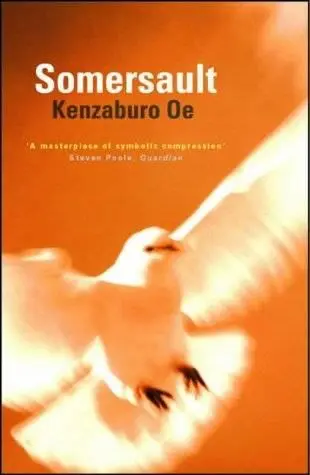
- Название:Somersault
- Автор:
- Жанр:
- Год:неизвестен
- ISBN:нет данных
- Рейтинг книги:4 / 5. Голосов: 1
-
Избранное:Добавить в избранное
- Отзывы:
-
Ваша оценка:
Somersault: краткое содержание, описание и аннотация
Предлагаем к чтению аннотацию, описание, краткое содержание или предисловие (зависит от того, что написал сам автор книги «Somersault»). Если вы не нашли необходимую информацию о книге — напишите в комментариях, мы постараемся отыскать её.
From Publishers Weekly
Nobelist Oe's giant new novel is inspired by the Aum Shinrikyo cult, which released sarin gas in Tokyo 's subway system in 1995. Ten years before the novel begins, Patron and Guide, the elderly leaders of Oe's fictional cult, discover, to their horror, that a militant faction of the organization is planning to seize a nuclear power plant. They dissolve the cult very publicly, on TV, in an act known as the Somersault. Ten years later, Patron decides to restart the fragmented movement, after the militant wing kidnaps and murders Guide, moving the headquarters of the church from Tokyo to the country town of Shikoku. Patron's idea is that he is really a fool Christ; in the end, however, he can't escape his followers' more violent expectations. Oe divides the story between Patron and his inner circle, which consists of his public relations man, Ogi, who is not a believer; his secretary, Dancer, an assertive, desirable young woman; his chauffeur, Ikuo; and Ikuo's lover, Kizu, who replaces Guide as co-leader of the cult. Kizu is a middle-aged artist, troubled by the reoccurrence of colon cancer. Like a Thomas Mann character, he discovers homoerotic passion in the throes of illness. Oe's Dostoyevskian themes should fill his story with thunder, but the pace is slow, and Patron doesn't have the depth of a Myshkin or a Karamazov-he seems anything but charismatic. It is Kizu and Ikuo's story that rises above room temperature, Kizu's sharp, painterly intelligence contrasting with Ikuo's rather sinister ardor. Oe has attempted to create a sprawling masterpiece, but American readers might decide there's more sprawl than masterpiece here.
Somersault — читать онлайн бесплатно полную книгу (весь текст) целиком
Ниже представлен текст книги, разбитый по страницам. Система сохранения места последней прочитанной страницы, позволяет с удобством читать онлайн бесплатно книгу «Somersault», без необходимости каждый раз заново искать на чём Вы остановились. Поставьте закладку, и сможете в любой момент перейти на страницу, на которой закончили чтение.
Интервал:
Закладка:
"Young Gii is really quite a leader in his own right," Kizu replied, "so even if they do include Ikuo in their activities I don't think they'd be incited by anything he did."
"Gii may not be the type who's easily flattered, but you have to realize that a boy that age is bound to look up to Ikuo, since he's older and open to their ideas."
"I have to admit Ikuo seems more youthful after being with the Fire- flies," Kizu said. "Today, for instance, he's having them help out at the Farm.
The Technicians are moving things along there so they can use the facilities as part of their future plans, but I imagine that for Ikuo it's more fun to work with the Fireflies than those older guys."
"I've met a few of the Technicians myself," Mayumi said, "and find them a bit eccentric. They're usually much quieter than Ikuo and just concentrate on the work at hand. They could be doing something really significant, but here they are doing these little piddling jobs in the middle of nowhere."
"Some people insist there's a special power in this place," Kizu said. "I have to tell you I find it a bit eccentric, too, that a young city woman like your- self would come to live way out here in the country."
"Maybe," Mayumi said, "but ever since I arrived here I've been excited, as if something amazing is about to happen. Which makes it a bit contradic- tory for me, I realize, to tell you church members not to respond if Gii throws up a challenge."
4
Once the design for the picture of Jonah in the belly of the whale was finished, Ikuo brought around Gii, Isamu, and five or six of the older mem- bers of the Fireflies, ones who were attending high school. Kizu had called ahead to the dining hall to order a lunch of sandwiches and milk for the young- sters. They stopped by the dining hall to pick up their lunch boxes before climbing the northern slope of the Hollow.
The boys were quite boisterous until they entered Kizu's studio, but once inside they were quieter than any students Kizu had had in an art classroom on either side of the Pacific; they stood behind him, silently gazing at the easel, their eyes fixed on his palette, shining like a mirror in its center where Kizu had mixed in turpentine and, using his own special technique, resin as well.
The first one to break the silence was, naturally, Gii, the boss who held the kids in order. Gii seemed to find the model for the painting, Ikuo, much more important than the painting itself.
"This really is Ikuo all right! It makes me want to call him Yonah."
"You're right about that," Kizu agreed, approving his use of the Japa- nese pronunciation.
"Ikuo told us that you were still wondering how to depict Jonah in the third panel of the triptych, Professor," Isamu said, "but from the looks of it I'd say you've already reached a conclusion."
"What kind of conclusion?"
"The one that Ikuo's had from the beginning."
"Ikuo hasn't said anything to me about it," Kizu said.
"But Ikuo as Jonah wouldn't obey God's suggestion that the people of Nineveh be spared," Isamu said. "Didn't Ikuo tell us it's possible Jonah wasn't convinced by the parable of the vine?"
"If he's already reached a conclusion, he wouldn't have brought us here,"
Gii said. "Didn't he tell us he wanted us to take a good look at the first and second panels and give our opinion about how the third one should go? He wants us kids to help figure out the conclusion he's been pondering."
"Which is why I just gave my opinion about the first panel," Isamu said.
"Oh, I see. You do have the right to say that, don't you, Isamu."
"There's no need to jump to conclusions," Ikuo broke in. "Just look at this painting in progress and tell us what you think. Professor Kizu plans to take his time to decide on how to do the third panel."
Having wrapped that up, they passed around the boxes of sandwiches.
The farm had just started milk production, and cups of milk were poured out for everyone from a large glass bottle.
As soon as they all began to eat, Ikuo turned to the Fireflies and brought the topic back to Jonah.
"Ever since I was a little boy, every time I thought about my life my thoughts would invariably converge on Jonah. You might laugh to hear this, but before that my model was Gusukonbudori."
"The Kenji Miyazawa story, you mean?" Gii asked.
"Right. The story where they come up with this idea to use an appara- tus to make a volcano on an island erupt and raise the temperature of the entire earth by five degrees. The kind of project that environmentalists would defi- nitely have problems with, for sure, but Gusukonbudori helps out. In order for the plan to succeed one person has to sacrifice himself, and that's the role he volunteers for.
"When I was a child that's exactly what I wanted to do. I was crazy about the part where he volunteers, is told that he shouldn't do it, and explains him- self very calmly to the professor: There will many more people like me from now on, and people who can do much more, whose work^, whose laughter, and lives are more outstanding, more beautiful than mine.
"When I ran across the book of Jonah the object of my youthful enthu- siasm changed. When I first read it I thought there were connections between it and "The Life of Gusukonbudori." Specifically, the part where the Lord announces to Jonah that the city of Nineveh will be destroyed in forty days.
This reminded me of the time when Gusukonbudori's teacher predicts that Samutori volcano will erupt in a month (though this isn't the volcano that he makes erupt).
"At any rate, I recommend that you read Kenji Miyazawa along with the book of Jonah."
Kizu was amused by how Ikuo took on the role of teacher. After quickly downing their sandwiches and milk, the boys gathered together all the un- done paper boxes and paper cups and were preparing to take them all back with them.
"Your new friends have certainly done a bit of training as a team, haven't they," Kizu noted.
"You should see them in the woods," Ikuo replied. "Their level of or- ganization is amazing. They keep a strict, almost military discipline."
"Is all that training done for a purpose?"
"Better to let the Fireflies speak for themselves," Ikuo said, turning to Gii. "You told me your training is to simulate how you'd protect the order found in this valley if it were under siege, right?"
Gii and two oí his fellows were relaxing on the wooden frame with a mattress that was Ikuo's bed when he returned from the farm, but he was attentively following their conversation and responded right away.
"We're just goofing around. If guys our age say that's what we're doing, then it's nothing worth discussing, really."
"It might be play, but even to an outside observer something intriguing is going on. Why don't you tell us about it?"
"There are these legends," Gii said, "stories handed down in these parts. A force came from over the mountains and occupied the village. And a farmers' revolt took place here, and when they marched out every last man joined them. We made a mobile unit that can move freely through the for- est-just like those groups in the old days."
"Do kids these days use the term mobile unit when they play?" Kizu asked.
"It's more your generation, Professor, that avoids using military ter- minology, isn't it?" Ikuo said.
Letting that little collision between Kizu and Ikuo pass, Gii picked up where he left off.
"There's one other element in our game," he said. "This is from a French play that Asa-san's older brother the novelist told me. In this play, at harvest time for a couple of days the young people in the village, who are usually belittled, grab power from the local lord. If young people were to do that, to take power, in the end they'd be hunted down and terrible things would hap- pen to them, right?
Читать дальшеИнтервал:
Закладка:
Похожие книги на «Somersault»
Представляем Вашему вниманию похожие книги на «Somersault» списком для выбора. Мы отобрали схожую по названию и смыслу литературу в надежде предоставить читателям больше вариантов отыскать новые, интересные, ещё непрочитанные произведения.





Обсуждение, отзывы о книге «Somersault» и просто собственные мнения читателей. Оставьте ваши комментарии, напишите, что Вы думаете о произведении, его смысле или главных героях. Укажите что конкретно понравилось, а что нет, и почему Вы так считаете.