Kenzaburo Oe - Somersault
Здесь есть возможность читать онлайн «Kenzaburo Oe - Somersault» весь текст электронной книги совершенно бесплатно (целиком полную версию без сокращений). В некоторых случаях можно слушать аудио, скачать через торрент в формате fb2 и присутствует краткое содержание. Жанр: Современная проза, на английском языке. Описание произведения, (предисловие) а так же отзывы посетителей доступны на портале библиотеки ЛибКат.
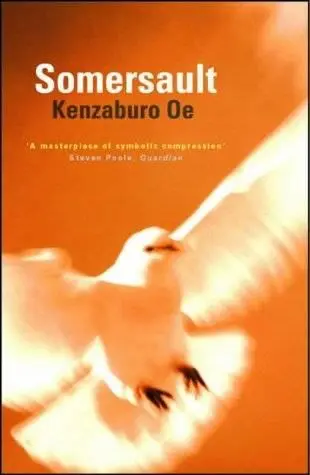
- Название:Somersault
- Автор:
- Жанр:
- Год:неизвестен
- ISBN:нет данных
- Рейтинг книги:4 / 5. Голосов: 1
-
Избранное:Добавить в избранное
- Отзывы:
-
Ваша оценка:
Somersault: краткое содержание, описание и аннотация
Предлагаем к чтению аннотацию, описание, краткое содержание или предисловие (зависит от того, что написал сам автор книги «Somersault»). Если вы не нашли необходимую информацию о книге — напишите в комментариях, мы постараемся отыскать её.
From Publishers Weekly
Nobelist Oe's giant new novel is inspired by the Aum Shinrikyo cult, which released sarin gas in Tokyo 's subway system in 1995. Ten years before the novel begins, Patron and Guide, the elderly leaders of Oe's fictional cult, discover, to their horror, that a militant faction of the organization is planning to seize a nuclear power plant. They dissolve the cult very publicly, on TV, in an act known as the Somersault. Ten years later, Patron decides to restart the fragmented movement, after the militant wing kidnaps and murders Guide, moving the headquarters of the church from Tokyo to the country town of Shikoku. Patron's idea is that he is really a fool Christ; in the end, however, he can't escape his followers' more violent expectations. Oe divides the story between Patron and his inner circle, which consists of his public relations man, Ogi, who is not a believer; his secretary, Dancer, an assertive, desirable young woman; his chauffeur, Ikuo; and Ikuo's lover, Kizu, who replaces Guide as co-leader of the cult. Kizu is a middle-aged artist, troubled by the reoccurrence of colon cancer. Like a Thomas Mann character, he discovers homoerotic passion in the throes of illness. Oe's Dostoyevskian themes should fill his story with thunder, but the pace is slow, and Patron doesn't have the depth of a Myshkin or a Karamazov-he seems anything but charismatic. It is Kizu and Ikuo's story that rises above room temperature, Kizu's sharp, painterly intelligence contrasting with Ikuo's rather sinister ardor. Oe has attempted to create a sprawling masterpiece, but American readers might decide there's more sprawl than masterpiece here.
Somersault — читать онлайн бесплатно полную книгу (весь текст) целиком
Ниже представлен текст книги, разбитый по страницам. Система сохранения места последней прочитанной страницы, позволяет с удобством читать онлайн бесплатно книгу «Somersault», без необходимости каждый раз заново искать на чём Вы остановились. Поставьте закладку, и сможете в любой момент перейти на страницу, на которой закончили чтение.
Интервал:
Закладка:
"We've discussed the book of Jonah before. He's talked about it with you too?"
"There seems to be some reason behind his interest," Dr. Koga said, suppressing a faint smile but not adding any details.
Kizu changed the topic. "Were you aware that the women's group that's moved into the Hollow does not include all the women who were living along the Odakyu Line?"
"I'd heard something about that. One of the fellows in my group is a friend of one of the women, and after they moved here they had a lot to talk about."
"It must have taken a great deal of resolve for them to break up the group they'd lived with for ten years, leave the children behind, and come here."
"It's the same with the Technicians-only half of those remaining from the former radical faction at Izu have moved here. There's another thing I've been thinking about, Professor Kizu. According to the mayor, there used to be a movement to change people's lifestyles here called the Base Movement."
"As a matter of fact," Kizu responded, "the frame for this painting came from the woodworking shop that was started by them and was later absorbed by the Church of the Flaming Green Tree."
"Don't you think what we're trying to do here is to build a kind of base ourselves-for a new church? There will be lots of people who don't move here but who come on a pilgrimage to this holy site to hear Patron's sermons, so in that sense this place will function as a kind of home base."
"Patron told me he's going to be busy with some sort of project here for the next six months or a year," Kizu said. "I don't think he said this just to encourage a sick person like myself."
Dr. Koga examined Kizu with the conscientious eyes of a veteran phy- sician and then turned his gaze outside, to the peeling wall of the now-unused sake warehouse across the narrow road, a wall that had a quiet antique look.
"Ikuo has the same idea," Dr. Koga said. "He was interested in the house we had after we were forced to leave the Izu facility, less a secret hid- ing place than a kind of liaison office, and dropped by to see us. He negoti- ated a lot of things between us and Patron's office. It seemed clear enough at the last meeting that his goal was to connect up with the more radical members of the faction.
"I was surprised to find that the members who moved here as a group are all intent on working at the Farm. But that sort of thing happens, I sup- pose. I don't expect that'll mean they'll be going the way of the Quiet Women, praying all the time. They have a plan of action, though they're not insisting on any outward, daring type of thing. They're like a bunch of bored dilet- tantes, hard to get worked up about anything.
"The gathering where they debated Guide aggravated the opposition within the group and forced them to split in two. They all agreed to the debate, and even members who had never shown their faces at our liaison office showed up for it. But once the meeting started it was the more radical group that took over. The moderate faction's motivation for attending, to hear about Patron's recent religious activities, went out the window. In the recording of the brutalizing that Dancer spoke of, there was a proposal made to let Guide go. I sided with the moderate faction on this. But a dispute arose and we were kept from further participation, after which the tragedy unfolded.
"With the interrogation of Guide still continuing at that point, it's no wonder people say it was irresponsible for the moderates to withdraw. Espe- cially for me, as a doctor. But Guide really wanted us to leave. I think deep down his attitude was similar to that of the moderate faction, myself included, who wanted somehow to express ourselves after Patron's ten years of silence.
I think he let them interrogate and torment him at will because he wanted, if worse came to worst, to let them find shelter in a place where the authorities wouldn't pursue them.
"Guide accepted the invitation for the meeting, after all, but was less concerned about me and the moderate faction than in searching out some accommodation, some third way, with a group that even after ten years was still pretty radical. Wasn't it precisely because those radical members would be there that he accepted the invitation at such short notice? But Guide's third way and the expectations of the radical group were completely at odds, which explains what took place."
"The more I listen to you," Kizu said, "the more I feel the reason Ikuo got close to you all was because he was attracted to these more extreme rem- nants of the radical faction."
"To me," Dr. Koga said, "Ikuo is a Jonah-type personality, which leads me to hope you'd express this in your painting. I guess I'm hoping your paint- ing will help me grasp who he really is. He's going to play an important role in Patron's new church, but there's one thing about him I don't quite under- stand that I'd like to-"
The two calm men at the open entrance door next to the reception area had finished their preparations for bringing in the chairs from outside.
Dr. Koga's expression became brisk and businesslike as he turned his atten- tion to the practical matters at hand, and Kizu bid him a swift farewell and withdrew from the clinic.
3
Kizu, painting in hand, had gotten a ride to the clinic from Ogi, who was on his way to the Old Town, but on the way back he had no choice but to walk home along the river. Groups of two or three junior high school stu- dents were coming toward him, the boys in matching smocks, the girls in navy blue uniforms and wine-colored mufflers. Their clothes struck Kizu as shabby.
On the heights on the other side of the Kame River was the cross- Shikoku highway bypass, with a ceaseless flow of huge trucks racing down the road. On the road on Kizu's side of the river, in contrast, there was only a scattering of cars and light trucks. With its view of the lush greenery be- hind the homes on the mountainside, the road was pleasant enough to walk down, but the children's rough and violent ways wiped the area's unique qualities away.
After he'd passed the T-shaped intersection that led to the bridge, Kizu located a general store that, while its frontage was the same as the stores to both sides of it, extended, as he could see through the glass door, much far- ther back. Thinking to buy something for the next day's breakfast, he went inside. Dancer had told him that this little market carried ham and bacon, as well as vegetables and eggs, produced by the Flaming Green Tree Farm.
To the right of the entrance was a cash register of the kind Kizu remem- bered seeing at the entrance to the public bath he frequented as a student, next to which squatted a person facing the interior of the store. This white-haired old woman showed no interest in Kizu as he entered. He was hit by a wave of nostalgia as he gazed at the simple displays. The shelves had the usual items- snacks, instant noodles, meats, fish, and pickled vegetables-but instead of appealing to the shopper, the products seemed shoved back in the shadows.
The fresh produce section was especially cramped, as was the meat sec- tion, with only packages of pork cut into bite-size chunks, slices of salted salmon, and half-dried, darkly glistening sardines. Every time Kizu returned to Japan he felt something akin to car sickness when confronted with the overflow of goods in Tokyo supermarkets. Used to life in America, he always found him- self stirred up by the vitality of Japanese consumerism. The vast gulf between that and this village market made Old Town look like a ghost town.
However, as he made one circuit of the chilly, dusty aisles, he came across a shelf and stand set apart in one corner, the only display that seemed alive.
On the shelf were packs of hams and bacon, butter in glass jars, eggs, and mounds of cabbages, carrots, onions, and other vegetables, as well as still warm-to-the-touch freshly baked bread, the kind sold in the supermarket in Aoyama as French Country Bread.
Читать дальшеИнтервал:
Закладка:
Похожие книги на «Somersault»
Представляем Вашему вниманию похожие книги на «Somersault» списком для выбора. Мы отобрали схожую по названию и смыслу литературу в надежде предоставить читателям больше вариантов отыскать новые, интересные, ещё непрочитанные произведения.





Обсуждение, отзывы о книге «Somersault» и просто собственные мнения читателей. Оставьте ваши комментарии, напишите, что Вы думаете о произведении, его смысле или главных героях. Укажите что конкретно понравилось, а что нет, и почему Вы так считаете.