Don DeLillo - Underworld
Здесь есть возможность читать онлайн «Don DeLillo - Underworld» весь текст электронной книги совершенно бесплатно (целиком полную версию без сокращений). В некоторых случаях можно слушать аудио, скачать через торрент в формате fb2 и присутствует краткое содержание. Жанр: Современная проза, на английском языке. Описание произведения, (предисловие) а так же отзывы посетителей доступны на портале библиотеки ЛибКат.
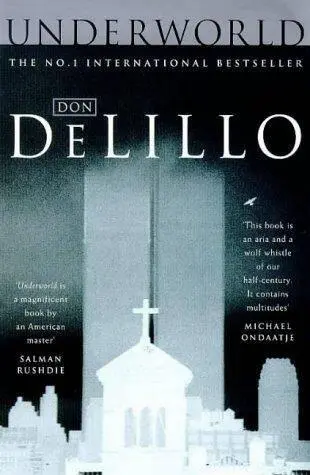
- Название:Underworld
- Автор:
- Жанр:
- Год:неизвестен
- ISBN:нет данных
- Рейтинг книги:2.5 / 5. Голосов: 2
-
Избранное:Добавить в избранное
- Отзывы:
-
Ваша оценка:
Underworld: краткое содержание, описание и аннотация
Предлагаем к чтению аннотацию, описание, краткое содержание или предисловие (зависит от того, что написал сам автор книги «Underworld»). Если вы не нашли необходимую информацию о книге — напишите в комментариях, мы постараемся отыскать её.
While Eisenstein documented the forces of totalitarianism and Stalinism upon the faces of the Russian peoples, DeLillo offers a stunning, at times overwhelming, document of the twin forces of the cold war and American culture, compelling that "swerve from evenness" in which he finds events and people both wondrous and horrifying. Underworld opens with a breathlessly graceful prologue set during the final game of the Giants-Dodgers pennant race in 1951. Written in what DeLillo calls "super-omniscience" the sentences sweep from young Cotter Martin as he jumps the gate to the press box, soars over the radio waves, runs out to the diamond, slides in on a fast ball, pops into the stands where J. Edgar Hoover is sitting with a drunken Jackie Gleason and a splenetic Frank Sinatra, and learns of the Soviet Union's second detonation of a nuclear bomb. It's an absolutely thrilling literary moment. When Bobby Thomson hits Branca's pitch into the outstretched hand of Cotter-the "shot heard around the world"-and Jackie Gleason pukes on Sinatra's shoes, the events of the next few decades are set in motion, all threaded together by the baseball as it passes from hand to hand.
"It's all falling indelibly into the past," writes DeLillo, a past that he carefully recalls and reconstructs with acute grace. Jump from Giants Stadium to the Nevada desert in 1992, where Nick Shay, who now owns the baseball, reunites with the artist Kara Sax. They had been brief and unlikely lovers 40 years before, and it is largely through the events, spinoffs, and coincidental encounters of their pasts that DeLillo filters the Cold War experience. He believes that "global events may alter how we live in the smallest ways," and as the book steps back in time to 1951, over the following 800-odd pages, we see just how those events alter lives. This reverse narrative allows the author to strip away the detritus of history and pop culture until we get to the story's pure elements: the bomb, the baseball, and the Bronx. In an epilogue as breathless and stunning as the prologue, DeLillo fast-forwards to a near future in which ruthless capitalism, the Internet, and a new, hushed faith have replaced the Cold War's blend of dread and euphoria.
Through fragments and interlaced stories-including those of highway killers, artists, celebrities, conspiracists, gangsters, nuns, and sundry others-DeLillo creates a fragile web of connected experience, a communal Zeitgeist that encompasses the messy whole of five decades of American life, wonderfully distilled.
***
Starting with a 1951 baseball game and ending with the Internet, "Underworld" is not a book for the faint-hearted. Elegiac in tone and described variously as DeLillo's Magnum Opus and his attempt to write the Great American Novel, the book weighs in at a hefty 827 pages and zips back and forwards in time, moving in and out of the lives of a plethora of different characters.
Following three main themes – the fate of a baseball from the winning game of the 1951 world series, the threat of atomic warfare and the mountains of garbage created by modern society – DeLillo moves forwards and backwards through the decades, introducing characters and situations and gradually showing the way their lives are interconnected.
Reading the prose can be uncannily like using a web browser: the narrative focus moves from character to character almost as quickly as we are introduced to them, and the time frame regularly changes to show further connections between the key players. This device – literature as hypertext – is particularly effective in the early parts of the novel and the technique never intrudes on the story itself.
The book focuses on Nick Shay, a former hoodlum who now works in the burgeoning waste management industry and owns the baseball from the 1951 game, "the shot heard around the world". In addition to Nick we hear from Frank Sinatra, J. Edgar Hoover, Lenny Bruce and the various people who move in and out of Nick's life: lovers, family, friends and colleagues. Through these seemingly disconnected narratives DeLillo paints a picture of Cold War paranoia at its peak – the baseball game happened the same day as the USSR 's first nuclear test – and the changes affecting his characters as a microcosm of American society as a whole.
Very few writers, however, can justify over 800 densely-printed pages to tell a story and "Underworld" would have benefited greatly from judicious wielding of the blue pencil. Potentially intriguing plots which feature strongly in the earlier parts of the book – an intriguing serial killer subplot, the stories of each person who possesses the winning baseball – are abandoned halfway through the book in favour of overlong childhood memories or the inane ponderings of a performance artist; other stories are neglected for over 400 pages before reappearing at the end of the novel, causing an unwelcome jolt as the reader tries to remember the pertinent details.
In this respect "Underworld" is a victim of its own ambition: by trying to cover such a wide range of characters and situations, DeLillo loses track of some of them and, in the latter parts of the novel in particular, the writing feels as if it is on autopilot while the author works out what to do next.
There is still much to recommend in "Underworld", however. Each vignette is lovingly crafted: DeLillo seems as comfortable writing from the perspective of a street missionary as he is inhabiting J Edgar Hoover's paranoia. The book employs vivid imagery, from painted angels on ghetto walls to the cityscape created by mountains of domestic waste, and the dialogue is usually well-observed and thoroughly believable although it does flag when describing Nick Shay's hoodlum past. Despite its faults DeLillo has created an ambitious and powerful novel which, due to its size, can also be used to swat annoying children on trains. Highly recommended.
Gary Marshall
Underworld — читать онлайн бесплатно полную книгу (весь текст) целиком
Ниже представлен текст книги, разбитый по страницам. Система сохранения места последней прочитанной страницы, позволяет с удобством читать онлайн бесплатно книгу «Underworld», без необходимости каждый раз заново искать на чём Вы остановились. Поставьте закладку, и сможете в любой момент перейти на страницу, на которой закончили чтение.
Интервал:
Закладка:
"You're talkative all of a sudden."
"He's always being photographed on the courthouse steps. He's the king of the steps."
"See, it's not a boatload of heroin. It's a boatload of shit."
We were momentarily alert and uncircling. It was one of those episodes of heightened clarity in a night of talking and drinking.
"At one point, am I right, the rumor suggested it wasn't an ordinary cargo ship."
" A sludge tanker. Turns out the rumor was correct."
"Carrying treated human waste."
"Port to port, it's nearly two years," he said.
We listened to the music, a cash register ringing at the end of the bar and a trace of a radio voice, radio or TV , coming from a back room somewhere.
"Tell her you're sorry. Go home, Sims."
"Maybe she ought to tell me."
"Tell her first."
"Maybe I'm not the guilty party. Ever think of that? The instigator."
"Doesn't matter, you jerk."
"That's the second time," he said, showing me two fingers.
We got out of there and went somewhere else, zebra walls and small tables, a fairly crowded room with a body hum, people in aviator glasses and silver shirts.
"He's wearing a white suit."
"Right."
"He's playing his alto."
"Right."
"And he's facing out of the picture, out of the frame."
"And he's wearing white and brown shoes. Two-tone shoes. But they're not saddle shoes."
"I didn't ask what kind of shoes. I don't care about his shoes."
"I'm just saying."
"I'm not interested in his shoes."
"They have a name I'm trying to think of."
"Do it somewhere else."
"In a club in New York," I said.
"You know this? And I don't? And it's my photograph? In my house we're talking about?"
The waiter brought drinks.
not who he resembled at all. He resembled the cabdriver I'd hailed earlier in the day, or the day before, the guy who'd said, "Light up a Lucky. It's light-up time."
When they put me in the squad car, or maybe they called it a radio car then, it was a green and white vehicle in any case and the cop who drove was smoking, which he wasn't supposed to do, a uniformed cop on duty was not supposed to smoke, and it surprised me to see this, I remember, an officer cupping a smoke between his knees, because I'd shot a man dead and thought I was being taken into a system where the rules were consistent and strict, and the other thing I remember is that no one put a hand on my head and folded me into the car because evidently this was not something they did at the time, this was something they developed later, preventing the felon from bumping his head when they took him in.
This happened back east of course. I've heard that term a lot since coming to this part of the country. But I never think of the term as a marker of geography. It's a reference to time, a statement about time, about all the densities of being and experience, it's time disguised, it's light-up time, shifting smoky time tricked out as some locus of stable arrangement. When people use that term they're talking about the way things used to be before they moved out here, the way the world used to be, not just New Jersey or South Philly, or before their parents moved, or grandparents, and about the way things still exist in some private relativity theory, some smoky shifting mind dimension, or before the other men and women came this way, the ones in Con-estoga wagons, a term we learned in grade school, a back-east term, stemming from the place where the wagons were made.
The room was very nearly empty and they were playing blues.
"Be nice to her," I said. "Go home, talk to her, make nice. You know this phrase? Make nice. They use this phrase when you were a Negro child in St. Louis, Sims?"
"They came to take the census."
"You're right. Let's leave," I said.
"Your father knew him. This means-what?"
"It means he knew him."
"In other words I have to show respect. I have to be reverent when I mention his name. This guy who runs a criminal enterprise in narcotics, extortion, what else. Murder, attempted murder, what else."
"Waste carting," I said.
"Could be. Why not? And I have to respect him. Because he was nice to your father."
"You're right. Let's leave," I said.
"I didn't say I wanted to leave. I don't want to leave."
"Tell her you're sorry and take a bath," I told him.
Half an hour later we were in the last club of the night, a blues room with an air of desperation, and the waiter resembled the old guy from two or three places ago, facially resembled-he wore a standard waiter's getup but looked a lot, I thought, like the other guy, in the football T-shirt, three or four places ago, or whenever it was, the T-shirt and cotton nose plug.
"This place reminds me. You know how they're always saying, Where were you when such and such? Where were you when Kennedy? Well, remember the time the lights went out. This place reminds me. The great Northeast blackout."
"Am I supposed to ask where you were?" he said.
"Thirty million people affected."
"I was in Germany. I never knew what caused it. What caused it?"
"Nobody remembers. Thirty million people. Not one of us remembers."
"But you remember where you were."
"Ask me where I was. I was in a bar that was a little like this place," I said. "Dead souls, sad jazz. Palm trees painted on the wall."
"This place doesn't have palm trees on the wall."
"Even better, even more similar. And the lights went out."
"They made a movie. I was in Germany," he said.
"Maybe they didn't have jazz at this other place. Maybe they used to have jazz but stopped. They had a jazz policy that became a policy of no jazz, which is much the same thing if you examine it closely."
He didn't resemble the old guy from three or four places ago. That's
"Wait wait wait wait wait wait."
"Think about it," he said.
He plucked his shirt, he did a thing big men do, he used both hands to pluck his shirt away from his chest and then he shook it, half dainty, letting his upper body breathe.
"Sims, you and I."
"Just think about it."
"We're not, remember, we don't have a word, you and I, for the science of dark forces. For what is behind an event. We don't accept the validity of this word or this science. Remember that conversation?"
"This is another conversation. And in this conversation I'm saying, Think about it."
"But you and I. We go against the tide, Sims. The tide is easy, it's irresponsible. We're responsible men. We've established this. We don't believe there are secret forces undermining our lives."
"Thirty million people affected by your local blackout. But only twenty-five million, they're saying, black people in the whole huge country."
"If that's the number, that's the number."
"And this is all you can say. We have an issue that's crying out for, really, scrutiny, to use one of your words."
"Go ahead, scrutinize it."
"Ibu're willing to accept this number."
"Twenty-five million. Yes, why not?"
" You don't think this number is way too low."
"Twenty-five million's not so low. It's twenty-five million," I said.
"You don't think this number is totally underreported."
"Why do you say scrutiny is my word?"
"Because you used it."
"This makes it my word?"
"I didn't use it. You used it."
"I believe the number. It's a believable number to me."
"You don't think somebody's afraid that if the real number is reported, white people gonna go weak in the knees and black people gonna get all pumped up with, Hey we oughta be gettin' more of this and more of that and more of the other."
"Yes, and what?"
"And my mother told me to hide."
"What for?"
"What for. That's the point. I didn't know what for. She thought, I don't know what she thought. I went and hid, you know. Two people at the door with clipboards. She said, Get inside, stay down."
Читать дальшеИнтервал:
Закладка:
Похожие книги на «Underworld»
Представляем Вашему вниманию похожие книги на «Underworld» списком для выбора. Мы отобрали схожую по названию и смыслу литературу в надежде предоставить читателям больше вариантов отыскать новые, интересные, ещё непрочитанные произведения.




Обсуждение, отзывы о книге «Underworld» и просто собственные мнения читателей. Оставьте ваши комментарии, напишите, что Вы думаете о произведении, его смысле или главных героях. Укажите что конкретно понравилось, а что нет, и почему Вы так считаете.