Don DeLillo - Underworld
Здесь есть возможность читать онлайн «Don DeLillo - Underworld» весь текст электронной книги совершенно бесплатно (целиком полную версию без сокращений). В некоторых случаях можно слушать аудио, скачать через торрент в формате fb2 и присутствует краткое содержание. Жанр: Современная проза, на английском языке. Описание произведения, (предисловие) а так же отзывы посетителей доступны на портале библиотеки ЛибКат.
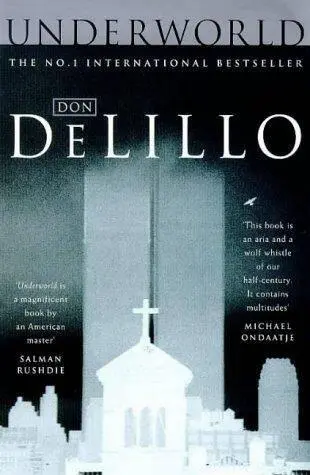
- Название:Underworld
- Автор:
- Жанр:
- Год:неизвестен
- ISBN:нет данных
- Рейтинг книги:2.5 / 5. Голосов: 2
-
Избранное:Добавить в избранное
- Отзывы:
-
Ваша оценка:
Underworld: краткое содержание, описание и аннотация
Предлагаем к чтению аннотацию, описание, краткое содержание или предисловие (зависит от того, что написал сам автор книги «Underworld»). Если вы не нашли необходимую информацию о книге — напишите в комментариях, мы постараемся отыскать её.
While Eisenstein documented the forces of totalitarianism and Stalinism upon the faces of the Russian peoples, DeLillo offers a stunning, at times overwhelming, document of the twin forces of the cold war and American culture, compelling that "swerve from evenness" in which he finds events and people both wondrous and horrifying. Underworld opens with a breathlessly graceful prologue set during the final game of the Giants-Dodgers pennant race in 1951. Written in what DeLillo calls "super-omniscience" the sentences sweep from young Cotter Martin as he jumps the gate to the press box, soars over the radio waves, runs out to the diamond, slides in on a fast ball, pops into the stands where J. Edgar Hoover is sitting with a drunken Jackie Gleason and a splenetic Frank Sinatra, and learns of the Soviet Union's second detonation of a nuclear bomb. It's an absolutely thrilling literary moment. When Bobby Thomson hits Branca's pitch into the outstretched hand of Cotter-the "shot heard around the world"-and Jackie Gleason pukes on Sinatra's shoes, the events of the next few decades are set in motion, all threaded together by the baseball as it passes from hand to hand.
"It's all falling indelibly into the past," writes DeLillo, a past that he carefully recalls and reconstructs with acute grace. Jump from Giants Stadium to the Nevada desert in 1992, where Nick Shay, who now owns the baseball, reunites with the artist Kara Sax. They had been brief and unlikely lovers 40 years before, and it is largely through the events, spinoffs, and coincidental encounters of their pasts that DeLillo filters the Cold War experience. He believes that "global events may alter how we live in the smallest ways," and as the book steps back in time to 1951, over the following 800-odd pages, we see just how those events alter lives. This reverse narrative allows the author to strip away the detritus of history and pop culture until we get to the story's pure elements: the bomb, the baseball, and the Bronx. In an epilogue as breathless and stunning as the prologue, DeLillo fast-forwards to a near future in which ruthless capitalism, the Internet, and a new, hushed faith have replaced the Cold War's blend of dread and euphoria.
Through fragments and interlaced stories-including those of highway killers, artists, celebrities, conspiracists, gangsters, nuns, and sundry others-DeLillo creates a fragile web of connected experience, a communal Zeitgeist that encompasses the messy whole of five decades of American life, wonderfully distilled.
***
Starting with a 1951 baseball game and ending with the Internet, "Underworld" is not a book for the faint-hearted. Elegiac in tone and described variously as DeLillo's Magnum Opus and his attempt to write the Great American Novel, the book weighs in at a hefty 827 pages and zips back and forwards in time, moving in and out of the lives of a plethora of different characters.
Following three main themes – the fate of a baseball from the winning game of the 1951 world series, the threat of atomic warfare and the mountains of garbage created by modern society – DeLillo moves forwards and backwards through the decades, introducing characters and situations and gradually showing the way their lives are interconnected.
Reading the prose can be uncannily like using a web browser: the narrative focus moves from character to character almost as quickly as we are introduced to them, and the time frame regularly changes to show further connections between the key players. This device – literature as hypertext – is particularly effective in the early parts of the novel and the technique never intrudes on the story itself.
The book focuses on Nick Shay, a former hoodlum who now works in the burgeoning waste management industry and owns the baseball from the 1951 game, "the shot heard around the world". In addition to Nick we hear from Frank Sinatra, J. Edgar Hoover, Lenny Bruce and the various people who move in and out of Nick's life: lovers, family, friends and colleagues. Through these seemingly disconnected narratives DeLillo paints a picture of Cold War paranoia at its peak – the baseball game happened the same day as the USSR 's first nuclear test – and the changes affecting his characters as a microcosm of American society as a whole.
Very few writers, however, can justify over 800 densely-printed pages to tell a story and "Underworld" would have benefited greatly from judicious wielding of the blue pencil. Potentially intriguing plots which feature strongly in the earlier parts of the book – an intriguing serial killer subplot, the stories of each person who possesses the winning baseball – are abandoned halfway through the book in favour of overlong childhood memories or the inane ponderings of a performance artist; other stories are neglected for over 400 pages before reappearing at the end of the novel, causing an unwelcome jolt as the reader tries to remember the pertinent details.
In this respect "Underworld" is a victim of its own ambition: by trying to cover such a wide range of characters and situations, DeLillo loses track of some of them and, in the latter parts of the novel in particular, the writing feels as if it is on autopilot while the author works out what to do next.
There is still much to recommend in "Underworld", however. Each vignette is lovingly crafted: DeLillo seems as comfortable writing from the perspective of a street missionary as he is inhabiting J Edgar Hoover's paranoia. The book employs vivid imagery, from painted angels on ghetto walls to the cityscape created by mountains of domestic waste, and the dialogue is usually well-observed and thoroughly believable although it does flag when describing Nick Shay's hoodlum past. Despite its faults DeLillo has created an ambitious and powerful novel which, due to its size, can also be used to swat annoying children on trains. Highly recommended.
Gary Marshall
Underworld — читать онлайн бесплатно полную книгу (весь текст) целиком
Ниже представлен текст книги, разбитый по страницам. Система сохранения места последней прочитанной страницы, позволяет с удобством читать онлайн бесплатно книгу «Underworld», без необходимости каждый раз заново искать на чём Вы остановились. Поставьте закладку, и сможете в любой момент перейти на страницу, на которой закончили чтение.
Интервал:
Закладка:
When Klara left him it turned something loose, a rant, an unworded voice that incited feelings so varied and confused and bled-together, so resistant to separation and scrutiny that he felt helpless in its surge. It was a hindrance to living. It made him distrust the man he was supposed to be, soft-spoken, well-spoken, gently reflective. Oh that bitch and how unworthy of him to think of her that way. It was his sister, eventually, who kept him from despair, another kind of voice, a woman marooned in introversion, only oddly loving.
He needed to walk, shake his muscles loose, and he went out into the street. Yes, people talking, eating, the loyal shoppers, they came from other boroughs, other counties, the double-parked cars, the coronary throb of the immediate streets still palpable. He walked west across Arthur Avenue and then edged warily north, an old route lately forsworn, toward the high school where he'd taught for thirty years.
Eddie dead, Mercedes in Puerto Rico now. Stop walking and you die.
When he entered a street behind the high school he was surprised to see it was closed to traffic. A play street, the pavement marked with painted game grids, with the numbered spaces of hopscotch and skelly, bases for slapball, and Albert was delighted. He'd thought this old custom of closing off streets for children's games was long dead, decades dead, a mind relic of life not yet dominated by cars and trucks. He stopped and watched the kids play, holding his cane across his waist as if gripping a stadium rail. Small children, slim and quick, Jamaican cadence in some of the voices and a girl with mottled skin maybe Malaysian or South Indian, he was only guessing, who jumped the hopscotch boxes with a measured deftness, doing a midair whirl so economical her hair was barely ruffled-bronze skin that went darker and lighter, olive-drab beneath the eyes. He wanted to stop her in midjump, stop everything for half a second, atomic clocks, body clocks, the microworld in which physicists search for time-and then run it backwards, unjump the girl, rewind the life, give us all a chance to do it over. He recalled the word for do-it-over, a word that kids used to shout during a game interrupted by a rare passing car or a lady crossing the street with a baby carriage. In-do, someone cried. In-do or hin-du, he wasn't completely sure. The Indian girl in sneakers and jeans.
Cheeky chose always goes. That's what the kid said when he got a second chance and did the same thing he'd done before the interruption. Hit a homer, kicked the can, shot a marble on target through the gutter dust. Cheeky chose always goes.
He saw a vendor selling sugarcane from an open-sided van, mangoes in wooden crates and tall cane sheaved with twine. Some things get better, Albert thought. A library, a play street, prods to his optimism block by block.
But what does do-it-over mean? He didn't want to lose his soul over compromises, second chances that turned him inside out. And anyway we don't depend on time finally. There is a balance, a kind of standoff between the time continuum and the human entity, our frail bundle of soma and psyche. We eventually succumb to time, it's true, but time depends on us. We carry it in our muscles and genes, pass it on to the next set of time-factoring creatures, our brown-eyed daughters and jug-eared sons, or how would the world keep going. Never mind the time theorists, the cesium devices that measure the life and death of the smallest silvery trillionth of a second. He thought that we were the only crucial clocks, our minds and bodies, way stations for the distribution of time. Think about it, Einstein, my fellow Albert.
He walked around to the front of the high school, tempted to go up on the portico and talk to the boys and girls standing there-but, no, they didn't know him and didn't care. Then why come here? The old squat pile of limestone and brick held his teacherly corpus, a million words spun into tepid air, and there was no reason to think he'd need to pass this way again. One documentary look to freeze the scene. He made a circuit of the block and headed home.
In one of the bare streets he came across a large stray dog that looked diseased, all ribs and flecked slaver, and he sidled away from it. In a culture of guard dogs there are always a few that fall from grace and end up haunting the streets. The trick is to skirt the animal without publishing your fear. Festina lente . Make haste slowly.
He cleaned the windowsills with a damp rag, fly wings, fly parts, the crumbled husks of glassy green beetles.
He had his teacher's pension and a small tax-deferred annuity and an old passbook with interest posted in cozy broken type.
Seasons ran together, the years were a stunned blur. Like time in books. Time passes in books in the span of a sentence, many months and years. Write a word, leap a decade. Not so different out here, at his age, in the unmargined world.
He put a record on the turntable and Laura sat in the chair seeming not to hear the music so much as see it.
Bread was dependable, bread with nearly every meal, bread fresh from the brick ovens. He kept library books stacked by the breadbox so he would be sure to return them by the due date.
"Are we moving, Albert?"
"No. We're not going anywhere."
"Someone told me, I don't remember, we're moving."
"Maybe we'll go see Teresa again. We'll take the bus. It's a beautiful ride. That's the only move we're making."
"Did you tell me you were going out?"
" You like the ride. Vermont. We'll go when the leaves turn. You like it then."
"Albert."
"What?"
"If you tell me, then I know."
Seasons and years. Laura read a soap opera digest to keep track of TV characters even though the TV had gone on the blink so long ago it was another life.
Oatmeal bubbled on the stove.
He came along and took her glasses off and cleaned them with a tissue, then placed them on her face again.
8
The old nun rose at dawn, feeling pain in every joint. She'd been rising at dawn since her days as a postulant, kneeling on hardwood floors to pray. First she raised the shade. That's creation out there, little green apples and infectious disease. Then she knelt in the folds of the white nightgown, fabric endlessly laundered, beaten with swirled soap, left gristled and stiff. Sister Alma Edgar. And the body beneath, the spindly thing she carried through the world, chalk pale mostly, and speckled hands with high veins, and cropped hair that was fine and flaxy gray, and her bluesteel eyes-many a boy and girl of old saw those peepers in their dreams.
She made the sign of the cross, murmuring the congruous words. Amen , an olden word, back to Greek and Hebrew, verily -the most familiar of everyday prayers yet carrying three years' indulgence, seven if you dip your hand in holy water before you mark the body.
Prayer is a practical strategy, the gaining of temporal advantage in the capital markets of Sin and Remission.
She said a morning offering and got to her feet. At the sink she scrubbed her hands repeatedly with coarse brown soap. How can the hands be clean if the soap is not? This question was insistent in her life. But if you clean the soap with bleach, what do you clean the bleach bottle with? If you use scouring powder on the bleach bottle, how do you clean the box of Ajax? Germs have personalities. Different objects harbor threats of various insidious types. And the questions turn inward forever.
An hour later she was in her veil and habit, sitting in the passenger seat of a black van that was headed south out of the school district and down past the monster concrete expressway into the lost streets, a squander of burnt-out buildings and unclaimed souls. Grace Fahey was at the wheel, a young nun in secular dress. All the nuns at the convent wore plain blouses and skirts except for Sister Edgar, who had permission from the motherhouse to fit herself out in the old things with the arcane names, the wimple, cincture and guimpe. She knew there were stories about her past, how she used to twirl the big-beaded rosary and crack students across the mouth with the iron crucifix. Things were simpler then. Clothing was layered, life was not. But Edgar stopped hitting kids years ago, even before she grew too old to teach, when the neighborhood changed and the faces of her students became darker. All the righteous fury went out of her soul. How could she strike a child who was not like her?
Читать дальшеИнтервал:
Закладка:
Похожие книги на «Underworld»
Представляем Вашему вниманию похожие книги на «Underworld» списком для выбора. Мы отобрали схожую по названию и смыслу литературу в надежде предоставить читателям больше вариантов отыскать новые, интересные, ещё непрочитанные произведения.






Обсуждение, отзывы о книге «Underworld» и просто собственные мнения читателей. Оставьте ваши комментарии, напишите, что Вы думаете о произведении, его смысле или главных героях. Укажите что конкретно понравилось, а что нет, и почему Вы так считаете.