Don DeLillo - Underworld
Здесь есть возможность читать онлайн «Don DeLillo - Underworld» весь текст электронной книги совершенно бесплатно (целиком полную версию без сокращений). В некоторых случаях можно слушать аудио, скачать через торрент в формате fb2 и присутствует краткое содержание. Жанр: Современная проза, на английском языке. Описание произведения, (предисловие) а так же отзывы посетителей доступны на портале библиотеки ЛибКат.
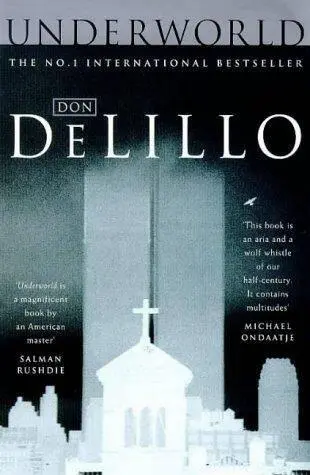
- Название:Underworld
- Автор:
- Жанр:
- Год:неизвестен
- ISBN:нет данных
- Рейтинг книги:2.5 / 5. Голосов: 2
-
Избранное:Добавить в избранное
- Отзывы:
-
Ваша оценка:
Underworld: краткое содержание, описание и аннотация
Предлагаем к чтению аннотацию, описание, краткое содержание или предисловие (зависит от того, что написал сам автор книги «Underworld»). Если вы не нашли необходимую информацию о книге — напишите в комментариях, мы постараемся отыскать её.
While Eisenstein documented the forces of totalitarianism and Stalinism upon the faces of the Russian peoples, DeLillo offers a stunning, at times overwhelming, document of the twin forces of the cold war and American culture, compelling that "swerve from evenness" in which he finds events and people both wondrous and horrifying. Underworld opens with a breathlessly graceful prologue set during the final game of the Giants-Dodgers pennant race in 1951. Written in what DeLillo calls "super-omniscience" the sentences sweep from young Cotter Martin as he jumps the gate to the press box, soars over the radio waves, runs out to the diamond, slides in on a fast ball, pops into the stands where J. Edgar Hoover is sitting with a drunken Jackie Gleason and a splenetic Frank Sinatra, and learns of the Soviet Union's second detonation of a nuclear bomb. It's an absolutely thrilling literary moment. When Bobby Thomson hits Branca's pitch into the outstretched hand of Cotter-the "shot heard around the world"-and Jackie Gleason pukes on Sinatra's shoes, the events of the next few decades are set in motion, all threaded together by the baseball as it passes from hand to hand.
"It's all falling indelibly into the past," writes DeLillo, a past that he carefully recalls and reconstructs with acute grace. Jump from Giants Stadium to the Nevada desert in 1992, where Nick Shay, who now owns the baseball, reunites with the artist Kara Sax. They had been brief and unlikely lovers 40 years before, and it is largely through the events, spinoffs, and coincidental encounters of their pasts that DeLillo filters the Cold War experience. He believes that "global events may alter how we live in the smallest ways," and as the book steps back in time to 1951, over the following 800-odd pages, we see just how those events alter lives. This reverse narrative allows the author to strip away the detritus of history and pop culture until we get to the story's pure elements: the bomb, the baseball, and the Bronx. In an epilogue as breathless and stunning as the prologue, DeLillo fast-forwards to a near future in which ruthless capitalism, the Internet, and a new, hushed faith have replaced the Cold War's blend of dread and euphoria.
Through fragments and interlaced stories-including those of highway killers, artists, celebrities, conspiracists, gangsters, nuns, and sundry others-DeLillo creates a fragile web of connected experience, a communal Zeitgeist that encompasses the messy whole of five decades of American life, wonderfully distilled.
***
Starting with a 1951 baseball game and ending with the Internet, "Underworld" is not a book for the faint-hearted. Elegiac in tone and described variously as DeLillo's Magnum Opus and his attempt to write the Great American Novel, the book weighs in at a hefty 827 pages and zips back and forwards in time, moving in and out of the lives of a plethora of different characters.
Following three main themes – the fate of a baseball from the winning game of the 1951 world series, the threat of atomic warfare and the mountains of garbage created by modern society – DeLillo moves forwards and backwards through the decades, introducing characters and situations and gradually showing the way their lives are interconnected.
Reading the prose can be uncannily like using a web browser: the narrative focus moves from character to character almost as quickly as we are introduced to them, and the time frame regularly changes to show further connections between the key players. This device – literature as hypertext – is particularly effective in the early parts of the novel and the technique never intrudes on the story itself.
The book focuses on Nick Shay, a former hoodlum who now works in the burgeoning waste management industry and owns the baseball from the 1951 game, "the shot heard around the world". In addition to Nick we hear from Frank Sinatra, J. Edgar Hoover, Lenny Bruce and the various people who move in and out of Nick's life: lovers, family, friends and colleagues. Through these seemingly disconnected narratives DeLillo paints a picture of Cold War paranoia at its peak – the baseball game happened the same day as the USSR 's first nuclear test – and the changes affecting his characters as a microcosm of American society as a whole.
Very few writers, however, can justify over 800 densely-printed pages to tell a story and "Underworld" would have benefited greatly from judicious wielding of the blue pencil. Potentially intriguing plots which feature strongly in the earlier parts of the book – an intriguing serial killer subplot, the stories of each person who possesses the winning baseball – are abandoned halfway through the book in favour of overlong childhood memories or the inane ponderings of a performance artist; other stories are neglected for over 400 pages before reappearing at the end of the novel, causing an unwelcome jolt as the reader tries to remember the pertinent details.
In this respect "Underworld" is a victim of its own ambition: by trying to cover such a wide range of characters and situations, DeLillo loses track of some of them and, in the latter parts of the novel in particular, the writing feels as if it is on autopilot while the author works out what to do next.
There is still much to recommend in "Underworld", however. Each vignette is lovingly crafted: DeLillo seems as comfortable writing from the perspective of a street missionary as he is inhabiting J Edgar Hoover's paranoia. The book employs vivid imagery, from painted angels on ghetto walls to the cityscape created by mountains of domestic waste, and the dialogue is usually well-observed and thoroughly believable although it does flag when describing Nick Shay's hoodlum past. Despite its faults DeLillo has created an ambitious and powerful novel which, due to its size, can also be used to swat annoying children on trains. Highly recommended.
Gary Marshall
Underworld — читать онлайн бесплатно полную книгу (весь текст) целиком
Ниже представлен текст книги, разбитый по страницам. Система сохранения места последней прочитанной страницы, позволяет с удобством читать онлайн бесплатно книгу «Underworld», без необходимости каждый раз заново искать на чём Вы остановились. Поставьте закладку, и сможете в любой момент перейти на страницу, на которой закончили чтение.
Интервал:
Закладка:
"I'm strange or you're strange?"
"You followed me into a ladies' room."
"No, wait wait wait wait. You can feel me watching you while you sleep and you think I'm strange? Who's strange?" I said.
And there were times when you detached yourself from the steepest breathing, even, and felt a kind of white shadow, a sliding away into a parallel person, someone made of mind-light who seemed to speak for you.
Or, "You can't make me do this," she'd say, running her hand up the seam of my fly, and I'm trying to drive the car.
And once when I was alone for a day and a night, not playing the radio or reading the newspaper and driving around aimlessly for hours, I finally stopped and parked and took a walk in a picnic grounds where there were white-barked trees and garbage cans for food scraps and a man who looked disturbed sitting on a bench, outside Fresno somewhere, but maybe he was only deep in thought, or worried about something, and I felt a sadness I could not exactly locate, a feeling that could have been mine or could have been theirs, the little families with food on paper plates, the unhappy man slouched on the bench, the place itself, the bench itself, the trash cans that didn't have lids.
I bought a postcard to send her after she went her way and I went mine, a card that showed a picnic table in the trees, and I slipped it in a book inside my bag until I had time to figure out what kind of message I would write.
4
The first man stood by the window of his stately suite at the Waldorf. He watched the yellow cabs sink into soulful dusk, that particular spendthrift light that falls dyingly on Park Avenue in the hour before people take leave of the office and become husbands and wives again, or whatever people become in whatever murmurous words when evenings grow swift and whispered.
The second man sat on the sofa, legs crossed, looking at Bureau reports.
Edgar said, "Of course you packed the masks."
The second man nodded yes, a gesture that went unseen.
"Junior, the masks."
"We have them, yes. I'm looking at a security memo that's a little, actually, rankling."
"I don't want to hear it. File it somewhere. I feel too good."
"Protest. Outside the Plaza tonight."
"What is it the bastards are protesting? Pray tell," Edgar said in a tone he'd perfected through the years, a tight amusement etched in eleven kinds of irony.
"The war, it seems."
"The war."
"Yes, that," the second man said.
They were staying at the Waldorf, which was J. Edgar Hoover's hotel of choice during his sojourns in New York, but the party was taking place, the ball, the fete, the social event of the season, the decade, the half century no doubt-the ball was in the ballroom at the Plaza.
Edgar changed the subject, if only in his mind. He gazed far up Park, where the earth curved toward Harlem. Maybe the deep and fleeting light was making him nostalgic, or the noise perhaps, the muted clamor of taxi horns below, a sound at this protected distance that was oddly and humanly happy, little toots and beeps that seemed to carry a pitch of celebration.
He said, "Where were you when Thomson hit the homer?"
"Beg pardon?"
"Where were you?"
"Yes?"
"Never mind. An idle thought, Junior."
Clyde Tolson, known as Junior, was Edgar's staunchest aide in the Bureau, his dearest friend and inseparable companion.
They were getting on, of course. Clyde was five years younger than Edgar but not so sharp as he used to be, his flash-card memory a little less prodigious now. But where Edgar was pug-nosed and compact, with brows like batwings, Clyde was long-jawed and tallish, sort of semidebonaire, a fairly gentle fellow who liked conversation-again, unlike his boss, who thought you gave yourself away, word by word, every time you opened your trap to speak.
Edgar held a tumbler of scotch. He checked the glass for smudges, then sniffed and sipped, feeling the charred fumes prickle his tongue. The complimentary suite, the soothing booze, the presence of Junior in the room, the party that everybody'd been talking about for months, famous long before it happened, the uninvited lapsing into states of acute confusion, insomniac, unable to function-yes, Edgar was feeling pretty good tonight.
Talkative or not, he loved a good party. He loved celebrities in particular and there would be an abundance of mammal glamour at the Plaza tonight. Personage and flair and stylish wit. A frail schoolboy still crouched inside the Director's pudgy corpus and this lonely crypto-child came to robust life in the presence of show people and other living icons-child stars, ballplayers, prizefighters, even Hollywood horses and dogs.
Celebrated people were master spirits, men and women who spiked the temper of the age. Whatever Edgar's own claim to rank and notoriety, he found himself subject to anal flutters when chatting with a genuine celeb.
Clyde said, "And this, of course, as well."
Edgar did not turn to see what the second man was reading. He studied the carpet instead. The carpets at the Waldorf were thick and lush, nesting grounds for bacteria of every sort. If you knew anything about modern war, you knew that weapons utilizing pathogenic bacteria could be every bit as destructive as megaton bombs. Worse, in a way, because the sense of infiltration was itself a form of death.
Clyde said, "I knew it was a mistake to publicize our methods regarding organized crime figures."
"What methods?"
"Ransacking their garbage."
"Makes good copy."
"And creates a copycat mentality. Now we have a situation that's a public relations nightmare. To wit, a so-called garbage guerrilla is targeting guess whose garbage, Boss?"
"Please. I'm enjoying my drink. A man enjoys a drink when the day winds down."
"Yours," Clyde said.
Edgar could not believe he'd heard the fellow correctly.
"This is what our confidential source tells us." And Clyde rattled the page he was reading for maximum nuisance effect. "Team of urban guerrillas planning a garbage raid at 4936 Thirtieth Place, Northwest, Washington, D.C. "
It was the end of the world in triplicate.
"When is this supposed to happen?"
"More or less momentarily."
" You've posted guards?"
"In unmarked cars. But whether we arrest them or not, they will find a way to make public theater of your garbage."
"I won't put the garbage out."
" You have to put it out, eventually."
" Ill put it out and lock it up."
"How will the garbage collectors collect it?"
When FBI agents stole off in the night with some mobster's household trash, they substituted fake garbage, to allay suspicion-aromatic food scraps, anchovy tins, used tampons prepared by the lab division. Then they took the real garbage back for analysis by forensic experts on gambling, handwriting, fragmented paper, crumpled photographs, food stains, bloodstains and every known subclass of scribbled Sicilian.
"Or do this," Edgar said. "Put out simulated garbage. Bland bits and pieces. Unnewsworthy."
"We can't use conventional methods, however clever, on these people. Because what they're doing flies in the face of ordinary confrontation. And no matter how well-guarded the premises, sooner or later they'll snatch a trash can and make off with it."
Edgar walked over to another window He needed a change, as they say, of scene.
"Confidential source says they intend to take your garbage on tour. Rent halls in major cities. Get lefty sociologists to analyze the garbage item by item. Get hippies to rub it on their naked bodies. More or less have sex with it. Get poets to write poems about it. And finally, in the last city on the tour, they plan to eat it."
Edgar could see part of the east facade of the Plaza , about a dozen blocks away.
Читать дальшеИнтервал:
Закладка:
Похожие книги на «Underworld»
Представляем Вашему вниманию похожие книги на «Underworld» списком для выбора. Мы отобрали схожую по названию и смыслу литературу в надежде предоставить читателям больше вариантов отыскать новые, интересные, ещё непрочитанные произведения.




Обсуждение, отзывы о книге «Underworld» и просто собственные мнения читателей. Оставьте ваши комментарии, напишите, что Вы думаете о произведении, его смысле или главных героях. Укажите что конкретно понравилось, а что нет, и почему Вы так считаете.