Don DeLillo - Underworld
Здесь есть возможность читать онлайн «Don DeLillo - Underworld» весь текст электронной книги совершенно бесплатно (целиком полную версию без сокращений). В некоторых случаях можно слушать аудио, скачать через торрент в формате fb2 и присутствует краткое содержание. Жанр: Современная проза, на английском языке. Описание произведения, (предисловие) а так же отзывы посетителей доступны на портале библиотеки ЛибКат.
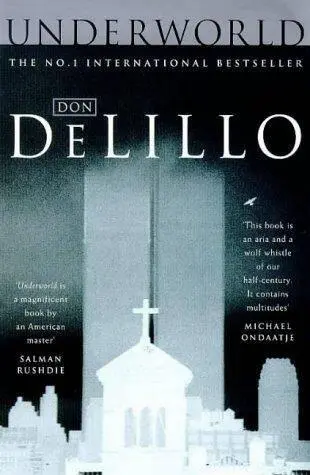
- Название:Underworld
- Автор:
- Жанр:
- Год:неизвестен
- ISBN:нет данных
- Рейтинг книги:2.5 / 5. Голосов: 2
-
Избранное:Добавить в избранное
- Отзывы:
-
Ваша оценка:
Underworld: краткое содержание, описание и аннотация
Предлагаем к чтению аннотацию, описание, краткое содержание или предисловие (зависит от того, что написал сам автор книги «Underworld»). Если вы не нашли необходимую информацию о книге — напишите в комментариях, мы постараемся отыскать её.
While Eisenstein documented the forces of totalitarianism and Stalinism upon the faces of the Russian peoples, DeLillo offers a stunning, at times overwhelming, document of the twin forces of the cold war and American culture, compelling that "swerve from evenness" in which he finds events and people both wondrous and horrifying. Underworld opens with a breathlessly graceful prologue set during the final game of the Giants-Dodgers pennant race in 1951. Written in what DeLillo calls "super-omniscience" the sentences sweep from young Cotter Martin as he jumps the gate to the press box, soars over the radio waves, runs out to the diamond, slides in on a fast ball, pops into the stands where J. Edgar Hoover is sitting with a drunken Jackie Gleason and a splenetic Frank Sinatra, and learns of the Soviet Union's second detonation of a nuclear bomb. It's an absolutely thrilling literary moment. When Bobby Thomson hits Branca's pitch into the outstretched hand of Cotter-the "shot heard around the world"-and Jackie Gleason pukes on Sinatra's shoes, the events of the next few decades are set in motion, all threaded together by the baseball as it passes from hand to hand.
"It's all falling indelibly into the past," writes DeLillo, a past that he carefully recalls and reconstructs with acute grace. Jump from Giants Stadium to the Nevada desert in 1992, where Nick Shay, who now owns the baseball, reunites with the artist Kara Sax. They had been brief and unlikely lovers 40 years before, and it is largely through the events, spinoffs, and coincidental encounters of their pasts that DeLillo filters the Cold War experience. He believes that "global events may alter how we live in the smallest ways," and as the book steps back in time to 1951, over the following 800-odd pages, we see just how those events alter lives. This reverse narrative allows the author to strip away the detritus of history and pop culture until we get to the story's pure elements: the bomb, the baseball, and the Bronx. In an epilogue as breathless and stunning as the prologue, DeLillo fast-forwards to a near future in which ruthless capitalism, the Internet, and a new, hushed faith have replaced the Cold War's blend of dread and euphoria.
Through fragments and interlaced stories-including those of highway killers, artists, celebrities, conspiracists, gangsters, nuns, and sundry others-DeLillo creates a fragile web of connected experience, a communal Zeitgeist that encompasses the messy whole of five decades of American life, wonderfully distilled.
***
Starting with a 1951 baseball game and ending with the Internet, "Underworld" is not a book for the faint-hearted. Elegiac in tone and described variously as DeLillo's Magnum Opus and his attempt to write the Great American Novel, the book weighs in at a hefty 827 pages and zips back and forwards in time, moving in and out of the lives of a plethora of different characters.
Following three main themes – the fate of a baseball from the winning game of the 1951 world series, the threat of atomic warfare and the mountains of garbage created by modern society – DeLillo moves forwards and backwards through the decades, introducing characters and situations and gradually showing the way their lives are interconnected.
Reading the prose can be uncannily like using a web browser: the narrative focus moves from character to character almost as quickly as we are introduced to them, and the time frame regularly changes to show further connections between the key players. This device – literature as hypertext – is particularly effective in the early parts of the novel and the technique never intrudes on the story itself.
The book focuses on Nick Shay, a former hoodlum who now works in the burgeoning waste management industry and owns the baseball from the 1951 game, "the shot heard around the world". In addition to Nick we hear from Frank Sinatra, J. Edgar Hoover, Lenny Bruce and the various people who move in and out of Nick's life: lovers, family, friends and colleagues. Through these seemingly disconnected narratives DeLillo paints a picture of Cold War paranoia at its peak – the baseball game happened the same day as the USSR 's first nuclear test – and the changes affecting his characters as a microcosm of American society as a whole.
Very few writers, however, can justify over 800 densely-printed pages to tell a story and "Underworld" would have benefited greatly from judicious wielding of the blue pencil. Potentially intriguing plots which feature strongly in the earlier parts of the book – an intriguing serial killer subplot, the stories of each person who possesses the winning baseball – are abandoned halfway through the book in favour of overlong childhood memories or the inane ponderings of a performance artist; other stories are neglected for over 400 pages before reappearing at the end of the novel, causing an unwelcome jolt as the reader tries to remember the pertinent details.
In this respect "Underworld" is a victim of its own ambition: by trying to cover such a wide range of characters and situations, DeLillo loses track of some of them and, in the latter parts of the novel in particular, the writing feels as if it is on autopilot while the author works out what to do next.
There is still much to recommend in "Underworld", however. Each vignette is lovingly crafted: DeLillo seems as comfortable writing from the perspective of a street missionary as he is inhabiting J Edgar Hoover's paranoia. The book employs vivid imagery, from painted angels on ghetto walls to the cityscape created by mountains of domestic waste, and the dialogue is usually well-observed and thoroughly believable although it does flag when describing Nick Shay's hoodlum past. Despite its faults DeLillo has created an ambitious and powerful novel which, due to its size, can also be used to swat annoying children on trains. Highly recommended.
Gary Marshall
Underworld — читать онлайн бесплатно полную книгу (весь текст) целиком
Ниже представлен текст книги, разбитый по страницам. Система сохранения места последней прочитанной страницы, позволяет с удобством читать онлайн бесплатно книгу «Underworld», без необходимости каждый раз заново искать на чём Вы остановились. Поставьте закладку, и сможете в любой момент перейти на страницу, на которой закончили чтение.
Интервал:
Закладка:
Dead at thirty-four, that was Bird, which was a ripe old age in the tunnels.
He knew he was getting fame because he had imitators, first, and because other writers did not disrespect him by spraying over his work, except some of them did, and because two women came looking for him in the Bronx.
But, see, this was the way his mind was reasoning at this particular time. Stay totally low and out of sight. Do not get your name or face in the papers. Do not get in trouble with the transit police. Because he had a woman he used to live with who was pregnant head to toe. They used to live with her mother and her mother's part-time man and it isn't that Ismael Mufioz doesn't want to be a father. It's just that this is not the time to get personally involved.
He heard they went into the superettes, two women from the galleries. They went into the bodegas, the church, the firehouse, he pictured them going into the firehouse to ask about graffiti, twenty men in rubber boots eating combination pizzas.
He sat on the Broadway train listening to the way his mind was reasoning.
People from the galleries were all over the Bronx looking for Moon-man, for Momzo Tops, for Snak-Bar and Rimester and the whole Voodoo crew.
Forget it, man. He could easily envision a case where the whole gallery scene is a scam by the police to get writers out of the tunnels and train yards and into the open, identified by name and face.
The man held his dick and eventually sucked it, whenever it was, a couple of days later, or weeks, that was the act he performed. And Ismael went down there, feeling sorry for himself, fairly often after that, going through a fence near the West Side Highway and into an opening in a grated emergency exit and down the narrow steps into the freight tunnel, where they had bookshelves, some of them, and Christmas decorations, and used half names and code names, tags like the writers would develop, and the truth of the matter is that he still goes down there for sex with men because some habits you drop and others you come to rely on.
The train went past City College, then veered east.
They did it herky-jerky in the dark. Or they went to a cable room and did it with sheets and towels. They kept pets down there arid ran clotheslines across the tunnel and stole electricity from the government.
Bop, bebop. And how Bird was dead at thirty-four.
And he sat there in his khaki slouch, looking down between his feet, glancing at the feet across the aisle, all the notched and dimpled shoes that did not seem to be things that people bought and wore so much as permanent parts, body parts, inseparable from the men and women sitting there, because the subway seals you durably in the stone of the moment.
The train entered the Bronx and he got off four stops later, at the end of the line, where his crew was waiting faithfully.
There were three of them, ages twelve, eleven and twelve, and they'd spent the day racking paint from hardware stores, which is a pastime, petty theft, that Ismael has long since risen above.
They walked up the steep hill at 242nd Street.
"Where's the rain?" Ismael said.
"Nothing happen," they said.
"I hear rain on the radio all day. I figure we don't work tonight. Ten to one against."
"Nothing happen," they said. "Two, three drops."
They had the spray-paint cans in three gym bags. They had Ismael's sketches in a manila portfolio. They had peaches and grapes in a paper bag inside a plastic bag. They had the French mineral water he liked to drink while he worked, also acquired in the day's little wave of thievery, Perrier, in pretty green bottles. He believed in going elite whenever possible. They had nozzles for the spray cans. They had master keys to open up the cars in case he wanted to work inside, which he did not.
His crew consisted of hopefuls, of course. Up writers of the future. They racked for the master. They kept lookout while he painted. They crossbraced their arms to support his weight when he needed to reach the upper part of a car.
A chain-link fence ran along the street, topped by razor ribbon. The crew paused near the west end of the fence, where there was a section of snipped links, concealed by poison ivy. They held back the fence and Ismael edged through, jump-stepping to the roof that was adjacent. There was a series of equipment sheds with sawtooth roofs. They went to the last roof and shinnied down drainpipes to the wooden planking at track level, which they could do in their sleep by now, and began to look around for a suitable train to tag.
They knew pretty much in advance that they wouldn't be hassled. There were too many trains, too many writers. The city could not afford all the guards that would be needed to patrol the yards and sidings through the night.
They saw Rimester near a light tower, one of the older writers, a black guy wearing a kufi, a skullcap, who did amazing wildstyle window-downs, Ismael had to admit-the letters decorated with love poems and sentiments of heartbreak.
They gave each other ceremonial respect, with precise and detailed flourishes of handshake and phraseology, and they rapped about this and that, and then Rimester described how he'd seen six of his cars going under the acid bath in the large yard about a mile and a half south of here. They run the cars under sprinklers built above the track. All his two-in-the-morning spray-crazy unpaid labor getting buffed away in minutes. Forget orange juice, man. This was the new graffiti killer, some weirdshit chemical from the CIA.
It's like you knock a picture off a shelf and someone dies. Only this time it's you that's in the photo.
That's how some writers felt about their tags.
There were a dozen tracks at the siding here. Ismael and his crew went to the far end, to the last track, overlooking the field where the Irish played Irish football. They picked out a flat-this was an old train with a paintable surface, much better than the ridgies that were coming on the market.
The crew lined up his colors and he went to work. He had a Rus-toleum yellow he'd started using, like mad canary, and the crew fitted different nozzles on the can so he could vary the breadth and mass of the strokes.
"We seen Lourdes," they said to him.
Lourdes was the woman he used to live with, two years older than Ismael, more or less, and maybe twenty pounds heavier right now.
"Who asked you who you seen?"
"She say she want to talk to you."
"Mdrzcdn, who asked? I ask?"
Ismael rarely got angry He was not an angry guy. He had the reflective head of an elder of the barrio, playing dominoes under a canopy while the fire engines idle up the street, but if the crew expected to do the fill-in once he set the style and faded the colors, they'd better learn the manners of the yard.
"Where's my Perrier, okay? You want to work with Ismael Munoz, you give him his Perrier and forget about messages from whoever."
They worked through the night without unnecessary talk. They handed him the spray cans. They shook the cans before handing them over and the clicking sound of the aerosol ball was basically the only noise in the yard except for the spray itself, the hissy wash of paint folding over the old iron flanks of the train.
The man who reached around and said excuse me.
Moonman 157. Add the digits and you get thirteen. But that's the street where he lives, or used to live, he lives a lot of places now, so it's properly part of his tag, it's what they know him as, and bad luck is an ego trip you can count on, and think of a train coming out of the tunnels and going elevated-think of your tag in maximum daylight rolling over the scorched lots where you were born and raised.
The crew shook the cans and the ball went click.
He stood on the door edge of one train and leaned across to the train parked adjacent and tagged it from the windows up.
Читать дальшеИнтервал:
Закладка:
Похожие книги на «Underworld»
Представляем Вашему вниманию похожие книги на «Underworld» списком для выбора. Мы отобрали схожую по названию и смыслу литературу в надежде предоставить читателям больше вариантов отыскать новые, интересные, ещё непрочитанные произведения.





Обсуждение, отзывы о книге «Underworld» и просто собственные мнения читателей. Оставьте ваши комментарии, напишите, что Вы думаете о произведении, его смысле или главных героях. Укажите что конкретно понравилось, а что нет, и почему Вы так считаете.