John Updike - Rabbit At Rest
Здесь есть возможность читать онлайн «John Updike - Rabbit At Rest» весь текст электронной книги совершенно бесплатно (целиком полную версию без сокращений). В некоторых случаях можно слушать аудио, скачать через торрент в формате fb2 и присутствует краткое содержание. Жанр: Современная проза, на английском языке. Описание произведения, (предисловие) а так же отзывы посетителей доступны на портале библиотеки ЛибКат.
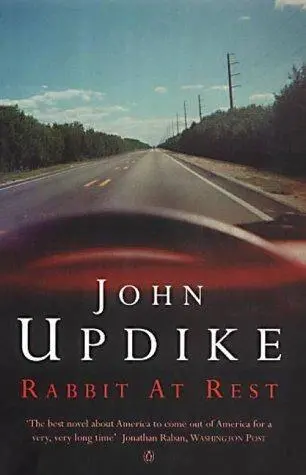
- Название:Rabbit At Rest
- Автор:
- Жанр:
- Год:неизвестен
- ISBN:нет данных
- Рейтинг книги:4 / 5. Голосов: 1
-
Избранное:Добавить в избранное
- Отзывы:
-
Ваша оценка:
Rabbit At Rest: краткое содержание, описание и аннотация
Предлагаем к чтению аннотацию, описание, краткое содержание или предисловие (зависит от того, что написал сам автор книги «Rabbit At Rest»). Если вы не нашли необходимую информацию о книге — напишите в комментариях, мы постараемся отыскать её.
***
Amazon.com Review
It's 1989, and Harry "Rabbit" Angstrom feels anything but restful. In fact he's frozen, incapacitated by his fear of death-and in the final year of the Reagan era, he's right to be afraid. His 55-year-old body, swollen with beer and munchies and racked with chest pains, wears its bulk "like a set of blankets the decades have brought one by one." He suspects that his son Nelson, who's recently taken over the family car dealership, is embezzling money to support a cocaine habit.
Indeed, from Rabbit's vantage point-which alternates between a winter condo in Florida and the ancestral digs in Pennsylvania, not to mention a detour to an intensive care unit-decay is overtaking the entire world. The budget deficit is destroying America, his accountant is dying of AIDS, and a terrorist bomb has just destroyed Pan Am Flight 103 above Lockerbie, Scotland. This last incident, with its rapid transit from life to death, hits Rabbit particularly hard:
Imagine sitting there in your seat being lulled by the hum of the big Rolls-Royce engines and the stewardesses bring the clinking drinks caddy… and then with a roar and giant ripping noise and scattered screams this whole cozy world dropping away and nothing under you but black space and your chest squeezed by the terrible unbreathable cold, that cold you can scarcely believe is there but that you sometimes actually feel still packed into the suitcases, stored in the unpressurized hold, when you unpack your clothes, the dirty underwear and beach towels with the merciless chill of death from outer space still in them.
Marching through the decades, John Updike's first three Rabbit novels-Rabbit, Run (1960), Rabbit Redux (1971), and Rabbit Is Rich (1981)-dissect middle-class America in all its dysfunctional glory. Rabbit at Rest (1990), the final installment and winner of the Pulitzer Prize, continues this brilliant dissection. Yet it also develops Rabbit's character more fully as he grapples with an uncertain future and the consequences of his past. At one point, for example, he's taken his granddaughter Judy for a sailing expedition when his first heart attack strikes. Rabbit gamely navigates the tiny craft to shore-and then, lying on the beach, feels a paradoxical relief at having both saved his beloved Judy and meeting his own death. (He doesn't, not yet.) Meanwhile, this all-American dad feels responsible for his son's full-blown drug addiction but incapable of helping him. (Ironically, it's Rabbit's wife Janice, the "poor dumb mutt," who marches Nelson into rehab.)
His misplaced sense of responsibility-plus his crude sexual urges and racial slurs-can make Rabbit seems less than lovable. Still, there's something utterly heroic about his character. When the end comes, after all, it's the Angstrom family that refuses to accept the reality of Rabbit's mortality. Only Updike's irreplaceable mouthpiece rises to the occasion, delivering a stoical, one-word valediction: "Enough."
Rabbit At Rest — читать онлайн бесплатно полную книгу (весь текст) целиком
Ниже представлен текст книги, разбитый по страницам. Система сохранения места последней прочитанной страницы, позволяет с удобством читать онлайн бесплатно книгу «Rabbit At Rest», без необходимости каждый раз заново искать на чём Вы остановились. Поставьте закладку, и сможете в любой момент перейти на страницу, на которой закончили чтение.
Интервал:
Закладка:
"I'm sorry, Grandpa. I did the best I could." Judy's little light voice, out of sight beneath him, wobbles and crackles with tears, like water sloshing in sun.
"You did great," he tells her.
A frantic stocky woman in a green committee T-shirt and truck-driver hat comes and hustles him away, to the head of the parade, past floats and drum-and-bugle corps, Model A Fords and civic leaders in neckties and a white limousine. A Mt. Judge patrol car with its blue light twirling and its siren silent will be the spearhead, then Harry at a distance. As if he doesn't know the route: as a child he used to participate in parades, in the crowd of town kids riding bicycles with red, white, and blue crépe paper threaded through the spokes. Down Central to Market a block short of 422, through the heart of the little slanting diagonal downtown, then left and uphill along Potter Avenue, through blocks of brick semidetached houses up on their terraced lawns behind the retaining walls, then downhill past Kegerise Alley as they used to call it, Kegerise Street it is now, with its small former hosiery factories and machine shops renamed Lynnex and Data Development and Business Logistical Systems, up to Jackson, the high end, a block from his old house, and on down to Joseph and past the big Baptist church, and sharp right on Myrtle past the post office and the gaunt old Oddfellows' Hall to end at the reviewing stand set up in front of the Borough Hall, in the little park that was full in the Sixties of kids smoking pot and playing guitars but now on a normal day holds just a few old retired persons and homeless drifters with million-dollar tans. The green-chested woman, along with a marshal with a big cardboard badge, a squinty stooped jeweller called Himmelreich – Rabbit was in school a few grades behind his father, whom everybody said was Jewish – makes sure he delays enough to let a distance build between him and the lead car, so Uncle Sam doesn't look too associated with the police. Immediately next in the parade is the white limousine carrying the Mt. Judge burgess and what borough councilmen aren't off in the Poconos or at the Jersey Shore. From further behind come the sounds of the drum-and-bugle corps and some bagpipers hired from Chester County and the scratchy pop tunes playing on the floats to help illustrate Liberty and the Spirit of 1776 and ONE WORLD/UN MUNDO and Head, Heart, Hands, and Health, and at the tail end a local rock singer doing ecstatic imitations of Presley and Orbison and Lennon while a megawatt electric fan loudly blows on all the amplifying equipment stacked on his flatbed truck. But up front, at the head of the parade, it is oddly silent, hushed. What a precarious weird feeling it is for Harry at last to put his suede-booted feet on the yellow double line of the town's main street and start walking! He feels giddy, ridiculous, enormous. Behind him there is the white limousine purring along in low gear, so he cannot stop walking, and far ahead, so far ahead it twinkles out of sight around corners and bends in the route, the police car; but immediately ahead there is nothing but the eerie emptiness of normally busy Central Street under a dazed July sky blue above the telephone wires. He is the traffic, his solitary upright body. The stilled street has its lunar details, its pockmarks, its scars, its ancient metal lids. The tremor in his heart and hands becomes an exalted sacrificial feeling as he takes those few steps into the asphalt void, rimmed at this end of the route with only a few spectators, a few bare bodies in shorts and sneakers and tinted shirts along the curb.
They call to him. They wave ironically, calling "Yaaaay" at the idea of Uncle Sam, this walking flag, this incorrigible taxer and frisky international mischief-maker. He has nothing to do but wave back, carefully nodding so as not to spill his hat or shake loose his goatee. The crowd as it thickens calls out more and more his name, "Harry," or "Rabbit" – "Hey, Rabbit! Hey, hotshot!" They remember him. He hasn't heard his old nickname so often in many years; nobody in Florida uses it, and his grandchildren would be puzzled to hear it. But suddenly from these curbstones there it is again, alive, affectionate. This crowd seems a strung-out recycled version of the crowd that used to jam the old auditorium-gym Tuesday and Friday nights, basketball nights, in the dead of the winter, making their own summer heat with their bodies, so that out on the floor sweat kept burning your eyes and trickling down from under your hair, behind your ears, down your neck to the hollow between your collar bones. Now the sweat builds under his wool swallowtail coat, on his back and his belly, which indeed is squeezed as Judy said, and under his hat even without the wig; thank God Janice got him out of that, she isn't always a dumb mutt.
His sweat, as with increasing ease and eagerness he waves at the crowd that clusters at the corners and in the shade of the Norway maples and on the sandstone retaining walls and terraced lawns up into the cool shadow of the porches, loosens his goatee, undermines the adhesive. He feels one side of it softly separate from his chin and without breaking stride – Uncle Sam has a bent-kneed, cranky stride not quite Harry's loping own – he digs out the Scotch tape from the pouchy pocket and tears off an inch, with the tab of red plaid paper. It wants to stick to his fingers; after several increasingly angry flicks it flutters away onto the street. Then he pulls off another piece, which he presses onto his own face and the detaching edge of synthetic white beard; the tape holds, though it must make a rectangular gleam on his face. The spectators who see him improvise this repair cheer. He takes to doffing his tall heavy hat, with a cautious bow to either side, and this stirs more applause and friendly salutation.
The crowd he sees from behind his wave, his smile, his adhesive gleam amazes him. The people of Mt. Judge are dressed for summer, with a bareness that since Harry's childhood has crept up from children into the old. White-haired women sit in their aluminum lawn chairs down by the curb dressed like fat babies in checks and frills, their shapeless veined legs cheerfully protruding. Middle-aged men have squeezed their keglike thighs into bicycle shorts meant for boys. Young mothers have come from their back-yard aboveground swimming pools in bikinis and high-sided slips of spandex that leave half their asses and boobs exposed. On their cocked hips they hold heat-flushed babies in nothing but diapers and rubber pants. There seem so many young – babies, tots, a bubbling up of generation on generation since the town brought him forth. Then it was full of the old: as he walked to school of a morning, severe and scolding women would come out of their houses shaking brooms and wearing thick dark stockings and housedresses with buttons all down the front. Now a cheerful innocent froth of flesh lines Jackson Road. Bare knees are bunched like grapes, and barrels of naked brown shoulders hulk in the dappled curbside shade. There are American flags on gilded sticks, and balloons, balloons in all colors, even metallic balloons shaped like hearts and pillows, held in hands and tied to bushes, to the handles of strollers containing yet more babies. A spirit of indulgence, a conspiring to be amused, surrounds and upholds his parade as he leads it down the stunning emptiness at the center of the familiar slanting streets.
Harry puts some Scotch tape on the other side of his goatee and out of the same pocket fishes his pill vial and pops a Nitrostat. The uphill section of the route tested him, and now turning downhill jars his heels and knees. When he draws too close to the cop car up ahead, carbon monoxide washes into his lungs. Mingled music from behind pushes him on: the gaps of "American Patrol" are filled with strains of "Yesterday." He concentrates on the painted yellow line, besmirched here and there by skid marks, dotted for stretches where passing is permitted but mostly double like the inflexible old trolley tracks, long buried or torn up for scrap. Cameras click at him. Voices call his several names. They know him, but he sees no face he knows, not one, not even Pru's wry red-haired heart-shape or Roy's black-eyed stare or Janice's brown little stubborn nut of a face. They said they would be at the corner of Joseph and Myrtle, but here near the Borough Hall the crowd is thickest, the summer-cooked bodies four and five deep, and his loved ones have been swallowed up.
Читать дальшеИнтервал:
Закладка:
Похожие книги на «Rabbit At Rest»
Представляем Вашему вниманию похожие книги на «Rabbit At Rest» списком для выбора. Мы отобрали схожую по названию и смыслу литературу в надежде предоставить читателям больше вариантов отыскать новые, интересные, ещё непрочитанные произведения.



Обсуждение, отзывы о книге «Rabbit At Rest» и просто собственные мнения читателей. Оставьте ваши комментарии, напишите, что Вы думаете о произведении, его смысле или главных героях. Укажите что конкретно понравилось, а что нет, и почему Вы так считаете.