Ha Jin - War Trash
Здесь есть возможность читать онлайн «Ha Jin - War Trash» весь текст электронной книги совершенно бесплатно (целиком полную версию без сокращений). В некоторых случаях можно слушать аудио, скачать через торрент в формате fb2 и присутствует краткое содержание. Жанр: Современная проза, на английском языке. Описание произведения, (предисловие) а так же отзывы посетителей доступны на портале библиотеки ЛибКат.
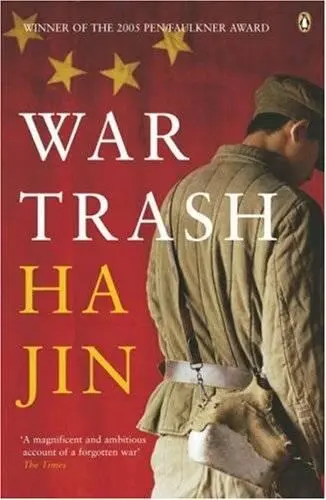
- Название:War Trash
- Автор:
- Жанр:
- Год:неизвестен
- ISBN:нет данных
- Рейтинг книги:5 / 5. Голосов: 1
-
Избранное:Добавить в избранное
- Отзывы:
-
Ваша оценка:
War Trash: краткое содержание, описание и аннотация
Предлагаем к чтению аннотацию, описание, краткое содержание или предисловие (зависит от того, что написал сам автор книги «War Trash»). Если вы не нашли необходимую информацию о книге — напишите в комментариях, мы постараемся отыскать её.
Jin (Waiting; The Crazed; etc.) applies his steady gaze and stripped-bare storytelling to the violence and horrifying political uncertainty of the Korean War in this brave, complex and politically timely work, the story of a reluctant soldier trying to survive a POW camp and reunite with his family. Armed with reams of research, the National Book Award winner aims to give readers a tale that is as much historical record as examination of personal struggle. After his division is decimated by superior American forces, Chinese "volunteer" Yu Yuan, an English-speaking clerical officer with a largely pragmatic loyalty to the Communists, rejects revolutionary martyrdom and submits to capture. In the POW camp, his ability to communicate with the Americans thrusts him to the center of a disturbingly bloody power struggle between two factions of Chinese prisoners: the pro-Nationalists, led in part by the sadistic Liu Tai-an, who publicly guts and dissects one of his enemies; and the pro-Communists, commanded by the coldly manipulative Pei Shan, who wants to use Yu to save his own political skin. An unofficial fighter in a foreign war, shameful in the eyes of his own government for his failure to die, Yu can only stand and watch as his dreams of seeing his mother and fiancée again are eviscerated in what increasingly looks like a meaningless conflict. The parallels with America 's current war on terrorism are obvious, but Jin, himself an ex-soldier, is not trying to make a political statement. His gaze is unfiltered, camera-like, and the images he records are all the more powerful for their simple honesty. It is one of the enduring frustrations of Jin's work that powerful passages of description are interspersed with somewhat wooden dialogue, but the force of this story, painted with starkly melancholy longing, pulls the reader inexorably along.
From The New Yorker
Ha Jin's new novel is the fictional memoir of a Chinese People's Volunteer, dispatched by his government to fight for the Communist cause in the Korean War. Yu Yuan describes his ordeal after capture, when P.O.W.s in the prison camp have to make a wrenching choice: return to the mainland as disgraced captives, or leave their families and begin new lives in Taiwan. The subject is fascinating, but in execution the novel often seems burdened by voluminous research, and it strains dutifully to illustrate political truisms. In a prologue, Yuan claims to be telling his story in English because it is "the only gift a poor man like me can bequeath his American grandchildren." Ha Jin accurately reproduces the voice of a non-native speaker, but the labored prose is disappointing from an author whose previous work – "Waiting" and " Ocean of Words " – is notable for its vividness and its emotional precision.
War Trash — читать онлайн бесплатно полную книгу (весь текст) целиком
Ниже представлен текст книги, разбитый по страницам. Система сохранения места последней прочитанной страницы, позволяет с удобством читать онлайн бесплатно книгу «War Trash», без необходимости каждый раз заново искать на чём Вы остановились. Поставьте закладку, и сможете в любой момент перейти на страницу, на которой закончили чтение.
Интервал:
Закладка:
The truth was that Ming couldn't walk in my shoes. Though he was a college graduate too, unlike me he had never been involved with the Nationalists. To the Communists he was a clean man, whereas I carried the heavy baggage of my past. If I had dined with Wang Yong's men, the whole company would have known of it. Then, facing the Communists' accusatory fingers, how could I have absolved myself? Wouldn't they punish me as a traitor too? Fortunately I hadn't touched the dinner, or else, compounded by the horrible words on my belly, I would have become too entangled with the pro-Nationalists to clear myself.
Like me, Dajian had been in low spirits ever since he was tattooed. He broke into wretched sobs from time to time. Once he even asked me whether we should sign up for Taiwan. I told him not to think this way and that we mustn't give up hope so easily.
Two days later, Ming and I met again at the northwestern end of the barbed-wire fence. He said we shouldn't worry too much about the tattoos and must adamantly insist on repatriation at the screening. I asked him, "Did you get this order from Commissar Pei?"
"No, we still haven't gotten in touch with him yet."
It was Hao Chaolin, the former artillery director of our division, who had given the instructions and who seemed to lead the Communist force now. Through Ming, Chaolin assured us that the tattoos could be removed. He provided convincing evidence as well: a few years ago, Warlord Yan in northwestern China had gotten a whole division of his troops tattooed with reactionary slogans on their chests; later many of these men had surrendered to the Communist army, whose surgeons effaced the words for them. This information comforted me some and bolstered my resolve to repatriate. With excitement I told Dajian the story, but it didn't cheer him up. He just said he'd follow me wherever I went. He was suffering from dysentery these days, passing blood and mucus, but he wouldn't stay at the hospital, afraid he might die there alone. I made him drink a lot of boiled water to prevent dehydration, and he took some medicine prescribed by a Korean doctor. The pills helped him and reduced his trips to the latrine, though his recovery was slow.
Spring in Korea was longer than in inland China, or to be more accurate, it was more distinct as a season. Indigo swallows and petrels appeared in the sky. The wind changed too, mostly coming from the Pacific, warm in the daytime but nippy at night. There were more fishing boats on the sea now, bobbing between the clouds and the water like large birds. Sometimes I watched them for hours on end, as though I knew some people on them. I even imagined myself making a living as a fisherman on the ocean – yes, I would love to do that. I was still young and could start my life afresh. I would prefer any land of life to this confinement, my heart full of longing for an untrammeled life.
On the morning of April 8 an American sound truck came to the gate of our compound and began broadcasting the policy for the screening, first in Korean, next in Chinese, then in English. The statement, repeated many times, moved and disturbed a lot of inmates. The Chinese part sounded smooth, firm, and clear. An amiable male voice announced:
… According to international law, both sides should return captured personnel as soon as possible. Repatriation will not be denied because some prisoners were forced to write their confessions, to have words or signs tattooed on them, or to have done what they would not do under normal circumstances. We understand that they were made to do things against their will. Therefore, we promise we will not hold them responsible. We wholeheartedly welcome every one of you back into the arms of our motherland. Brothers and comrades, your parents and families are expecting you. Please come home and rejoin them to live in peace and to participate in the construction of our great country…
After that statement, another man declared in stiff Chinese the United Nations' position on the screening. This voice represented the prison authorities and also urged us to repatriate. It declared:
The U.N. Command can offer no guarantee whatsoever on the ultimate fate of those of you who refuse to return to your own people. Therefore, before any of you decide irrevocably to resist repatriation, you must consider the consequences of your decision for your family. If you fail to go back, your government may hold your family accountable. On top of that, you may never see them again…
Hearing those words, many POWs became tearful. Some men drifted back into their tents and buried their heads in blankets, weeping. Wang Yong flew into a fury. "Fuck the Americans!" he cursed. "If I had a grenade I'd blow up that sound truck."
But the loudspeaker kept on: "Please also consider this possibility: if you refuse to go home, you will be held in custody here for at least several months longer. The United Nations cannot feed you forever, will make no promise about your future, and will not guarantee to send you to any safe place…"
Indeed, the broadcast was undermining the work the pro-Nationalists had painstakingly accomplished, and it made some prisoners more homesick. Worried about their future, some wanted to change their minds about going to Taiwan. The English part of the announcement also encouraged the captives to return home. It emphasized that the United Nations would keep only those who "forcibly resist repatriation." It sounded like the Americans were not interested in detaining POWs at all. Perhaps they didn't want to embarrass China and North Korea with a huge number of nonrepatriates, which would complicate a POW exchange and getting their own men back. Besides, it must have been an enormous burden to have tens of thousands of prisoners on their hands.
As soon as the sound truck pulled away to blare at a neighboring compound, our battalion was assembled in Liberty Hall. Han Shu, the chief of our regiment, came to speak to us. He was a slim, soft-spoken man, who in every way looked more like an official than an officer. Without Liu Tai-an's help, Han Shu could not have ruled the compound. But somehow the Americans liked him and had put him in the top position. Pacing the platform back and forth with his hands clasped behind him, Han Shu seemed lost in thought. We watched him silently. Then he lifted his intelligent face and said to us, "I have had a question on my mind for a long time." He pointed at Dajian standing in the front row. "Now, brother, I need you to help me figure out an answer. Yes, you. Come up here. Don't be nervous."
Dajian shuffled onto the platform. Han Shu continued, "Actually, my question isn't that hard to understand. We were all in the Red Army once and know the answer in our hearts. Now, my friend, what's your name?"
"Bai Dajian."
"Tell me, Brother Bai, what is the Seventh Article of the Conduct Code of the Communist army?"
Dajian wheezed out, "Never surrender. Never let yourself be taken prisoner even at the cost of your life."
"Correct. Please say it loudly so that everybody can hear you."
Dajian repeated it to the audience.
"Good, you can go back now." Han Shu turned to us. "This is what I want to talk about today. You all know the Communists' discipline and understand what will happen to you as a returned POW. If you still mean to repatriate, you must prepare to go through denunciations, corporal punishment, prison terms, and executions once you're back in our homeland. Even if the Communists let you remain alive, I can assure you that you will be the dregs of their society for the rest of your lives. Brothers, you all know I'm speaking the truth, which some of you are too afraid to face. So I have to bring it up now. History has shown that the Communists always treat their enemies more leniently than their own people. Only by becoming their significant enemies can you survive decently. I'm your chief here and ought to be concerned about your safety. Once you have set foot in this camp, you'll never be able to exonerate yourselves from the blame the Communists will pin on you, because they believe you have brought shame on China. They'll punish you ruthlessly in order to maintain discipline within their ranks. You may protest and say to them, 'But I've always been loyal to our country!' They'll counter, 'Then why didn't you kill yourself to keep our honor intact?' What can you say? Admit you're a coward? You may have to do that. If you're really a brave man, you can take your life now, right here in front of us. Then they'll be informed of your heroic deed and will publicize your story, name you a Revolutionary Martyr, and turn you into a big hero to inspire others.
Читать дальшеИнтервал:
Закладка:
Похожие книги на «War Trash»
Представляем Вашему вниманию похожие книги на «War Trash» списком для выбора. Мы отобрали схожую по названию и смыслу литературу в надежде предоставить читателям больше вариантов отыскать новые, интересные, ещё непрочитанные произведения.





Обсуждение, отзывы о книге «War Trash» и просто собственные мнения читателей. Оставьте ваши комментарии, напишите, что Вы думаете о произведении, его смысле или главных героях. Укажите что конкретно понравилось, а что нет, и почему Вы так считаете.