Ha Jin - War Trash
Здесь есть возможность читать онлайн «Ha Jin - War Trash» весь текст электронной книги совершенно бесплатно (целиком полную версию без сокращений). В некоторых случаях можно слушать аудио, скачать через торрент в формате fb2 и присутствует краткое содержание. Жанр: Современная проза, на английском языке. Описание произведения, (предисловие) а так же отзывы посетителей доступны на портале библиотеки ЛибКат.
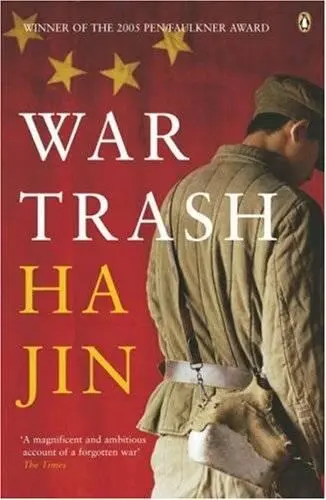
- Название:War Trash
- Автор:
- Жанр:
- Год:неизвестен
- ISBN:нет данных
- Рейтинг книги:5 / 5. Голосов: 1
-
Избранное:Добавить в избранное
- Отзывы:
-
Ваша оценка:
War Trash: краткое содержание, описание и аннотация
Предлагаем к чтению аннотацию, описание, краткое содержание или предисловие (зависит от того, что написал сам автор книги «War Trash»). Если вы не нашли необходимую информацию о книге — напишите в комментариях, мы постараемся отыскать её.
Jin (Waiting; The Crazed; etc.) applies his steady gaze and stripped-bare storytelling to the violence and horrifying political uncertainty of the Korean War in this brave, complex and politically timely work, the story of a reluctant soldier trying to survive a POW camp and reunite with his family. Armed with reams of research, the National Book Award winner aims to give readers a tale that is as much historical record as examination of personal struggle. After his division is decimated by superior American forces, Chinese "volunteer" Yu Yuan, an English-speaking clerical officer with a largely pragmatic loyalty to the Communists, rejects revolutionary martyrdom and submits to capture. In the POW camp, his ability to communicate with the Americans thrusts him to the center of a disturbingly bloody power struggle between two factions of Chinese prisoners: the pro-Nationalists, led in part by the sadistic Liu Tai-an, who publicly guts and dissects one of his enemies; and the pro-Communists, commanded by the coldly manipulative Pei Shan, who wants to use Yu to save his own political skin. An unofficial fighter in a foreign war, shameful in the eyes of his own government for his failure to die, Yu can only stand and watch as his dreams of seeing his mother and fiancée again are eviscerated in what increasingly looks like a meaningless conflict. The parallels with America 's current war on terrorism are obvious, but Jin, himself an ex-soldier, is not trying to make a political statement. His gaze is unfiltered, camera-like, and the images he records are all the more powerful for their simple honesty. It is one of the enduring frustrations of Jin's work that powerful passages of description are interspersed with somewhat wooden dialogue, but the force of this story, painted with starkly melancholy longing, pulls the reader inexorably along.
From The New Yorker
Ha Jin's new novel is the fictional memoir of a Chinese People's Volunteer, dispatched by his government to fight for the Communist cause in the Korean War. Yu Yuan describes his ordeal after capture, when P.O.W.s in the prison camp have to make a wrenching choice: return to the mainland as disgraced captives, or leave their families and begin new lives in Taiwan. The subject is fascinating, but in execution the novel often seems burdened by voluminous research, and it strains dutifully to illustrate political truisms. In a prologue, Yuan claims to be telling his story in English because it is "the only gift a poor man like me can bequeath his American grandchildren." Ha Jin accurately reproduces the voice of a non-native speaker, but the labored prose is disappointing from an author whose previous work – "Waiting" and " Ocean of Words " – is notable for its vividness and its emotional precision.
War Trash — читать онлайн бесплатно полную книгу (весь текст) целиком
Ниже представлен текст книги, разбитый по страницам. Система сохранения места последней прочитанной страницы, позволяет с удобством читать онлайн бесплатно книгу «War Trash», без необходимости каждый раз заново искать на чём Вы остановились. Поставьте закладку, и сможете в любой момент перейти на страницу, на которой закончили чтение.
Интервал:
Закладка:
A breezy voice answered, "Relax, man. We got eight of them, not bad."
"Are they Koreans or Chinese?"
"Must be Chinks."
"How can you tell?"
"They don't wear no uniform."
The jeep horn tooted, then some passing vehicle beeped back. The man in the passenger seat called out, "Hey, how's it going?"
"Swell," someone cried back from a distance.
They caught me! This realization shot a sharp pang to my heart, which seemed to jump up and block my throat. Two other Chinese men, whose faces I couldn't see, were also lying in the jeep. I couldn't tell if they were dead or alive. I could still move both arms, but my legs were numb. I tried to wriggle my toes to make sure they were still there; to my horror, I couldn't feel anything in my left foot. I touched my left thigh, which felt wooden. Hard as I tried, I couldn't move the leg; it must have been fractured. I touched my crotch – we had been told that some Americans would castrate Chinese POWs – but everything was all right there except that my thigh was bandaged. It seemed my captors meant to keep me alive. Why didn't they kill me? It would've been better that way. At least people back home would treat Mother as a Revolutionary Martyr's parent and the government would take care of her.
Where were they taking me? To a prison? To a hospital? I was overwhelmed by fear and shame. What should I do? We had never been instructed how to act honorably if we were taken prisoner, except to kill ourselves. Only Commissar Pei had once said that if we fell into the enemy's hands, we must never tell them the truth: always lie to them. That was all the preparation I had received for this situation. I was confused. Why hadn't the Americans finished me off? That would have made their job much simpler.
4. DR. GREENE
I was shipped to the First Closure of the POW Collection Center in Pusan. The city, then the provisional capital of South Korea, had so many American military offices and supply stations that the bustling streets reminded me of the Chinese city Dandong on the Yalu River, though more automobiles rolled around here and ships in the foggy harbor loomed like small buildings. Besides, this was a much bigger city with an airport. The closure I was put in comprised a hospital and several large compounds, each of which held over a thousand prisoners. The Collection Center was a transit point, where wounded POWs received medical treatment. But most prisoners stayed here just a few days; after being processed – registered and interrogated – they would be sent to different camps in other places.
My left thigh was fractured. A piece of shrapnel had hit the area near my groin and shattered the femur. Because of my injury I didn't go to registration, which I heard was a tedious process – the waiting lines were long there, though the clerks, mostly North Korean prisoners, were sympathetic to Chinese captives. Nor was I interrogated like other POWs, some of whom collapsed under the torment.
Nonetheless, I was ordered to have my fingerprints taken and to provide the information needed for registration. A stout American officer and a Chinese interpreter came to our ward, in which over seventy patients, wounded and diseased, were lying on canvas cots. The ward was in a large iron-framed tent with a plywood floor and two entrances. The air was foul in here. The officer asked me my name, rank, education, my unit's serial number, and questioned me about my immediate superiors. I told him that my name was Feng Yan and that I was a new recruit, serving as a secretary in an infantry company in the 539th Regiment. The Americans must have known that regiment's serial number, so I told him the truth: 3692. He showed me a bunch of snapshots of Chinese soldiers who all looked like officers, and asked me whether I knew any of them. I didn't recognize a single one. I was still weak, having been operated on just three days before, so after a few more questions the officer and the interpreter left, saying they'd come again. Throughout the questioning, I didn't speak English, fearful that I might reveal my true identity.
Outside the compound fenced with barbed wire, forty yards away from the gate, stood a white-stuccoed building, two stories high, with a red-tiled roof and dormer windows. Before the war it had been a schoolhouse, and now it was occupied by the Operating Section, which the patients called the Butchery. Almost every day dead bodies were carried out of it and then stacked in front of the closure's admission center, to join those who had died en route to the hospital. I had spent four hours in that building three days before. After I was placed on a table, two doctors had talked in whispers about my leg. I couldn't understand their words completely, because I was still delirious and unfamiliar with their medical vocabulary. They sounded unsure about the procedure to come. An anesthetist injected some drug into my lower abdomen and the small of my back, and then they tied down my arms and calves. When a nurse had spread a white sheet over my belly, one of the doctors smirked, saying, "I never thought there'd be so many patients to cut when I was drafted. This definitely beats any residency."
"I guess I'll be qualified for chief surgeon after the war is over," said a tall doctor with blond eyebrows. Apparently he was in charge of the operation.
My heart shuddered as I realized they were two medical school students who probably hadn't completed their course work yet. I closed my eyes tight wondering if I should beg them to save my leg, but I decided not to talk and just endure it. Outside, a downpour lashed and blurred the windowpanes.
"Ow!" I yelled as one of them poked my wound.
"It hurts?" asked a concerned voice.
Before I could answer, the tall doctor said, "We should start."
The anesthesia hadn't taken full effect yet when they began cutting me. Bouts of pain radiated to my insides and to my neck and head. Despite gritting my teeth, I couldn't stop groaning and twisting while their instruments explored my wound.
The room turned foggy. All the objects – the intense lights, the bottles hung on a steel stand, the bluish caps on the human heads – all seemed to be floating and bobbing around. A moment later I blacked out.
When I came to, my left thigh was dressed with a wooden board tied alongside my leg and hip. "You're all set for the time being," the tall doctor said to me with a grin. "You'll keep your leg."
"Thank you," I sighed.
"You speak English?"
I shook my head and regretted having blurted that out.
"Do you understand what I'm saying?" he asked again.
I didn't respond, just stared at him. With a wave of his hand he summoned two orderlies to take me away on a stretcher.
Besides the American medical staff, there were more than three dozen orderlies working in the hospital. Most of them were Chinese who had cooperated with our captors and had been assigned to work in the building, carrying patients and cleaning. As "collaborators," they probably wouldn't be going back to mainland China, where they would be held accountable for their behavior here, so they treated us according to their own moods and whims. Sometimes they even beat patients. The two orderlies who carried me back to the ward made fun of me all the way, saying I was lucky the doctors hadn't sawed off my leg.
The minute I was returned to the tent I began shivering. The doctor hadn't prescribed any painkiller for me, so I sweated and moaned throughout the night and the next morning. Thanks to the fellow inmates who gave me water to drink and even fed me some rice porridge, I survived that night. Among the ward mates there was a man from the Guards Company of our division, Ding Wanlin by name, who had suffered a bullet wound in his left side, which had almost healed. His bed was next to mine. He had recognized me, having seen me with Commissar Pei a few times, but I didn't remember him. He was considerate to me and sat at my bedside for several hours that night, wiping the sweat and tears off my face now and then. Meantime, a Korean man, wounded in the chest, raved continually and flung his hands as though quarreling with someone.
Читать дальшеИнтервал:
Закладка:
Похожие книги на «War Trash»
Представляем Вашему вниманию похожие книги на «War Trash» списком для выбора. Мы отобрали схожую по названию и смыслу литературу в надежде предоставить читателям больше вариантов отыскать новые, интересные, ещё непрочитанные произведения.




Обсуждение, отзывы о книге «War Trash» и просто собственные мнения читателей. Оставьте ваши комментарии, напишите, что Вы думаете о произведении, его смысле или главных героях. Укажите что конкретно понравилось, а что нет, и почему Вы так считаете.