Alan Judd - A Breed of Heroes
Здесь есть возможность читать онлайн «Alan Judd - A Breed of Heroes» весь текст электронной книги совершенно бесплатно (целиком полную версию без сокращений). В некоторых случаях можно слушать аудио, скачать через торрент в формате fb2 и присутствует краткое содержание. Год выпуска: 2011, ISBN: 2011, Издательство: Simon & Schuster UK, Жанр: Современная проза, на английском языке. Описание произведения, (предисловие) а так же отзывы посетителей доступны на портале библиотеки ЛибКат.
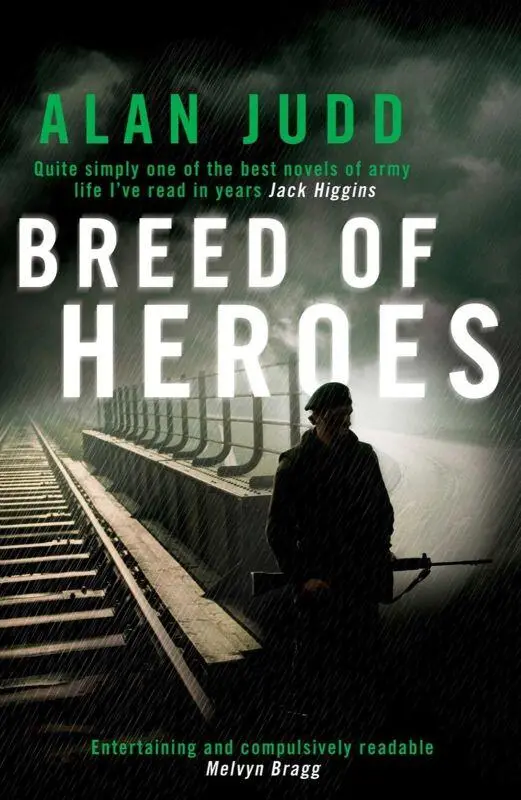
- Название:A Breed of Heroes
- Автор:
- Издательство:Simon & Schuster UK
- Жанр:
- Год:2011
- ISBN:9781847397720
- Рейтинг книги:3 / 5. Голосов: 1
-
Избранное:Добавить в избранное
- Отзывы:
-
Ваша оценка:
A Breed of Heroes: краткое содержание, описание и аннотация
Предлагаем к чтению аннотацию, описание, краткое содержание или предисловие (зависит от того, что написал сам автор книги «A Breed of Heroes»). Если вы не нашли необходимую информацию о книге — напишите в комментариях, мы постараемся отыскать её.
Alan Judd tells Thoroughgood’s tale with verve, compassion and humour. The result is an exceptionally fine novel which blends bitter human incident with army farce.
A Breed of Heroes — читать онлайн бесплатно полную книгу (весь текст) целиком
Ниже представлен текст книги, разбитый по страницам. Система сохранения места последней прочитанной страницы, позволяет с удобством читать онлайн бесплатно книгу «A Breed of Heroes», без необходимости каждый раз заново искать на чём Вы остановились. Поставьте закладку, и сможете в любой момент перейти на страницу, на которой закончили чтение.
Интервал:
Закладка:
Underlying everything in his life was the feeling that no one in the world cared for him. He suspected that everyone felt this. It was evident in occasional surliness and in the deliberate, hearty display of lack of emotion. The positive side of this was that he found he worried less about his own concerns but at the same time he cared less for other people, and noticed them less.
Each man developed a front of unconcern, which in some was ingrained, to the extent that the more he hardened himself the more he relied upon the corporate identity to take the place of his own. This corporate identity could be seen and felt: each man borrowed from it and lent to it; it embraced all and excluded none, to such an extent that all seemed merely to be aspects of it. It was difficult to say how much these conditions contributed to the suicide of Lance-Corporal Winn but, whether or not they acknowledged it, everyone felt that the contribution must have been substantial.
Lance-Corporal Winn was a small, chunky soldier from Birmingham, a man of few words but reliable and conscientious. He appeared to have little or no ambition to distinguish himself but simply jogged along and ‘kept his nose clean’, as the Army would have it. Charles knew him by sight but had never spoken to him, except to give orders when mounting guard in Aldershot. In time he would probably have made sergeant. The day before his death he had been told by another soldier, who had had a letter from his own wife, that back in Aldershot his wife had been carrying on with someone from one of the other regiments there. He had not said much about this at the time. In fact, his informant had had the impression that he didn’t much care. He had been on guard duty that night and had shot himself just after six, when he had come off duty. He had walked over to where the Pigs were parked in the Factory yard and had gone behind one of them. His relief, who had not spoken to him except to remark upon the cold, had assumed that he had gone to pee against the wall. When the shot came, he and one of the other guards had run to the Pig and found Winn on the ground behind it, but with the back half of his head splattered over the wall. He had apparently rested his rifle butt on the ground, bent over and put his mouth round the barrel.
Winn was in Tim’s platoon and Tim had been roused immediately. Henry Sandy was sent for and the body taken away in his Land-Rover ambulance. The padre came and Tim was unnecessarily rude to him. Arrangements were made to inform Winn’s widow through the Families officer in Aldershot. The CO appeared during the morning and talked to Edward, Tim and the soldier who had received the letter. The effect on the company — and, to a lesser extent, on the rest of the battalion — was to lower morale for a few days. Everyone was quieter and more serious, there was none of the normal banter and boisterousness amongst the soldiers nor any of the perennial grumbling that was so necessary to them. However, things were done quietly and conscientiously, and there was less fuss. But days pass in the Army as they do everywhere else and normality reasserts itself with the willing assistance of everyone, perhaps more quickly than in civilian life because of the consciousness of common purpose. Layer upon layer of daily and nightly routine soon smothered any exceptional event.
Charles was not sorry, though, when a telephone call summoned him with all his kit to battalion headquarters. There had been another shooting: Philip Lamb had inadvertently shot himself in the foot and Charles had to take his place as PRO. He was glad to leave the company and the Factory. The people and the place had become depressingly familiar, like a tedious argument for ever repeated and never resolved. There was a dreary intimacy about it all from which he was glad to free himself. The police station occupied by battalion HQ, though far from comfortable, could not fail to be an improvement upon the Factory, and dealing with the press would be a welcome change from the sordid concerns of his platoon, where kit inspections and deficiencies seemed to be the paramount concern in his life. Sergeant Wheeler was to look after the platoon until a new subaltern arrived from the Depot. Charles bade him goodbye in the Factory yard with what seemed even to himself an absurd formality considering he was moving half a mile or so.
‘’Spect we’ll see you back with all them press poofters, sir,’ Sergeant Wheeler said as they shook hands.
‘No doubt, and I shall expect your help.’
‘You’ll be too good for us then, sir. You won’t want to know us.’
‘Goodbye, Sergeant Wheeler. Good luck.’
‘Goodbye, sir, and you, sir.’
Despite the relief at leaving the Factory there were disadvantages about going to battalion HQ. It was renowned throughout the battalion as a place of madness and fear. In addition to the loathing which most soldiers have for the headquarters of higher formations, even their own, the personality of the CO pervaded the building and induced in all who entered it a sense of urgency bordering on panic and the feeling that heads were about to roll. As Charles’s Land-Rover entered the gates into the yard around which the police station was built he already began to feel that there had, after all, been something homely and reassuring about company life. Battalion HQ contained much that was unknown and hence dangerous for second lieutenants. No move in the Army was entirely for the better.
‘Going to be murder with the CO breathing down your neck all the time,’ Edward had said. ‘Rather you than me, old son. Still, it’s more your sort of line, I suppose, all this press rubbish. You read books. Apparently, the new chap we’re getting is very good. Bit of life and a drop of new blood won’t do the company any harm. Drop in and see us sometime when you’re swanning around. Don’t forget to hand your kit in to the company stores. And your rifle.’
‘No more action for you,’ Chatsworth had said. ‘You’re being more or less pensioned off. There might be some women amongst these journalists, so bear me in mind. You know, the sort who have to do it to prove to themselves how liberated they are. With a chauvinistic Ackie shit like me they can feel they’re even more liberated than they thought by embracing the opposition, so to speak. Poor fools. Bring ’em round for an interview.’
It turned out that Philip Lamb had shot his foot whilst entering B company’s location with a TV team. While unloading his pistol for the sentry’s inspection, as was compulsory when entering any defended area, he had carelessly cocked it with the full magazine still in and, pointing towards the ground, had squeezed the trigger to clear it. The TV team had filmed his subsequent writhings. It was the first negligent discharge in the battalion and the CO, who was furious, had fined him heavily. He had brought public disgrace to the regiment and the CO was determined not to have him back.
Charles reported to the adjutant, Colin Wood. Colin, who had left the Army to go into business and had rejoined it after marrying, looked as weary and long-suffering as might be expected of anyone who worked closely with the CO. But he had a reputation for competence and sanity, and his face was kindly. Having been outside the Army, he did not regard all civilians as odd nor all subalterns as criminally irresponsible. ‘Nice to have you with us, Charles,’ he said, balancing on the rear legs of his chair and clasping his hands behind his head. ‘We could do with a new face round here. You’ve got a pretty cushy job, but apart from that it’s all bad news. You’re sharing a bedroom with Tony Watch and an office with me. You’re on the list for watchkeeping in the ops room, which means three eight-hour shifts a week — six till two, two till ten, ten till six. You also have to help me deal with complaints from the locals, of which there are many, and you have some sort of responsibility under Anthony Hamilton-Smith for community relations. Though I don’t think there’s too much of that going on. There’s a telly in the Mess, which sometimes works, the food’s awful and we’re still not allowed gravy. You have to wear a pistol and carry ammunition at all times, including in the bath if you can find one, so better draw one from the armoury. We’re not allowed out, of course, except on duty, and the press, I’m told, can be very difficult. If anyone in the battalion cocks it up the CO will hold you responsible. Apart from all that it’s heaven.’
Читать дальшеИнтервал:
Закладка:
Похожие книги на «A Breed of Heroes»
Представляем Вашему вниманию похожие книги на «A Breed of Heroes» списком для выбора. Мы отобрали схожую по названию и смыслу литературу в надежде предоставить читателям больше вариантов отыскать новые, интересные, ещё непрочитанные произведения.










Обсуждение, отзывы о книге «A Breed of Heroes» и просто собственные мнения читателей. Оставьте ваши комментарии, напишите, что Вы думаете о произведении, его смысле или главных героях. Укажите что конкретно понравилось, а что нет, и почему Вы так считаете.