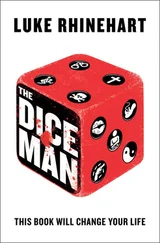
Luke Rheinhart - The Diceman
Здесь есть возможность читать онлайн «Luke Rheinhart - The Diceman» весь текст электронной книги совершенно бесплатно (целиком полную версию без сокращений). В некоторых случаях можно слушать аудио, скачать через торрент в формате fb2 и присутствует краткое содержание. Жанр: Современная проза, на английском языке. Описание произведения, (предисловие) а так же отзывы посетителей доступны на портале библиотеки ЛибКат.

- Название:The Diceman
- Автор:
- Жанр:
- Год:неизвестен
- ISBN:нет данных
- Рейтинг книги:3 / 5. Голосов: 1
-
Избранное:Добавить в избранное
- Отзывы:
-
Ваша оценка:
The Diceman: краткое содержание, описание и аннотация
Предлагаем к чтению аннотацию, описание, краткое содержание или предисловие (зависит от того, что написал сам автор книги «The Diceman»). Если вы не нашли необходимую информацию о книге — напишите в комментариях, мы постараемся отыскать её.
The Diceman — читать онлайн бесплатно полную книгу (весь текст) целиком
Ниже представлен текст книги, разбитый по страницам. Система сохранения места последней прочитанной страницы, позволяет с удобством читать онлайн бесплатно книгу «The Diceman», без необходимости каждый раз заново искать на чём Вы остановились. Поставьте закладку, и сможете в любой момент перейти на страницу, на которой закончили чтение.
Интервал:
Закладка:
"But it's ridiculous. When I do any one of these things, play any one of these roles, the other selves are not satisfied. You've got to help me satisfy one self in such a way that the others will feel that they are somehow being considered too. Make them shut up. You've got to help me pull myself together and stop spilling all over the goddamn universe without actually doing anything."
'Dr. Rhinehart looked up and smiled. `Our Western psychologies try to solve O. B.'s problem by urging him to form some single integrated personality, to suppress his natural multiplicity and build a single dominant self to control the others. This totalitarian solution means that a large standing army of energy must be maintained to crush the efforts of the minority selves to take power. The normal personality exists in a state of continual insurrection.'
`Some of this makes sense,' added Dr. Ecstein helpfully.
`In dice theory we attempt to overthrow the totalitarian personality and -'
`The masses need a strong leader,' interrupted Dr. Moon.
The silence which followed was broken only by his uneven breathing.
`Go on,' said Dr. Weinburger.
`All I've got to say for now,' replied Dr. Moon, closing the shutters on the red furnaces of his eyes and beginning to swing in a slow arc toward the shoulder of Dr. Mann.
`Go on, Dr. Rhinehart,' said Dr. Weinburger, his face expressionless but his hands crumpling up the papers in front of him like octopi demolishing squid.
Dr. Rhinehart glanced at his wristwatch and went on.
Thank you. In our metaphor - which has that same admirable degree of scientific precision and rigor as Freud's famous parable of the superego, the ego, and the id - in our metaphor, the anarchic chance - led person is governed in fact by a benevolent despot: the Die. In the early stages of therapy only a few selves are able to offer themselves as options to the Die. But as the student progresses, more and more selves, desires, value and roles are raised into the possibility of existence; the human being grows, expands, becomes more flexible, more various. The ability of major selves to overthrow the Die declines, disappears. The personality is destroyed. The man is free. He-' `I see no need to let Dr. Rhinehart go on,' said Dr. Weinburger, suddenly standing up. `Although, as Dr. Ecstein has so helpfully observed, some of it makes sense, the idea that the destruction of the personality is the way to mental health may be rejected on a priori grounds. I need only remind you gentlemen of the first sentence of Dr. Mann's brilliant textbook on abnormal psychology: "If a person has a strong sense of his identity, of the permanency of things and of an integral selfhood, he will be secure."
He smiled over at Dr. Mann. `I therefore move-'
`Precisely,' said Dr. Rhinehart. `Or rather, precisely, sir. It is always rejected on a priori grounds and not on empirical grounds. We have never experimented with the possibility of a strong man being able to demolish his personality and become more various, happy and creative than he was before. The first sentence of our textbook will read: "If a person can attain a strong confidence in his inconsistency and unreliability, a strong yea-saying sense of the impermanence of things and of an un-integrated, non-patterned chaos of selves, he will be fully at home in a multivalent society - he will be joyous ….
`We have plenty of empirical evidence regarding the destruction of the personality,' said Dr. Cobblestone quietly. `Our mental hospitals are overflowing with people who have a sense of an un-integrated, non-patterned chaos of selves.'
`Yes, we do,' replied Dr. Rhinehart calmly. `But why are they there?'
There was no answer to this question, and Dr. Rhinehart, after waiting while Dr. Weinburger sat down again, continued, `Your therapies tried to give them a sense of an integral self and failed. Isn't it just possible that the desire not to be unified, not to be single, not to have one personality may be the natural and basic human desire in our multivalent societies?'
Again there was a silence, except for Dr. Moon's expiring breaths and an irritable throat-clearing by Dr. Weinburger.
`Whenever I look at the Western psychotherapies of the last hundred years,' Dr. Rhinehart went on, `it seems to me incredible that no one acknowledges the almost total failure of these therapies to cure human unhappiness. As Dr. Raymond Felt has observed: "The ratio of spontaneous remission of symptoms and the rate of supposed `cures' by the psychotherapies of the various schools has remained essentially the same throughout the twentieth century."
`Why have our efforts to cure neurosis been so uniformly unsuccessful? Why does civilization expand unhappiness faster than we can develop new theories about how it occurs and what we ought to do about it? Our mistake is booming obvious. We have carried over from the simple, unified, stable societies of the past an image of the ideal norm for man which is totally wrong for our complex, chaotic, unstable and mufti-' valued urban civilizations of today. We assume that "honesty" and "frankness" are of primary importance in healthy human relations, and the lie and the act are, in the anachronistic ethics of our time, considered evil.'
'Ah, but Dr: Rhinehart, you can't-' said Dr. Cobblestone.
'No, sir. I regret to say I'm serious. Every society is based upon lies. Our society of today is based on conflicting lies. The man who lived in a simple, stable, single-lie society absorbed the single-lie system into a unified self and spouted it for the rest of his life, un-contradicted by his friends and neighbors, and unaware that ninety-eight percent of his beliefs were illusions, his values artificial and arbitrary and most of his desires comically ill-aimed.
`The man in our multi-lie society absorbs a chaos of conflicting lies and is reminded daily by his friends and neighbors that his beliefs arc not universally held, that his values are personal and arbitrary and his desires often ill-aimed. We must realize that to ask this man to be honest and true to himself, when his contradictory selves have multiple contradictory answers to most questions, is a safe and economical method of driving -him insane.
`On the other hand, to free him from his unending conflict we must urge him to let go, to act, to pretend, to lie. We must give him the means to develop these abilities. He must become a diceperson.'
`See! See!' Dr. Peerman interrupted. `He just confessed to advocating a therapy which encourages lying. Did you hear him?'
`I believe we have been listening to Dr. Rhinehart, thank you, Dr. Peerman,' said Dr. Weinburger, again mangling the papers in front of him. `Dr. Rhinehart, you may go on.'
Dr. Rhinehart glanced at his watch and continued.
`When all men lie by their very being in a multi-lie society, only the sick try to be honest, and only the very sick ask for honesty in others. Psychologists, of course, urge the patient to be authentic and honest. Such methods '
`If our methods are so bad,' asked Dr. Weinburger harshly, `then why do any of our patients improve at all?'
`Because we've encouraged them to play new roles,' Dr. Rhinehart answered promptly. `Primarily the role of "being honest", but also the roles of feeling guilty, having sinned, being oppressed, discovering insights, being sexually liberated and so on. Of course, the patient and therapist are under the illusion that they are getting at true desires, when in fact they are only releasing and developing new and different selves.`
'Good point, Luke,' said Dr. Ecstein.
'The limitations placed on this new role-playing are catastrophic. The patient is being pressed to get at his "true" feelings and thus to be single and unitary. In discovering unlived roles in his search for a "true self" he may experience brief periods of liberation, but as soon as he is urged to enthrone some new self as the true one, he will again feel locked up and divided. Dice therapy alone acknowledges what we all know and choose to forget: man is multiple.'
Читать дальшеИнтервал:
Закладка:
Похожие книги на «The Diceman»
Представляем Вашему вниманию похожие книги на «The Diceman» списком для выбора. Мы отобрали схожую по названию и смыслу литературу в надежде предоставить читателям больше вариантов отыскать новые, интересные, ещё непрочитанные произведения.






Обсуждение, отзывы о книге «The Diceman» и просто собственные мнения читателей. Оставьте ваши комментарии, напишите, что Вы думаете о произведении, его смысле или главных героях. Укажите что конкретно понравилось, а что нет, и почему Вы так считаете.