Nikos Kazantzakis - Zorba The Greek
Здесь есть возможность читать онлайн «Nikos Kazantzakis - Zorba The Greek» весь текст электронной книги совершенно бесплатно (целиком полную версию без сокращений). В некоторых случаях можно слушать аудио, скачать через торрент в формате fb2 и присутствует краткое содержание. Жанр: Современная проза, на английском языке. Описание произведения, (предисловие) а так же отзывы посетителей доступны на портале библиотеки ЛибКат.
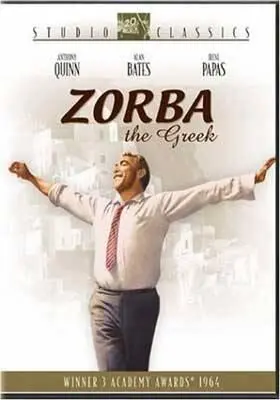
- Название:Zorba The Greek
- Автор:
- Жанр:
- Год:неизвестен
- ISBN:нет данных
- Рейтинг книги:3 / 5. Голосов: 1
-
Избранное:Добавить в избранное
- Отзывы:
-
Ваша оценка:
Zorba The Greek: краткое содержание, описание и аннотация
Предлагаем к чтению аннотацию, описание, краткое содержание или предисловие (зависит от того, что написал сам автор книги «Zorba The Greek»). Если вы не нашли необходимую информацию о книге — напишите в комментариях, мы постараемся отыскать её.
Zorba The Greek — читать онлайн бесплатно полную книгу (весь текст) целиком
Ниже представлен текст книги, разбитый по страницам. Система сохранения места последней прочитанной страницы, позволяет с удобством читать онлайн бесплатно книгу «Zorba The Greek», без необходимости каждый раз заново искать на чём Вы остановились. Поставьте закладку, и сможете в любой момент перейти на страницу, на которой закончили чтение.
Интервал:
Закладка:
"God Almighty!" the men murmured, crossing themselves.
"You left your picks down there!" Zorba shouted angrily.
The men said nothing.
"Why didn't you take them with you?" he shouted again, furious. "You wet your pants, I bet! Too bad about the tools, eh?"
"Oh, Zorba, this is no time to bother about the picks," I said, coming between them. "Let's be grateful that all the men are safe and sound! Thanks to you, Zorba, for we all owe our lives to you."
"I'm hungry!" Zorba said. "That's made me feel empty."
He took his haversack, which he had left on a stone, opened it and pulled out some bread, olives, onions, a boiled potato and a little gourd of wine.
"Come on, boys, let's eat!" he said, with his mouth full.
He bolted his food quickly, as if he had suddenly lost a lot of strength and wanted to stoke up again.
He ate leaning forward, without speaking. He took his gourd, threw his head back and let the wine gurgle down his parched throat.
The workmen also took courage, opened their haversacks and started eating. They sat, cross-legged round Zorba, and ate, looking at him. They wanted to throw themselves at his feet and kiss his hands, but they knew he was brusque and strange, and none of them dared make a movement.
Finally Michelis, the eldest, who had a big, grey moustache, made up his mind and spoke:
"If you hadn't been there, good master Alexis," he said, "our children would be orphans by this time."
"Dry up!" Zorba said, with his mouth full; and no one else ventured a word.
10
"WHAT THEN created this labyrinth of hesitation, this temple of presumption, this pitcher of sin, this field sown with a thousand deceptions, this gateway to Hell, this basket overflowing with artfulness, this poison which tastes like honey, this bond which chains mortals to the earth: woman?"
I was slowly, silently copying this Buddhist song, sitting on the ground near the brazier. I was trying exorcism upon exorcism, bent on casting out from my mind the image of a woman's body soaked by the rain, which every night that fall passed in the humid air to and fro before my eyes with swaying hips. Ever since the collapse of the gallery, when my life had nearly been cut short, I sensed the widow in my blood. She called to me like a wild animal, pressingly and reproachfully.
"Come! Come!" she cried. "Life passes in a flash. Come quickly, come, come, before it is too late!"
I was well aware that it was Mara, the spirit of the Evil One, in the shape of a woman with powerful thighs and buttocks. I fought against him. I applied myself to writing Buddha in the same way that savages in tbeir caves engraved with a pointed stone or painted in red and white the famished and ferocious beasts who prowled around them. They, too, endeavored, by engraving and painting these beasts, to fix them fast on the rock. If they had not done so, the beasts would have leapt upon them.
From the day I had just missed being crushed to death, the widow passed ceaselessly in the fiery air of my solitude,, beckoning to me and voluptuously swaying her hips. During the day I was strong, my mind was alert and I managed to cast her out. I wrote in what guise the Tempter appeared to Buddha, how he took on the shape of a woman, how he pressed his firm breasts against the knees of the ascetic, how Buddha saw the danger, mobilized all his powers and routed the Evil One.
Each sentence I wrote brought me fresh relief, I took courage, I felt the Evil One was withdrawing, cast out by the all-powerful exorcism of the word. I fought during the daytime with all my strength, but at night my mind laid down its arms, the inner doors opened and the widow entered.
In the morning I awoke exhausted and vanquished, and the struggle began afresh. When I raised my head from my paper, it was the end of the afternoon; the light was being chased away; darkness suddenly fell upon me. The days were shortening, Christmas was approaching. I threw myself with all my might into the struggle. I said to myself: I am not alone. A great force, the light of day, is also fighting. It, too, is sometimes vanquished, sometimes victorious. But it does not despair. I struggle and hope together with the light!
It seemed to me, and this thought gave me courage, that in fighting against the widow I, too, was obeying a great universal rhythm. Guileful matter has chosen this body, I thought, slowly to dampen and extinguish the free flame which flickers within me. I said to myself: The imperishable force which transforms matter into spirit is divine. Each man has within him an element of the divine whirlwind and that is how he can convert bread, water and meat into thought and action. Zorba was right: "Tell me what you do with what you eat and I will tell you who you are!"
And so I was painfully endeavoring to transform that violent desire of the flesh into Buddha.
"What are you thinking about, boss? You don't seem to be quite yourself," Zorba said to me on Christmas Eve. He had a shrewd idea as to what demon I was fighting.
I pretended not to hear. But Zorba did not give up so easily.
"You're young, boss," he said.
And suddenly his voice assumed a bitter and angry tone.
"You're young and pretty tough, eating well, drinking well, breathing exhilarating sea air, and storing up energy-but what are you doing with it all? You sleep alone, and it's just too bad for the energy! You get along there tonight-yes, lose no tíme! Boss, everything's simple in this world. How many times must I tell you? So don't go and complicate things!"
The manuscript of Buddha was open in front of me and I turned over its leaves as I listened to Zorba's words and realized that they showed me a sure, attractive and very human path to tread. It was again the spirit of Mara, the crafty pander, who was calling.
I listened without saying a word and continued slowly to turn the pages of the manuscript. I whistled to conceal my emotion. But Zorba, seeing I did not speak, suddenly burst out:
"This is Christmas Eve, my friend, hurry up, get to her before she goes to church. Christ will be born tonight, boss; you go and perform your miracle, too!"
I rose, irritated.
"That's enough, Zorba," I said. "Every one follows his own bent. Man is like a tree. You've never quarrelled with a fig tree because it doesn't bear cherries, have you? Well then, that'll do! It's nearly midnight. Let us go to the church and see Christ born ourselves."
Zorba pulled his thick winter cap over his head.
"All right, then!" he said unhappily. "Let's go! But I want you to know that God would have been much more pleased if you'd gone to the widow's tonight, like Archangel Gabriel. If God had followed the same path as you, boss, he'd never have gone to Mary's and Christ would never have been born. If you asked me what path God follows, I'd say: the one leading to Mary's. Mary is the widow."
He waited in silence and in vain for my reply. He thrust the door open, and he went out. He angrily struck at the pebbles with the end of his stick.
"Yes," he repeated persistently, "Mary is the widow!"
"Now, let's get along!" I said. "Don't shout!"
We strode along at a good pace in the winter night. The sky was perfectly clear, the stars looked big and hung low in the sky like balls of fire. The night, as we made our way along the shore, resembled a great black beast lying along the water's edge.
"From tonight," I said to myself, "the light which winter has forced back will begin to fight victoríously. As if it were born this night together with the infant god."
All the villagers had crowded into the warm and scented hive of the church. The men stood in front and the women, with clasped hands, behind. The tall priest, Stephanos, was in an exasperated state after his forty-days' fast. Clad in his heavy gold chasuble, he was running hither and thither in great strides, swinging his censer, singing at the top of his voice and in a great hurry to see Christ born and get home to a thick soup, savory sausages and smoked meats…
Читать дальшеИнтервал:
Закладка:
Похожие книги на «Zorba The Greek»
Представляем Вашему вниманию похожие книги на «Zorba The Greek» списком для выбора. Мы отобрали схожую по названию и смыслу литературу в надежде предоставить читателям больше вариантов отыскать новые, интересные, ещё непрочитанные произведения.









Обсуждение, отзывы о книге «Zorba The Greek» и просто собственные мнения читателей. Оставьте ваши комментарии, напишите, что Вы думаете о произведении, его смысле или главных героях. Укажите что конкретно понравилось, а что нет, и почему Вы так считаете.