Eugene Vodolazkin - The Aviator
Здесь есть возможность читать онлайн «Eugene Vodolazkin - The Aviator» весь текст электронной книги совершенно бесплатно (целиком полную версию без сокращений). В некоторых случаях можно слушать аудио, скачать через торрент в формате fb2 и присутствует краткое содержание. Город: London, Год выпуска: 2018, ISBN: 2018, Издательство: Oneworld Publications, Жанр: Современная проза, на английском языке. Описание произведения, (предисловие) а так же отзывы посетителей доступны на портале библиотеки ЛибКат.
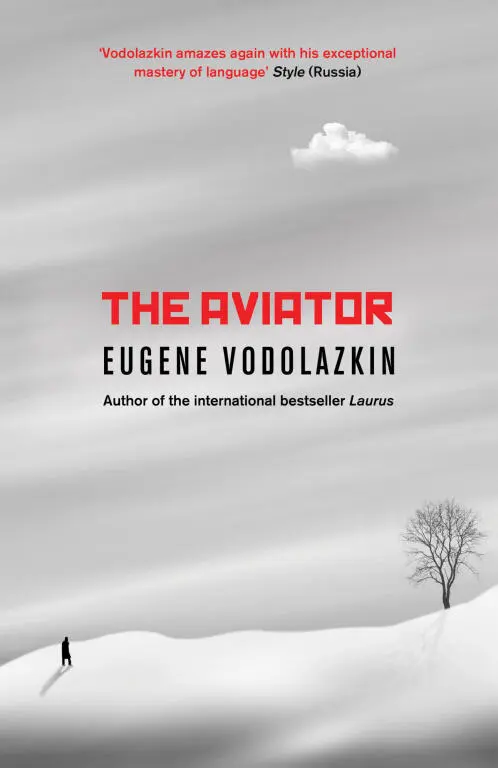
- Название:The Aviator
- Автор:
- Издательство:Oneworld Publications
- Жанр:
- Год:2018
- Город:London
- ISBN:978-1-78607-271-9
- Рейтинг книги:4 / 5. Голосов: 2
-
Избранное:Добавить в избранное
- Отзывы:
-
Ваша оценка:
The Aviator: краткое содержание, описание и аннотация
Предлагаем к чтению аннотацию, описание, краткое содержание или предисловие (зависит от того, что написал сам автор книги «The Aviator»). Если вы не нашли необходимую информацию о книге — напишите в комментариях, мы постараемся отыскать её.
Reminiscent of the great works of twentieth-century Russian literature, with nods to Dostoevsky’s
and Bulgakov’s
,
cements Vodolazkin’s position as the rising star of Russia’s literary scene.
The Aviator — читать онлайн бесплатно полную книгу (весь текст) целиком
Ниже представлен текст книги, разбитый по страницам. Система сохранения места последней прочитанной страницы, позволяет с удобством читать онлайн бесплатно книгу «The Aviator», без необходимости каждый раз заново искать на чём Вы остановились. Поставьте закладку, и сможете в любой момент перейти на страницу, на которой закончили чтение.
Интервал:
Закладка:
On Vasilievsky Island, I turned on to Maly Prospect and walked, crossing Line after Line on the city’s grid of streets. Some things, of course, had changed, but everything is recognizable. I turned right on 17th Line and walked a block to Smolensky Cemetery. Here it was, the cemetery dear to me; my memory had not led me astray. My heart began thumping as I entered the cemetery gates, even stopping for a minute. I started off along the central tree-lined alley, passing the church, and stopped again.
I remembered. Straight: to my mother. My mother. But which way to her, Anastasia’s mother? After all, we had come here together more than once. I thought it was to the left. I stepped off the path and began squeezing my way between graves, crunching on fallen branches. I read names. Sologub, Chebotarevskaya… How about that? I was just thinking about Chebotarevskaya and, there you go, we met here and I was not surprised.
Voronina… I felt frightened, oh so frightened. I looked away and then looked again, as if I were running. Voronina Antonina. Mikhailovna. That initial A in her name took my breath away. I could not even finish reading. I took a deep breath and tried again: Antonina, not Anastasia. Thus, Anastasia is not denoted here. And what follows from that? Nothing, I fear. It was simply joyful for me to find out that Anastasia was not in this grave.
As I was leaving, I came across a pauper by the cemetery gates. He had no yellow leaves in his hands this time: this was seemingly already some other pauper. And now it’s May, so how could there be yellow leaves here? Even so: it occurred to me that if I turned my head, she’d be behind me… Fainthearted, I did not turn. When I gave money to the pauper, I asked him to pray for Anastasia and Innokenty.
‘For health, for repose?’ he asked.
It began to drizzle.
‘I don’t know… I cannot be sure in either case.’
All the same, it is too bad I did not turn around. This was a moment when anything might have happened.
MONDAY
On a May day in 1921, Ostapchuk and I were knocking together wooden display boards. They asked him:
‘What is your name?’
And he said:
‘Ostapchuk. Ivan Mikhailovich.’
After the clerk wet her pencil with saliva, that’s what she wrote down, right there, on one of the boards, on its fluttering sheet. She had a copying pencil; her lips and tongue were violet. Her hair was tied with a scarf, golden under red. The sun had been shining all morning. Completely insignificant events take place for some reason and this is how they are recalled.
The display boards were for agitational purposes and thus intended for use with posters. We were making them on the Zhdanovka embankment in the yard at a carpenter’s workshop, to fulfill our labor service. We did not even know what would hang on them, what sort of agitation. We simply took old boards from a huge pile, sawed them up into pieces of the correct size, and placed them neatly on the ground. We tossed two boards on top, width-wise, and fastened them to the boards lying on the ground. Then we turned them over and nailed frames made from wooden strips along the edges. The result was a display board.
Ostapchuk took off his high-collared jacket and shirt. I told him:
‘You’ll catch cold. It’s cool, you know.’
‘No,’ said Ostapchuk, ‘I won’t catch a cold in the sun. My body should feel the sun for once.’
Ostapchuk’s body truly was defiantly white, unpleasantly white, like some night creature’s.
‘And I want to spare the jacket and shirt, too,’ he added a few minutes later. ‘I wouldn’t want to ruin them working.’
I did not understand Ostapchuk’s apprehension: his clothes were blatantly shabby. But I kept silent. I did not take my things off. Anticipating a later camp habit, I already felt then that the more a person was wearing, the better.
During the break, they brought us each a hunk of bread, lump of sugar, and mug of carrot tea from the workshop. Ostapchuk poured out his tea and offered to do the same for me. I wavered at first but he insisted. Ostapchuk carried himself like a person who firmly knows what he is doing. I poured out the contents of my mug, too. And then Ostapchuk took from his rucksack, lying on the boards, a bottle containing a cloudy liquid. From his sly squint, I understood I should express approval. And indifference about the poured-out tea, even if it was carrot. I expressed both things, though drinking homebrew with Ostapchuk was no great joy.
‘My wife’s relatives from the village sent it,’ said my drinking-mate. ‘Do you have relatives in a village?’
No, I did not have any relatives like that. I did not even have a wife.
Ostapchuk poured homebrew into the mugs with a gurgle. He shifted the bottle from mug to mug without raising the neck but not spilling a drop. The smell of impure alcohol made itself sharply felt in the air.
‘To the success of our agitation,’ said Ostapchuk.
Judging from the grimace he fabricated, he did not believe in that success. We clinked with a tinny sound. I sipped from the mug and, between swallows, ate up my bread and then the sugar, too. Ostapchuk limited himself to the bread, neatly placing his sugar in his rucksack after licking it a few times.
He and I lay on the boards for the remainder of the break. Ostapchuk told of his life and I watched clouds float across the sky. They floated very quickly, changing form and even color as they went. They appeared from behind the workshop’s wall and soon hid behind the roof of the next house. Each was the embodiment of fluidity and changeability, unlike Ostapchuk, who had served as a watchman at the Pulkovo Observatory his whole life. The observatory was not in operation so there was nothing for him to watch over for the time being.
I experienced a feeling close to happiness from the smell of the boards, from that May day, and even from Ostapchuk’s stories. Everything that I saw and felt on that day distinctly spoke to how life was only beginning. And if life’s simplest events are so fresh and joyful, then what can be expected from outstanding events that still lie ahead? That is how things seemed to me then.
TUESDAY
Seva says to me:
‘Join the party of the Bolsheviks!’
It is already June. Sun. The sun is breaking its way through oak foliage in Petrovsky Park. We are walking along a path, stepping on last year’s acorns.
‘Why join?’
‘To organize the revolution. According to Marx, revolutions are the locomotives of history.’
It turns out Seva is now a Marxist.
‘What if,’ I am asking, ‘the locomotive heads the wrong way? After all, you’re not the one steering.’
Seva does not allow that possibility. He looks at me with anger; this gaze of his appeared some time ago.
‘The party,’ he says, ‘is strength. There are so many of us! Everyone cannot be mistaken.’
In the first place, they can.
In the second place, it is enough for the engineer to be mistaken.
In the third place, this can be a matter of intentional action. Bad-intentioned.
I don’t say any of this to Seva because I don’t want to anger him more. In another situation, I might have said something, but I don’t want to now. This summer day is dear to me, as are the whistles of steamboats on the Neva, and our walking along the path. ‘The party is strength.’ And Seva, I think as I walk alongside him, is weak. And is raging at me out of his own weakness because I know him through and through. He attaches himself to people who seem strong to him and hopes they will give him part of their strength. They will not give him anything. For a moment, it occurs to me that if Seva were to become a tyrant, I would be the first person he would destroy.
Seva, where are you now? In which grave?
Читать дальшеИнтервал:
Закладка:
Похожие книги на «The Aviator»
Представляем Вашему вниманию похожие книги на «The Aviator» списком для выбора. Мы отобрали схожую по названию и смыслу литературу в надежде предоставить читателям больше вариантов отыскать новые, интересные, ещё непрочитанные произведения.






Обсуждение, отзывы о книге «The Aviator» и просто собственные мнения читателей. Оставьте ваши комментарии, напишите, что Вы думаете о произведении, его смысле или главных героях. Укажите что конкретно понравилось, а что нет, и почему Вы так считаете.