Julian Rathbone - Kings of Albion
Здесь есть возможность читать онлайн «Julian Rathbone - Kings of Albion» весь текст электронной книги совершенно бесплатно (целиком полную версию без сокращений). В некоторых случаях можно слушать аудио, скачать через торрент в формате fb2 и присутствует краткое содержание. Жанр: Современная проза, на английском языке. Описание произведения, (предисловие) а так же отзывы посетителей доступны на портале библиотеки ЛибКат.
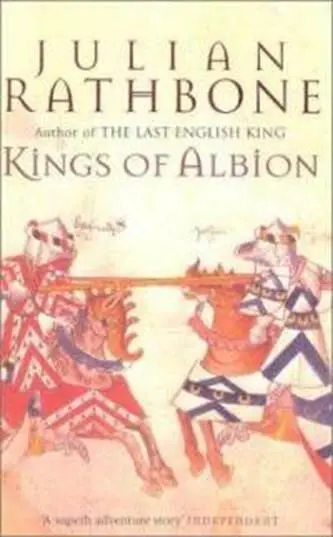
- Название:Kings of Albion
- Автор:
- Жанр:
- Год:неизвестен
- ISBN:нет данных
- Рейтинг книги:3 / 5. Голосов: 1
-
Избранное:Добавить в избранное
- Отзывы:
-
Ваша оценка:
Kings of Albion: краткое содержание, описание и аннотация
Предлагаем к чтению аннотацию, описание, краткое содержание или предисловие (зависит от того, что написал сам автор книги «Kings of Albion»). Если вы не нашли необходимую информацию о книге — напишите в комментариях, мы постараемся отыскать её.
'Set in 1460, this hugely enjoyable romp is narrated by Mah-Lo from Mandalay – a wink at Joseph Conrad and the sort of sly joke with which the book abounds. The heart of darkness is not Africa, however, but England in the grip of the Wars of the Roses. The novel tells of a group of men who travel from Goa to trace a kinsman. Rathbone vividly describes the "Inglysshe, the least civilised and most barbaric people on earth", and brings to life the sounds, sights and, above all. smells of fifteenth-century England' Sunday Times
'Rathbone's novel is excellent, both as a fictional adventure story and as a detailed and enlightening description of an ancient land' The Times
Kirkus Reviews
No doubt hoping to extend the extravagant sweep-of-history-on-the-road theme of his previous novel (The Last English King, 1999), but falling short, Rathbone shifts to the Wars of the Roses, and a group of travelers from India who arrive just in time to be in the thick of the intrigue. In 1459, the disfigured but widely traveled Arab trader Ali, already pushing 60, agrees to deliver a packet from a mysterious, soon-dead stranger he meets in an English inn to the royal family of Vijayanagara in southern India. Ali's success earns him a return to the cold and rain of Albion, but this time with a prince of the family and his retinue in tow. The mission now: to track down the prince's brother, long estranged and believed to be practicing a secret, forbidden religion somewhere in the north. As they head west, Ali discovers that the monk in their party is actually a sensuous young woman he met briefly before leaving India. Later, Uma seduces him in a Cairo bathhouse, and adds a teenaged English nobleman to her list of conquests as they prepare to cross the English Channel. The boy, Eddie, is one of those plotting to overthrow the king of England; finding a hostile reception when Ali and company make it to London, he is forced to flee. Ali and the others get caught up in the civil war as well, with the prince shut up in the Tower of London and Ali and Uma leaving town without him. When Ali falls ill and stops in a monastery to recuperate, Uma keeps going, looking for Eddie, but she's thrown in prison, too, just as the two sides begin their series of bloody battles. Eventually, she finds her hot-blooded boy, and the prince finds his brother-but these reunions aren't what they've been expecting.The rambling seems more travelogue than novel, including, as it does, everything from theology to weather reports, and the notion of strangers in a strange land never quite catches fire.
Kings of Albion — читать онлайн бесплатно полную книгу (весь текст) целиком
Ниже представлен текст книги, разбитый по страницам. Система сохранения места последней прочитанной страницы, позволяет с удобством читать онлайн бесплатно книгу «Kings of Albion», без необходимости каждый раз заново искать на чём Вы остановились. Поставьте закладку, и сможете в любой момент перейти на страницу, на которой закончили чтение.
Интервал:
Закладка:
At first we can hardly see the land, which lies low and flat a couple of miles away on either side, but slowly both banks inch in towards us and the great river begins to meander the way rivers do, and the villages we pass become more frequent: Gravesend and Tilbury, Greenhithe and Purfleet, Thamesmead and Creekmouth. The traflic increases too, or seems to, as the space it can move in slowly narrows: carvels like ours, some from distant parts, smaller cogs, flat-bottomed wherries, fishing-boats trailing nets, skiffs and tiny coracles.
Lord Djym – that is his name or nickname for he surely is no real lord – points out to me men and women who swing their way across the mudflats on wooden plates for shoes to gather oysters, scallops, clams and mussels wherever a turn of the river makes a bank of shingle the tide will soon cover, while in the mouths of the smaller streams that empty into the mighty one others cut reeds with billhooks to make roofing thatch. We see slipways, too, and sheds where boats are built, and sawmills powered by the water of the inland streams. Although it is the depths of winter, and we can see snow lying on the hills behind Woolwich and Greenwich, there is bustle and business almost everywhere, except on Bugsby Marsh to our left, an evil, cursed patch caught in a loop of the river where blue flames flicker above outlets of poisonous air.
And then, suddenly, an unnatural darkness tails on us, and the sun, which had shone wanly but low and bright enough to make me want to shade my eyes with my hand, becomes a red disc floating in a pool of blackness.
'What's happened?' I ask, thinking perhaps some sort of eclipse or heavenly intervention is marking our arrival.
Lord Djym is puzzled. 'Nothing.'
'But it's all gone dark, and the sun is almost blotted out.'
'Oh, that's just the smoke from the city. In winter, and especially when it's cold and frosty and there's not much wind, it lies like a blanket over everything. Sometimes it comes down so heavy you can't see your hand in front of your face at midday.'
Slowly, very slowly, we edge round a tongue of land this time on the right bank. It's flat and looks marshy apart from heaps and heaps of smouldering rubbish whose fumes must make up much of the cloud that hangs above and around us. The smell is overpowering, sickening, because amongst it all there is much rotting flesh and much of it is burning.
'The Isle of Dogs," says Lord Djym, and cups his ear towards it. Indeed now I can hear a monotonous howling and barking, and just make out through the gloom the shapes of diseased, emaciated canines loping along the strand and barking at us, or nosing and digging in the piles of waste and garbage.
The river turns again and now is almost straight for a couple of miles or so with the sun about setting above it. Beneath the swirling fog, the surface runs red, not solidly so but splashed in zigzagging lines where the light catches the crests of the ripples, as if a dagger has been slashed finely but closely across its velvet skin and made it bleed. Soon, looming through the smoke and fog on the right-hand side, we can see four big square towers, capped with pyramids of black slate or lead, heavy against the sky, behind a battlemented curtain wall that snakes round them over a low hill. Behind these towers soars the tall, elegant spire that has been on our horizon but getting ever nearer through most of the day.
'Tower of London,' says Djym. 'And St Paul's.'
And that's as far as we go tonight, for the ship's master lays us alongside a wharf on the southern bank, and March calls us into the waist of the boat around the main mast.
'We stay on board tonight,' he says, his voice loud and firm. 'It's not safe to walk through the city streets at night without a guard, and it is too late to find a proper lodging. We shall be up early in the morning and we'll decide on our next move then."
The sun dips below what looks like a line of houses upstream of the towers, or Tower, and suddenly all is dark except for the glimmer of a torch one of the crew is holding. Dim lights glow in casements along the riverbank on the other side, more numerous than the few stars that are bright enough to prick the mantle above. The blood has gone from the river, but fills the western sky instead.
The morning is another of those magic mornings like the one we had the day we arrived in Calais. The sky is perfectly clear, a pale-azure not the lapis blue of the dawn sky in Vijayanagara, but more like an aquamarine. Smoke, white from wood and black from coal, climbs into it in perfectly straight lines from ten thousand chimneys – it looks like the warp on a weaving frame. Frost glitters on every shingled roof and coats the slates and tiles like ground glass. No thatch: within the walls it's forbidden, Djym tells me, for fear of fire. Shadows long and deep fill the spaces between the houses with purple darkness. Most marvellous of all, every rope and spar on our boat and on all the others moored nearby is coated with tiny sharp crystals.
For a moment there is stillness, then downriver, the sun pushes an edge above the water, fills the sky above with gold, and makes the river, too, run with gold where the night before it ran with blood, and at that moment the city comes to life: church bells ring, cocks crow, a cannon cracks on the battlements of the Tower and a puffball of white smoke hangs like a fist for almost a minute above the water – so still is the air. The river begins to till with boats that ply as ferries, for the most part carrying goods and people from the south bank to the north. Vendors appear on the quay beside us. selling bread hot from the ovens, filled with melting cheese and the crisp, smoked and salted porkmeat they call bacon, and canteens tilled with hot spiced red wine. This is welcomed by the men for, as March says, coming to stand beside me: 'Cold, ain't it? Bloody cold.' then, 'Get brekkers out of the way first, then we'll have to organise some animals here for your baggage. Shouldn't be a problem. There's an inn a couple of streets away called the Tabard where pilgrims heading for Canterbury meet. But the pilgrim season don't get under way until April, so I reckon they'll have spare beasts.'
He throws what is left of his pint of wine down his throat, buys a second lump of bread, and saunters off down an alleyway, whose cave-like shadows quickly swallow him up.
But as he goes a strange thing happens. On the corner of the alley he tosses a copper to a legless beggar whose sawn-off stumps rest on the cobbles. This beggar looks after him, watery eyes narrowed, then blinks the rheum out of them, staring still at March's retreating back, shakes his shaggy head. 'Fuck me,' he says. He grabs his crutches and. with remarkable agility, hoists himself into the air above them and swings himself like a tall bird, a heron or a crane, first one stick then the other, along the quay, upstream.
One by one the others come on deck and I repeat to them what March has said while they, too, buy food and drink, though they refuse the hot wine and take warm milk instead. Then Ali makes our porters bring the baggage up from the hold. The ship's master insists it stay on board until he has been paid and Prince Harihara, not knowing what would be a fair price for our voyage from Calais, agrees to leave it on the deck until March returns. Which he does, about an hour later, by when the sun is higher in the sky, though not much – so low is its trajectory in these climes.
It's all bustle now for twenty minutes or so, getting the mules he-has brought with him loaded up, together with two Ingerlonder muleteers, the ship's captain paid, and so on. Then all at last is ready, and I say goodbye to Djym, who surprises me with a kiss. The last to leave is Genet who, for a horse, is quite intelligent and. perceiving he is to be returned to dry land, gives no trouble. One of March's grooms saddles him up yet March does not mount him, but leads him by the bridle. Perhaps he sees the question on my face.
Читать дальшеИнтервал:
Закладка:
Похожие книги на «Kings of Albion»
Представляем Вашему вниманию похожие книги на «Kings of Albion» списком для выбора. Мы отобрали схожую по названию и смыслу литературу в надежде предоставить читателям больше вариантов отыскать новые, интересные, ещё непрочитанные произведения.





Обсуждение, отзывы о книге «Kings of Albion» и просто собственные мнения читателей. Оставьте ваши комментарии, напишите, что Вы думаете о произведении, его смысле или главных героях. Укажите что конкретно понравилось, а что нет, и почему Вы так считаете.