Andrew Neiderman - Deficiency
Здесь есть возможность читать онлайн «Andrew Neiderman - Deficiency» весь текст электронной книги совершенно бесплатно (целиком полную версию без сокращений). В некоторых случаях можно слушать аудио, скачать через торрент в формате fb2 и присутствует краткое содержание. Год выпуска: 2004, ISBN: 2004, Жанр: Современная проза, на английском языке. Описание произведения, (предисловие) а так же отзывы посетителей доступны на портале библиотеки ЛибКат.
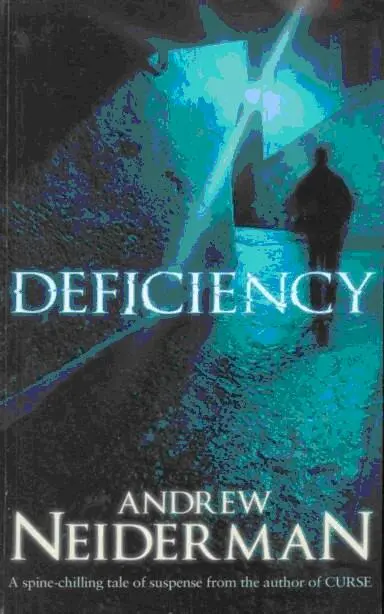
- Название:Deficiency
- Автор:
- Жанр:
- Год:2004
- ISBN:0-7434-7828-2
- Рейтинг книги:5 / 5. Голосов: 1
-
Избранное:Добавить в избранное
- Отзывы:
-
Ваша оценка:
Deficiency: краткое содержание, описание и аннотация
Предлагаем к чтению аннотацию, описание, краткое содержание или предисловие (зависит от того, что написал сам автор книги «Deficiency»). Если вы не нашли необходимую информацию о книге — напишите в комментариях, мы постараемся отыскать её.
Deficiency — читать онлайн бесплатно полную книгу (весь текст) целиком
Ниже представлен текст книги, разбитый по страницам. Система сохранения места последней прочитанной страницы, позволяет с удобством читать онлайн бесплатно книгу «Deficiency», без необходимости каждый раз заново искать на чём Вы остановились. Поставьте закладку, и сможете в любой момент перейти на страницу, на которой закончили чтение.
Интервал:
Закладка:
"That's ridiculous," Terri shouted at the screen. "Why would someone burn a house down to kill herself? And besides, it's a painful death." She went to the phone to try to contact Will Dennis. It took a while for her to be passed through to his cell phone.
"Yes, terrible coincidence," he said. "But arson? No one in my office has given out any information like that," he said. "There wasn't much left of the old lady. You'd need a psychic forensic expert to come to any conclusion this early in the investigation. All we know at the moment, as I understand it from the people I have in the field, is that the old lady was found away from where the fire actually had begun."
"Maybe it wasn't such a coincidence, Will. Could the families of these women be in some danger too?"
"Now, don't get wild on me, Doc. Expanding it into some fantastic sort of psychotic conspiracy won't do anyone any good," he said. "We'll panic the Thorndykes, to say the least."
"Of course, I don't want to do anything like that, but..."
"Anyway, Doc, we have other problems, more pressing," he interrupted. "Our fears last night were confirmed very early this morning for me: Paula Gilbert had zero traces of what she needed to clot blood. Our vitamin vampire took all of her K," he concluded.
"I had no doubt. This is an incredible nightmare."
"Who sleeps long enough to have nightmares?" he replied. "One good thing came out of it all last night," he continued. "We've acquired a fairly good detailed description from Darlene Stone, the bartender at the Old Hasbrouck Inn. It matches with what you gave me. I've already had a police artist draw a facsimile of the man Darlene claimed showed great interest in Paula Gilbert. The chief characteristics match our guy and the descriptions you've given. We got it completed in time to make the front page of the local newspaper."
"Good. About time," she added. She was not unhappy if Will Dennis took it as a bit of criticism. If he did, however, he ignored it.
"The FBI is here in more strength, convinced our man is still in our backyard. Their profiler is with them and she says the speed at which he is adding victims now and the fact that he has done so within the same vicinity indicates a major change in his M.O. In other words he is keeping himself here for one reason or another. I was going to call you at your office today and fill you in on all this, Doc. We might consider having an officer near you, considering all that's happened to you and Curt."
"What happened to the idea of my being bait?" she asked. "If we have a policeman on my tail, our guy won't return, will he?"
"Far, far too dangerous for you to think of doing that now. As you know better than anyone, we don't know how he does this, why, or if he really does anything? All we know at this point is young women are dying from these deficiencies and our suspect is either with them or around them at the time. Even if we catch this guy, can you imagine what it will be like trying to convict him of anything?"
"No," she said. "It might be easier to be a doctor than a lawyer after all." He laughed.
"The only solid thing I have is what he did with you, impersonate a policeman. This might be a form of biological terror, but no one I've spoken with at CDC or the FBI or anywhere can explain how any compound would deprive people of their vitamin stores and selectively to boot!" he exclaimed. It was the first time he sounded on the verge of hysterical frustration. Gone was the possibility of local law enforcement solving any crime. If anything, the bizarre nature of all of it made it far too complicated, even for the Feds.
"I understand," she said.
"I'm glad you do. I don't. Look, I'll just have a patrolman at your offices today and one will follow you about and be close by should you spot our guy or should he try to contact you again, okay? They won't be in your way. I promise."
"Okay," she said. With the way she was calling the sheriff's office, it almost amounted to the same thing anyway, she thought.
She looked at the time.
"I've got to get moving. I'm going to the office soon, but first I have to call my in-laws and then my own parents and tell them about Curt."
"I'd love to tap those calls, just so I hear how you explain it. In any case reassure them we're providing protection."
"Thanks," she said, smiling for the first time this morning. "If I come up with something good, I'll send it over to you."
He laughed and they concluded their conversation. After a moment to catch her breath, she called Curt's parents. His father answered.
"Good morning, Pop," she said. She had been calling Curt's father "Pop" ever since Curt had given her the engagement ring. Then she began to relate the events as close to any form of logic she could compose.
"What's that?" he asked after every revelation, partly because he really needed it repeated as a result of his faulty hearing, which he stubbornly refused to correct with an aid, and second because he needed to confirm he really understood what she was saying. "Why didn't you call us last night?" he demanded at the end of her attempt at any explanations. The best she could come up with was some sort of psychotic schizophrenic was out and about their hometown and Curt had intercepted him trying to break into her home.
"It was very late by the time I left the hospital. Curt was out of any danger," she explained.
"None of this makes any sense to me. I've been reading about these deaths that involve some sort of deficiency or another, but I still don't understand how you are involved," Bill Levitt said.
"Neither do I, Pop."
"Terri. I don't like being left out of the loop," he added sternly.
"You're not, believe me. There isn't much of a loop at the moment."
"Makes no sense," he repeated. "We'll head over to the hospital. You should have called us last night," he repeated, obviously disturbed.
"I'm sorry. I thought I was being sensible."
"I might be retired," he said, "but I'm not dead."
"I'm sorry," she chanted.
"What?"
"I'm sorry," she practically shouted.
"I'll see you later," he concluded.
Now, feeling worse, she punched out her parents' phone number, dreading their reaction even more. Everything she expected resulted: her mother's hysterical panic, her father's deep concern.
Somehow, her mother found a way to blame it on her delaying her marriage to Curt.
"A woman can't be alone in today's world," she declared with a formality and portentous air that made it sound like the title of an Oprah show. "You might be a doctor, but you're still a woman. Poor Curt," she followed. "We'll go right up there."
Terri was going to discourage that or at least have them go later, but then she thought, the more Curt is occupied, the less he will be worrying about her.
"You'll come home tonight, won't you, Terri?" her mother asked.
"I'll see, Ma."
"I'll fix your old room. You'll be safe," she insisted. Here she was a physician responsible for the health and lives of hundreds of people and her mother wanted her home, sleeping in her old room, surrounded by her stuffed animals. Maybe, she thought, maybe I really did make a mistake coming back here to practice medicine.
Hyman warned me in so many ways. 'You can't be a prophet in your own land.'
If depression fell like raindrops, she was leaving the house in the midst of a torrential downpour.
SIXTEEN
He was never a late sleeper, especially after he had fed and felt invigorated the night before. Sometimes, immediately after he awoke, he would literally fall to the floor and do dozens of push-ups, hundreds of sit-ups before going for his jog. He was like that today, exploding with energy. He had gotten a wonderful rest. The room had proven to be as quiet as the ugly motel owner had predicted. The highway itself was lightly traveled and his room was a good distance from the road.
Читать дальшеИнтервал:
Закладка:
Похожие книги на «Deficiency»
Представляем Вашему вниманию похожие книги на «Deficiency» списком для выбора. Мы отобрали схожую по названию и смыслу литературу в надежде предоставить читателям больше вариантов отыскать новые, интересные, ещё непрочитанные произведения.











Обсуждение, отзывы о книге «Deficiency» и просто собственные мнения читателей. Оставьте ваши комментарии, напишите, что Вы думаете о произведении, его смысле или главных героях. Укажите что конкретно понравилось, а что нет, и почему Вы так считаете.