Alex Garland - The Beach
Здесь есть возможность читать онлайн «Alex Garland - The Beach» весь текст электронной книги совершенно бесплатно (целиком полную версию без сокращений). В некоторых случаях можно слушать аудио, скачать через торрент в формате fb2 и присутствует краткое содержание. Жанр: Современная проза, на английском языке. Описание произведения, (предисловие) а так же отзывы посетителей доступны на портале библиотеки ЛибКат.

- Название:The Beach
- Автор:
- Жанр:
- Год:неизвестен
- ISBN:нет данных
- Рейтинг книги:4.5 / 5. Голосов: 2
-
Избранное:Добавить в избранное
- Отзывы:
-
Ваша оценка:
The Beach: краткое содержание, описание и аннотация
Предлагаем к чтению аннотацию, описание, краткое содержание или предисловие (зависит от того, что написал сам автор книги «The Beach»). Если вы не нашли необходимую информацию о книге — напишите в комментариях, мы постараемся отыскать её.
The Beach — читать онлайн бесплатно полную книгу (весь текст) целиком
Ниже представлен текст книги, разбитый по страницам. Система сохранения места последней прочитанной страницы, позволяет с удобством читать онлайн бесплатно книгу «The Beach», без необходимости каждый раз заново искать на чём Вы остановились. Поставьте закладку, и сможете в любой момент перейти на страницу, на которой закончили чтение.
Интервал:
Закладка:
'No, I'm not... I'm...'
Sal reached over and squeezed my hand. 'After a little while you'll see that this is a wonderful place, as long as you appreciate it for what it is.'
I nodded. 'I'm sorry, Sal. I didn't mean to look disappointed. I'm not disappointed. I mean, this longhouse and the trees outside... It's all amazing.' I laughed. 'It's silly really. I think I was expecting an... an ideology or something. A purpose.'
I paused while I finished the cigarette. Sal made no movement to leave. 'How about the gunmen in the dope fields?' I asked, conscientiously tucking the dead butt back into the packet. 'Are they anything to do with you?'
Sal shook her head.
'They're drug lords?'
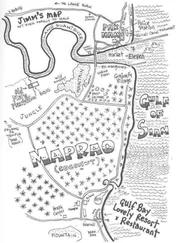
'I think 'drug lords' is a bit dramatic. I have a feeling the fields are owned by ex-fishermen from Ko Samui, but I could be wrong. They turned up a couple of years ago and pretty much took over that half of the island. We can't go there now.'
'How do they get around the marine-park authorities?'
'Same as us. Keep quiet. And half of the wardens are probably in on it, so they make sure the tourist boats don't come near.'
'But they know you're here.'
'Of course, but there isn't much they can do. It'snot like they can report us. If we got raided then they'd get raided too.'
'So there's no trouble between you?'
Sal's hand flicked to the sea-shell necklace around her neck. 'They stick to their half. We stick to ours,' she said briskly, then suddenly stood up, patting the dust from her skirt with pointless attention. 'Enough talk, Richard. I really do have to go now, and you're still running a fever. You need some rest.'
I didn't bother protesting and Sal began walking away, her T-shirt catching the candlelight a little longer than her skin and skirt.
'One more question,' I called after her, and she looked round. 'The man in Bangkok. You knew him?'
'Yes,' she said quietly, then she began walking again.
'Who was he?'
'He was a friend.'
'He lived here?'
'He was a friend,' she repeated.
'But... OK, just one more question.'
Sal didn't stop, and now only her saffron T-shirt was visible, bobbing in the darkness.
'One more!'
'What?' her voice floated back. 'Where's the toilet?'
'Outside, second hut along by the edge of the camp.' The bright sliver of light through the longhouse door slid back to blackness.
Exploring
The toilet, a small bamboo hut on the edge of the clearing, was a good example of how well the camp had been organized. Inside the hut was a low bench with a football-sized hole, through which I could see running water - a tributary from the diverted waterfall stream. There was a second hole cut into the roof, to let in what little light filtered past the canopy ceiling.
All in all, it was a lot more agreeable than many of the bathrooms one finds outside the westernized world. There wasn't, however, any toilet paper. Not a surprise in itself, but I'd thought there might be some leaves or something. Instead, by the water channel, there was a plastic pitcher.
You find plastic pitchers all around provincial Asia and their purpose has confounded me for years. I refuse to believe that Asians wipe themselves with their hands — it's a ridiculous idea - but, aside from washing digits, I can't see what other use the pitcher has. I'm sure they don't splash themselves down. Apart from being ineffective, it would make an incredible mess, and they emerge from their ablutions as dry as a bone.
Of the various mysteries of the Orient this should be the easiest to unravel, but the subject matter appears to be veiled in a conspiracy of silence. A Manilan friend once came with me on a trip to a small island off the coast of Luzon. One day I found him standing on a mud-dike, peering into the mangrove swamps with obvious concern. When I asked him what the matter was he blushed furiously, which made his brown skin go almost purple, and pointed to some bits of toilet paper that were floating in the water. The tide was leading thetoilet paper towards some houses, and this prospect had thrown him into a panic. Not for reasons of hygiene but because it would betray his western toilet habits - habits that the locals would find unacceptably disgusting. In his shame, he was considering wading into the swamps to hoick the pieces out and hide them elsewhere.
We managed to solve the problem by bombarding the water with stones until the paper shredded or sank. As we slunk away from the scene of the crime I asked him to describe the locals' acceptable alternative, but he refused to tell me. He just hinted darkly that I'd find it as disgusting as they found our way. This was as close as I ever got to finding out the truth.
Luckily I only needed to piss so I was spared having to experiment. When the time came for solids I decided I'd slip into the jungle.
I left the toilet and began walking back across the clearing. I was still feeling slightly feverish but I didn't want to spend yet more hours breathing stuffy air and watching flickering candle-flames. Instead I continued past the longhouse, thinking I might explore. I also hoped that I might find Étienne and Françoise, who'd been missing since I woke up. I imagined they were exploring too.
I counted nine tents in the clearing and five huts, not including the longhouse. The tents were only used for sleeping — inside the flaps I could see backpacks and clothes, and in one I even saw a Nintendo Gameboy — but the huts all seemed to have functional uses. Apart from the toilet, there was a kitchen and a washing area, also fed by tributaries. The other huts were for storage. One contained carpentry tools and another some boxes of tinned food. It made we wonder how long the camp had existed. Sal had said that the dope fields had appeared a couple of years ago, which implied the travellers had been around for some time before that.
Tents, tools, tinned food, Nintendo. The more I saw, the more I marvelled. It wasn't just how much the camp had been organized, it was how it had been organized. None of the huts looked newer than the others. The tents' guy lines were held with rocks, and the rocks were moulded into the ground. Nothing seemed random, everything seemed calculated: designed as opposed to evolved.
As I wandered around the clearing, peering through tent flaps and studying the canopy ceiling until my neck ached, my sense of awe was matched only by a sense of frustration. Questions kept appearing in my mind, and each question raised another. It was clear that, at some point, the people who'd set up the camp had needed a boat. This suggested the help of Thais, which in turn suggested a certain kind of Thai. A Ko Samui spiv might bend the rules to let backpackers stay on a marine-park island for a few nights, but it was harder to imagine them ferrying crates of food and carpentry tools.
I also found it strange that the camp was so deserted. It apparently supported a large number of people, and a couple of times I thought I heard voices near by, but no one ever appeared.
After a while, the quietness and occasional distant voices began to get to me. At first I just felt a little lonely and sorry for myself. I didn't think Sal should have left me on my own, especially when I was ill and new to the camp. And Étienne and Françoise were supposed to be my friends. Shouldn't friends have hung around to make sure I was OK?
But soon loneliness turned into paranoia. I found that I was starting when I heard jungle noises, my shuffling footsteps in the dirt sounded oddly loud, and I caught myself acting with an affected casualness, aimed at the eyes I suspected were watching me from the trees. Even the absence of Étienne and Françoise became a reason to worry.
Maybe it was partly to do with my fever, or maybe it was a normal reaction in abnormal circumstances. Either way, the eerie quietness was freaking me out. I decided I had to get out of the clearing. I went back to the longhouse to pick up my cigarettes and some shoes, but when I saw the long avenue of shadow that lay between the door and my candle-lit bed, I changed my mind.
Читать дальшеИнтервал:
Закладка:
Похожие книги на «The Beach»
Представляем Вашему вниманию похожие книги на «The Beach» списком для выбора. Мы отобрали схожую по названию и смыслу литературу в надежде предоставить читателям больше вариантов отыскать новые, интересные, ещё непрочитанные произведения.










Обсуждение, отзывы о книге «The Beach» и просто собственные мнения читателей. Оставьте ваши комментарии, напишите, что Вы думаете о произведении, его смысле или главных героях. Укажите что конкретно понравилось, а что нет, и почему Вы так считаете.