Stanley Elkin - A Bad Man
Здесь есть возможность читать онлайн «Stanley Elkin - A Bad Man» весь текст электронной книги совершенно бесплатно (целиком полную версию без сокращений). В некоторых случаях можно слушать аудио, скачать через торрент в формате fb2 и присутствует краткое содержание. Год выпуска: 2010, Издательство: Open Road Integrated Media LLC, Жанр: Современная проза, на английском языке. Описание произведения, (предисловие) а так же отзывы посетителей доступны на портале библиотеки ЛибКат.
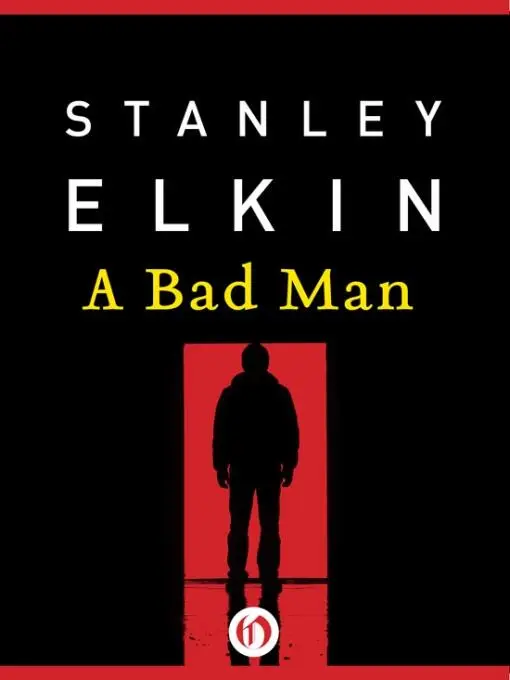
- Название:A Bad Man
- Автор:
- Издательство:Open Road Integrated Media LLC
- Жанр:
- Год:2010
- ISBN:нет данных
- Рейтинг книги:5 / 5. Голосов: 1
-
Избранное:Добавить в избранное
- Отзывы:
-
Ваша оценка:
A Bad Man: краткое содержание, описание и аннотация
Предлагаем к чтению аннотацию, описание, краткое содержание или предисловие (зависит от того, что написал сам автор книги «A Bad Man»). Если вы не нашли необходимую информацию о книге — напишите в комментариях, мы постараемся отыскать её.
A Bad Man — читать онлайн бесплатно полную книгу (весь текст) целиком
Ниже представлен текст книги, разбитый по страницам. Система сохранения места последней прочитанной страницы, позволяет с удобством читать онлайн бесплатно книгу «A Bad Man», без необходимости каждый раз заново искать на чём Вы остановились. Поставьте закладку, и сможете в любой момент перейти на страницу, на которой закончили чтение.
Интервал:
Закладка:
He came, Feldman talking so fast Victman didn’t know what was happening. Of course he came. Expecting perhaps to find mud streets, plank sidewalks, boomtown — assay offices, burlap sacks of nugget and dust, old-timers leading packmules. Finding instead only Feldman’s somber city, a place of half a million looking older and more settled than New York. Then held in check: allowed to fiddle, seek sites, arrange for surveys, market-research reports; consult till the cows came home sociologists, city planners; even consulting architects at some predecision, top-of-the-tablecloth level, positioning goblets, inclining forks. Seen everywhere, overheard everywhere, egged on by Feldman himself, spilling his dreams in restaurants near the tables of men Feldman recognized as competitors and he didn’t. His enthusiasm daily primed, each scheme encouraged, Feldman himself squaring his plans, complicating, flourishing, until the man thought he dealt with some merchant Midas and that on this rock would be founded some new commercial Rome. Until the casual chitchat of millions made even this city slicker’s head spin: “Invest at a hundred dollars a man. That’s the best rule of thumb, I think.” “But that’s fifty-five and a half million dollars!” “Today. I don’t mean today. What were those population projections you got from the university? Let me see them, please. But this is only for two generations. It’s a mistake to plan for under three. That’s house-of-cards thinking, pigs who build with straw and sticks.” “Wow!” “Wow indeed. Indeed wow.”
Only gradually disappointed, held off for eight months by Feldman’s ploys: Feldman dutifully inspecting Victman’s sites. “You know your business, Victman, or you wouldn’t be working with me, but I thought we were speaking about three generations. Can you see this place in even two generations?” (They were standing in a green pasture eight miles from town.) “It’ll be a slum. Women unsafe on the street after eight o’clock at night, men unsafe after nine.” Held off some more by his ploys for backing (“We don’t want our capital from American sources”). Sent once to India, another time to Dutch Guiana (“That’s where the money is, Norman, in your underdeveloped nations. Among those old Dutch planters”). And one time actually coming back with a pledge for twenty million from a man in Mexico (“No, Norman, I want thirty million from him. Either he’s willing to show some good faith in this or we don’t want to have anything to do with him”).
And then, in a year, the disappointment growing in leaps and bounds: “I don’t understand, Leo. Let’s not sit on this. It’s been eighteen months. We should break ground this winter so we can start building in the spring. The competition has its sites already.” “Give them their rope, Norman, please.” And then, later, after he had obtained additional pledges and pushed the Mexican up to thirty million: “Leo, we could have the capital investment tomorrow if we wanted. Let’s move already.” “‘Let’s move already’? We have moved. We have moved, Norman, you silly man. What else do you think we’ve been doing for two years? And don’t talk to me about having the capital investments tomorrow, when I have them today, when I’ve had them for two years. You’re the capital investments, Norman . Don’t you see what’s happening? They’ve taken the bait! They’re overextending! Those stores will be open in a year. Built in the sticks. Who’ll go? Who’ll go? And not just the double maintenance, but the double staff, the double advertising, the double trouble. We’ve thinned them out, we’ve spread them thin. You did, Norman. With your table talk, your reputation, your picture and the three columns in Woman’s Wear Daily . You believe in progress? Progress is irreligious. Read your Bible. Seven fat years. Seven lean. And the seven lean shall be seven times leaner than the seven fat are fat. Seven lean, Norman, and all it takes is two — say three. No, Norman, no, they’re tough, these guys. Say four. Say five, and have a margin of two. So don’t speak to me about capital investment, nor prattle of progress. Checkmate is the name of the game. Not moving forward: standing pat when all about you are losing theirs.”
“Don’t you believe in progress?” Victman asked, shocked, shattered, who had based his life and staked his reputation on that principle.
“I believe,” said Feldman softly, for they were in a restaurant now too, and he recognized faces and the walls had ears, “I believe in smearing the competition, survival of the fittest, cartel by default. I believe in the disappointed expectation and the harpooned hope, and that the best-laid plans of mice and men often gang astray. The tire with the plumpest tread has never moved an inch. Norman, Norman, consider the man in the club chair. That bulk comes from exercise’s opposite: if you’d increase, decrease and desist. The proud falsetto of the castrate, the fat lap of the dowager, the banker’s big ass — seats of power, Victman. I believe in ploy and stratagem and maneuver and conspiracy. I believe in espionage, the coup d’état, assassination, the palace revolt, guerrilla attacks and the cheaper revolutions. No more parades, sir. No more expensive reviews and costly May Day brags. No more shopping centers, no more sites, no more branch stores. Think me up commando schemes!”
He’d been had, poor man. When the other stores had their grand openings Feldman would have fired him, but he had invested $150,000 in him in the past two years and could not consider the deal closed until the stores had gone under. In the third year, having thoroughly discredited him, he lowered his salary to a more wieldy $30,000. (Two years, and not one coup to add to his score. No one knew, of course, how Feldman used him.) And the next year his salary was lowered again, by five thousand dollars. “The laborer is worth his hire,” Feldman told him. “That’s the best rule of thumb, I think.”
Only one thing. And Feldman now considered it.
The stores had not gone under. There had not been seven fat years and seven lean ones, but fourteen fat. Disastrously, there had been no disaster. Red China had not laid a finger on the competition. “If you’re so smart,” he sang, “why ain’t you rich?”
“They’re taking us off the charge plate, Leo,” Victman said.
“They’re what?”
“What they threatened. When the new plates come out in the fall, we won’t be on them.” Feldman stared at him. “We haven’t kept pace,” Victman said shyly.
“Why? How can they do that?”
“I’ve been trying to tell you. There isn’t any one reason — pressure from the retail clerks’ union.”
“I pay a straight commission.”
“Hiring policy—”
“The first store in the state to hire a Negro?”
“Token, Leo.”
“ Tahkee token,” Feldman said.
“They claim we run phony sales.”
“Phony sales? Phony? ”
“Who celebrates Arbor Day today?” Victman asked tragically. He was inconsolable.
“Some irony, hey, kid? It must be tough for you. You practically invented the charge plate.”
“I was in on the discussions.”
“Sure you were,” Feldman said. “Come on, Victman, cheer up. It’s not so bad. Smile once for me. Grin and bear it. Say ‘cheese.’ We’ve been there before, you and me. Back to the wall. Listen, try to look at it this way. You’ve had your back to the wall ever since you came here. I put you there. I made you stand in the corner with your back to the wall. What, you’ve forgotten all the lousy tricks I’ve played on you? The underhanded deals, the way I’ve used you, all the dirt I’ve made you eat? I’ve been hacking away at your salary for years. Why let a little thing like this get to you? I know. It’s symbolic, your being in on the discussions and all, but frig them, I say. Listen to me. Please take heart. You’ve got Feldman back there against the wall with you now. That’s my territory, the landscape I know and love.
Читать дальшеИнтервал:
Закладка:
Похожие книги на «A Bad Man»
Представляем Вашему вниманию похожие книги на «A Bad Man» списком для выбора. Мы отобрали схожую по названию и смыслу литературу в надежде предоставить читателям больше вариантов отыскать новые, интересные, ещё непрочитанные произведения.





Обсуждение, отзывы о книге «A Bad Man» и просто собственные мнения читателей. Оставьте ваши комментарии, напишите, что Вы думаете о произведении, его смысле или главных героях. Укажите что конкретно понравилось, а что нет, и почему Вы так считаете.